
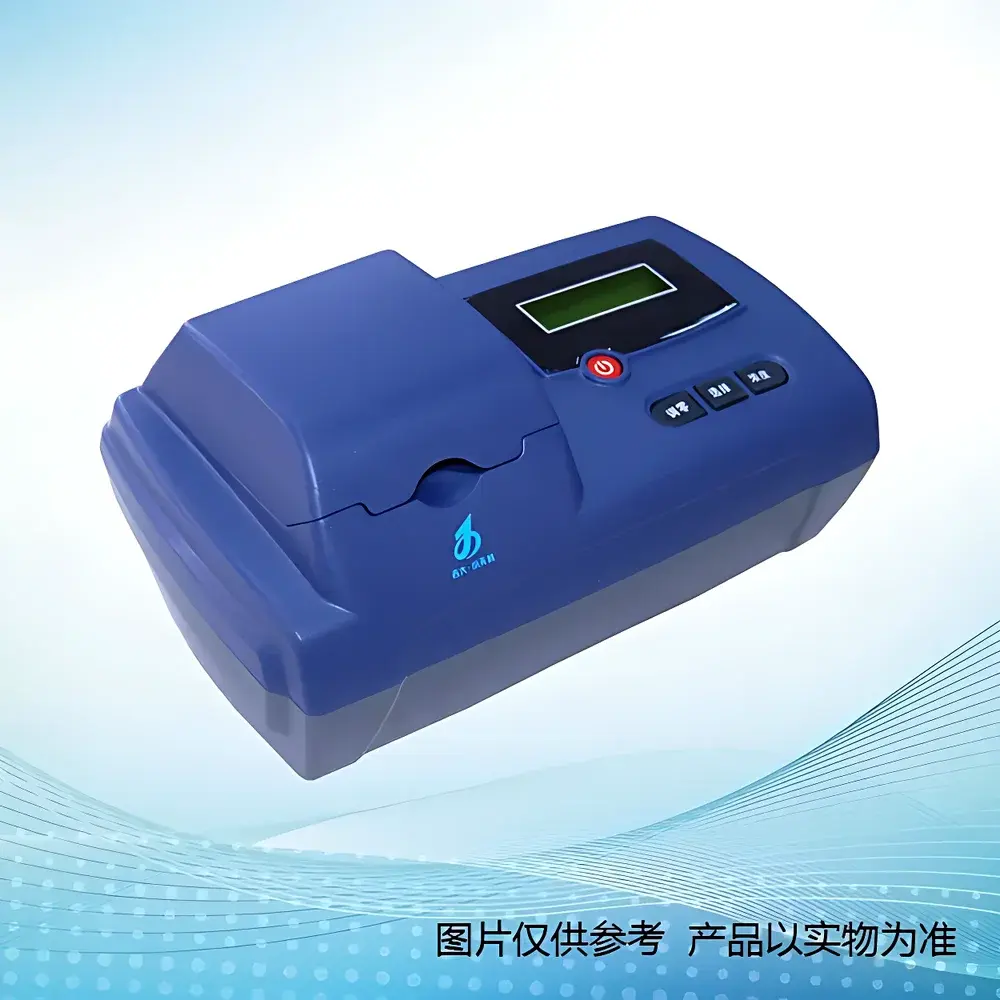
Jiada Xiaotianshe GDYS-601SB Portable Disinfectant & Disinfection By-Product Analyzer
| Brand | Jiada Xiaotianshe |
|---|---|
| Origin | Jilin, China |
| Manufacturer Type | Direct Manufacturer |
| Country of Origin | China |
| Model | GDYS-601SB |
| Instrument Type | Portable/HANDHELD Water Quality Analyzer |
| Detection Parameters | Chlorine Dioxide, Free Chlorine, Total Chlorine, Chlorite, Ozone, Formaldehyde |
| Light Source | High-Brightness LED |
| Wavelengths | 520 nm, 538 nm |
| LOD | Free Cl₂: 0.01 mg/L |
| Total Cl₂ | 0.01 mg/L |
| ClO₂ | 0.02 mg/L |
| ClO₂⁻ | 0.05 mg/L |
| O₃ | 0.05 mg/L |
| HCHO | 0.05 mg/L |
| Measurement Range | Free Cl₂ & Total Cl₂: 0.00–2.50 mg/L |
| ClO₂ | 0.00–3.00 mg/L |
| ClO₂⁻ & O₃ | 0.00–2.00 mg/L & 0.00–2.50 mg/L respectively |
| HCHO | 0.00–1.50 mg/L |
| Operating Temperature | 15–40 °C |
| Power Supply | DC 9 V (9V alkaline battery) |
| Dimensions | 170 × 90 × 35 mm |
| Weight | 300 g |
| Cuvette | Dedicated 30-mm disposable reaction/measurement cuvette |
| Calibration | Built-in calibration curves |
Overview
The Jiada Xiaotianshe GDYS-601SB is a compact, field-deployable photometric analyzer engineered for rapid, on-site quantification of key disinfectants and their regulated by-products in drinking water, wastewater effluent, swimming pools, and distribution systems. It operates on the principle of colorimetric analysis—measuring absorbance changes induced by specific chromogenic reactions between target analytes and proprietary reagents at two fixed wavelengths (520 nm and 538 nm). This dual-wavelength design enhances selectivity and compensates for minor turbidity or background interference. Unlike benchtop spectrophotometers requiring standard curve preparation and multi-step dilution protocols, the GDYS-601SB embeds factory-calibrated, analyte-specific working curves—enabling direct concentration readout after simple zero-point calibration. Its design prioritizes operational robustness in non-laboratory environments: sealed optical path, low-power LED illumination, and integrated power management ensure consistent performance under variable ambient conditions.
Key Features
- Simultaneous quantitative analysis of six critical parameters: free chlorine, total chlorine, chlorine dioxide, chlorite ion, ozone, and formaldehyde—all within a single handheld unit.
- Optimized reagent chemistry: free chlorine detection employs a single-reagent system for rapid, stable color development—reducing procedural steps and operator-induced variability.
- Integrated energy-saving architecture: automatic shutdown after 30 minutes of inactivity; real-time battery voltage monitoring with audible and visual low-power alerts.
- Dedicated 30-mm optical cuvette functions as both reaction vessel and measurement cell—eliminating transfer steps, minimizing contamination risk, and improving repeatability.
- Pre-packaged, single-use reagent kits ensure batch-to-batch consistency, reduce reagent handling errors, and extend shelf life under ambient storage conditions.
- Compact form factor (170 × 90 × 35 mm) and lightweight construction (300 g) support extended field use without ergonomic fatigue or logistical burden.
Sample Compatibility & Compliance
The GDYS-601SB is validated for use with clarified aqueous samples meeting standard drinking water turbidity limits (<5 NTU). It complies with fundamental methodological requirements outlined in ISO 7393-2 (chlorine determination), EPA Method 334.0 (chlorine dioxide), and APHA Standard Methods 4500-Cl G & 4500-O₃ B (ozone). While not certified to ISO/IEC 17025 for accredited testing, its performance characteristics—including detection limits, linear dynamic range, and inter-day precision—are aligned with routine compliance monitoring needs under national regulatory frameworks such as China’s GB/T 5750 series and the U.S. EPA Safe Drinking Water Act (SDWA) Tier 1 screening criteria. All reagents are manufactured under controlled conditions and accompanied by lot-specific certificate of analysis.
Software & Data Management
The GDYS-601SB operates as a standalone instrument with no external software dependency. All calibration data, wavelength selection logic, and concentration algorithms are stored in non-volatile memory. Results are displayed numerically on a high-contrast LCD screen with unit annotation (mg/L) and measurement status indicators (e.g., “CAL OK”, “LOW BATT”). The device does not store historical readings or support USB/data export—consistent with its role as a rapid verification tool rather than a GLP-compliant data logger. For laboratories requiring audit trails or electronic records, manual transcription into LIMS or QA documentation systems is recommended per internal SOPs aligned with 21 CFR Part 11 principles.
Applications
- Real-time verification of disinfectant residual levels at water treatment plant exit points and booster stations.
- Field assessment of chlorine dioxide decay kinetics during pipeline transport or storage tank retention periods.
- Monitoring chlorite accumulation in systems using chlorine dioxide as primary disinfectant—supporting compliance with WHO and EPA MCLs (≤1.0 mg/L).
- Routine ozone residual checks in bottled water facilities and pharmaceutical process water loops.
- Emergency response screening for formaldehyde contamination following industrial spill incidents or biocide overfeed events.
- QA/QC spot-checking in municipal pool maintenance programs where rapid turnaround is essential for public health intervention.
FAQ
Does the GDYS-601SB require daily recalibration?
No—only zero-point calibration with blank reagent is required before each measurement session. Factory-loaded curves remain stable across operating temperature ranges (15–40 °C).
Can it measure chloramines separately from free and total chlorine?
No—the instrument reports total chlorine as the sum of free chlorine and combined chlorine; it does not differentiate monochloramine, dichloramine, or nitrogen trichloride.
Are reagents compatible with international standards like ASTM D1253?
Reagent chemistry aligns functionally with ASTM D1253 for total residual chlorine but uses proprietary formulations optimized for the GDYS-601SB’s optical path and cuvette geometry.
What is the typical lifetime of the LED light source?
The high-brightness LEDs are rated for ≥50,000 hours of operation—effectively exceeding the instrument’s service life under normal field usage.
Is the 30-mm cuvette reusable?
No—it is designed as a single-use, disposable component to prevent cross-contamination and ensure optical consistency; replacement cuvettes are supplied in kit format.
Related Products







