
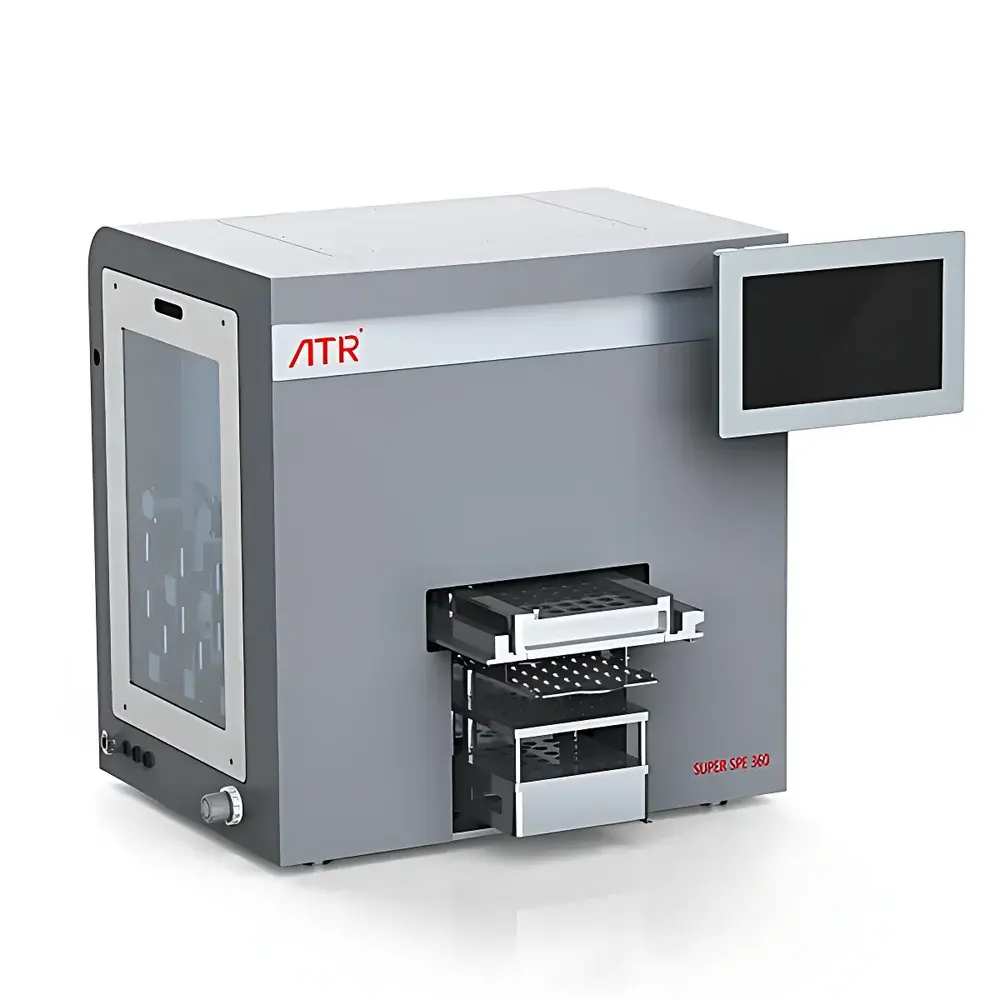
ATR SuperSPE 360 Fully Automated Solid Phase Extraction System
| Brand | ATR |
|---|---|
| Origin | USA |
| Model | SuperSPE 360 |
| Automation Level | Fully Automatic |
| Number of Channels | 6 Independent Channels |
| Extraction Format | Cartridge-Based SPE |
| Flow Rate Control | 0.1–60 mL/min |
| Solvent Reservoirs | 8 |
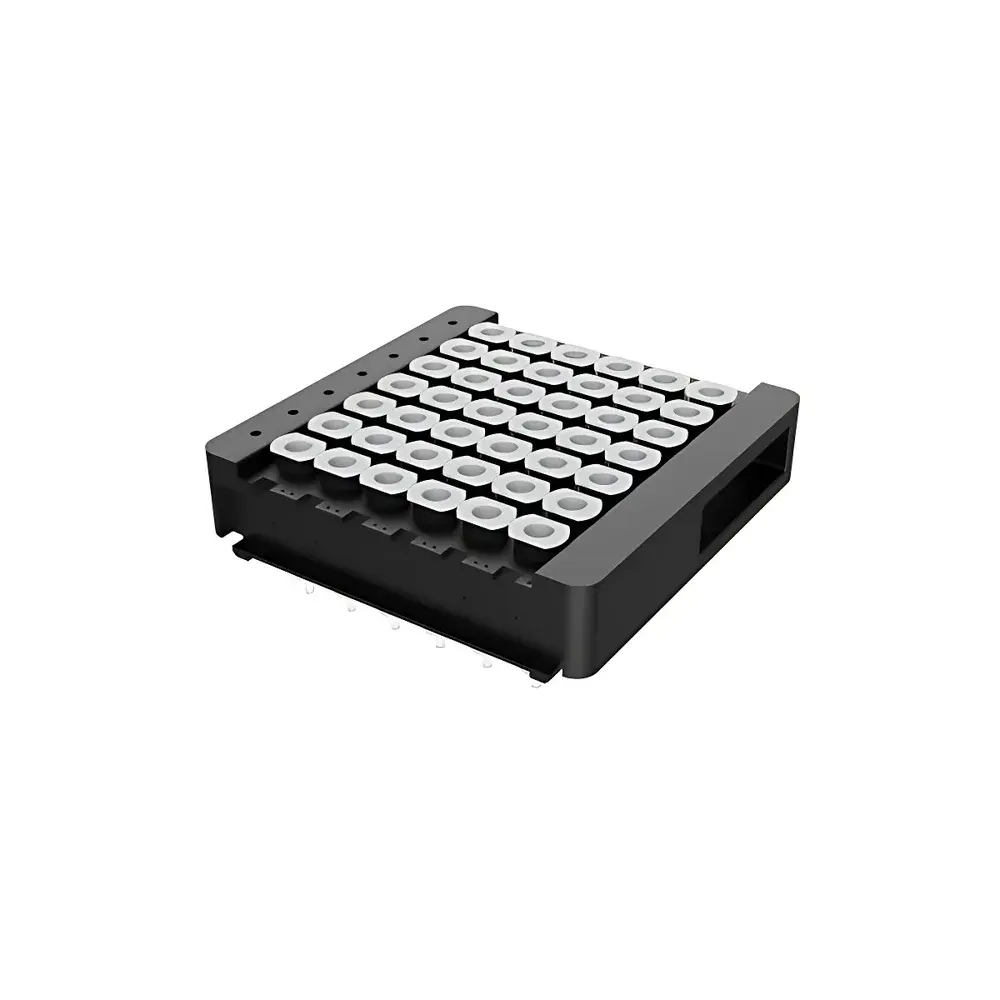
| Sample Capacity | 36 Positions |
| Sample Volume Range | 10–20,000 mL |
| Wetted Materials | PTFE |
Overview
The ATR SuperSPE 360 Fully Automated Solid Phase Extraction System is an engineered solution for high-throughput, large-volume aqueous sample preparation in regulated environmental and analytical laboratories. It implements positive-pressure-driven, cartridge-based solid phase extraction (SPE) — a method standardized by the U.S. Environmental Protection Agency (USEPA) for trace organic analysis in water matrices. Unlike vacuum- or gravity-based systems, the SuperSPE 360 employs precision metering pumps to deliver consistent, programmable flow rates across all six independent channels, ensuring reproducible breakthrough control, optimal sorbent utilization, and minimal channel-to-channel variability. Designed specifically for compliance with USEPA Methods 508.1, 525.3, 549.2, and 8270D — as well as Chinese national standards (GB/T 5750, GB 17378, HJ 478, HJ 699), the system enables robust, auditable sample cleanup prior to GC-MS, LC-MS/MS, or HPLC analysis. Its architecture supports unattended operation over extended durations (up to 24 hours), making it suitable for routine monitoring programs requiring batch processing of up to 36 samples without manual intervention.
Key Features
- Six independently controlled SPE channels with synchronized or asynchronous operation — each channel equipped with its own high-accuracy positive-pressure metering pump (±2.5% volumetric accuracy)
- Scalable sample volume handling from 10 mL to 20,000 mL per extraction, accommodating raw surface water, wastewater, seawater, and drinking water sources
- Eight solvent reservoirs supporting gradient elution, sequential conditioning, washing, and elution protocols with full programmability
- PTFE-wetted fluid path throughout — chemically inert, low extractables, compatible with aggressive solvents (e.g., DCM, acetone, methanol, hexane) and acidic/basic aqueous phases
- Integrated nitrogen drying module with pressure-regulated purge for consistent solvent removal post-elution
- Real-time process simulation and dynamic progress tracking via integrated 12-inch industrial touchscreen HMI — no external PC required
- Leak detection system utilizing proprietary capacitive sensing technology for immediate identification of fluid loss at cartridge interfaces or tubing junctions
- Dual-waste routing: separate disposal paths for aqueous and organic effluents to prevent cross-contamination and meet laboratory waste segregation requirements
- Hermetically sealed chassis with optional exhaust ducting — eliminates need for fume hood installation while maintaining operator safety
Sample Compatibility & Compliance
The SuperSPE 360 accommodates standard 1 mL, 3 mL, and 6 mL SPE cartridges from all major vendors (e.g., Waters, Agilent, Thermo Fisher, Phenomenex), regardless of sorbent chemistry (C18, SCX, SAX, Florisil, silica, mixed-mode). Its flow stability and pressure tolerance ensure reliable performance with high-particulate or viscous water samples — including raw sewage, estuarine water, and algae-laden surface runoff. The system meets design and operational criteria outlined in ISO/IEC 17025:2017 for method validation, supports audit-ready electronic records per FDA 21 CFR Part 11 (when paired with compliant LIMS integration), and aligns with GLP/GMP documentation expectations for environmental testing laboratories. Built-in calibration verification routines and event-logged error diagnostics further support regulatory readiness during inspections by EPA, NELAC, CNAS, or provincial environmental monitoring centers.
Software & Data Management
The embedded control software provides intuitive, icon-driven workflow configuration — allowing users to define multi-step methods (conditioning → loading → washing → drying → elution) with variable flow rates, dwell times, and solvent selection per step. Preloaded templates include validated protocols for PAHs, phenols, organochlorine/organophosphate pesticides, pharmaceuticals, and explosives (e.g., TNT, RDX). All method parameters, run logs, alarm events, and calibration history are stored locally with timestamped metadata. Export options include CSV and PDF reports compatible with laboratory information management systems (LIMS). Audit trail functionality records user actions, parameter changes, and system status transitions — satisfying traceability requirements under ISO 17025 Clause 7.11 and USP .
Applications
- Environmental monitoring: enrichment of priority pollutants (e.g., PCBs, phthalates, endocrine disruptors) from municipal intake water, river discharge, and wastewater treatment plant influents/effluents
- Forensic toxicology: isolation of rodenticides, nitroaromatic explosives, and illicit drug metabolites from aquatic crime scene evidence
- Public health surveillance: preconcentration of disinfection by-products (e.g., haloacetic acids, trihalomethanes) and microcontaminants in drinking water distribution systems
- Marine and coastal research: trace-level analysis of hydrophobic organic contaminants in seawater and sediment pore water
- Academic and method development labs: platform for optimizing SPE recovery, matrix effect mitigation, and method transfer studies
FAQ
Does the SuperSPE 360 support method validation per EPA guidelines?
Yes — its programmable flow control, calibrated pump accuracy, and documented system suitability checks enable full compliance with EPA Method 525.3 validation requirements for recovery, precision, and carryover.
Can the system handle turbid or particulate-rich water samples without clogging?
Yes — the positive-pressure architecture eliminates check valves and uses pulse-free metering; combined with inline filtration options (e.g., glass fiber prefilters), it maintains stable flow through challenging matrices.
Is remote monitoring or integration with enterprise LIMS possible?
The system supports Ethernet-based communication (TCP/IP) and exports structured data files; custom API integration is available upon request for centralized lab automation environments.
What maintenance intervals are recommended for long-term reliability?
Pump calibration verification every 6 months; PTFE tubing replacement every 12 months under continuous use; cartridge holder cleaning after each 36-sample batch.
How does the leak detection system differentiate between normal dispensing and actual leakage?
It monitors capacitance changes at critical junctions in real time — triggering alarms only when sustained deviation from baseline capacitance exceeds statistically defined thresholds, minimizing false positives.



