
Uniformly Apodized Fiber Bragg Grating
| Brand | AOE Tech |
|---|---|
| Origin | Shanghai, China |
| Manufacturer Type | Authorized Distributor |
| Origin Category | Domestic (China) |
| Model | PM980 |
| Component Category | Optical Component |
| Price Range | USD 140 – 420 (FOB Shanghai) |
| Wavelength Options | 980 nm, 1064 nm, 1310 nm, 1550 nm |
| Center Wavelength Tolerance | ±0.05% |
| Reflectivity Range | 1–99.999% (±0.5% absolute) |
| FWHM | 0.03–1.0 nm |
| Side-Mode Suppression Ratio (SMSR) | >20 dB |
| Grating Length | 0.2–50 mm |
| Coating | UV-curable acrylate |
| Compatible Fibers | HI980, HI1060, SMF-28e, PM980, PM1550, active fibers (Yb-, Er-doped), or custom fiber |
| Operating Temperature | −5 to +80 °C |
Overview
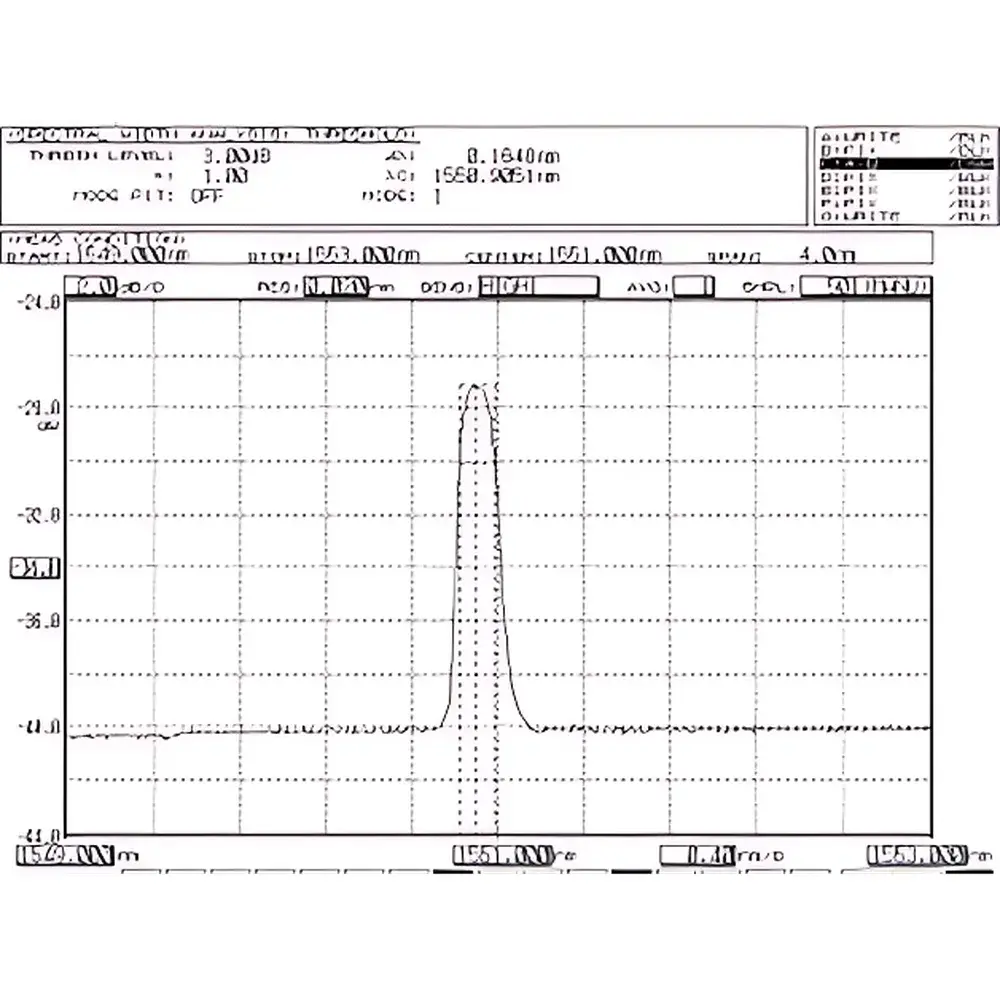
Uniformly apodized fiber Bragg gratings (FBGs) are precision-engineered passive optical components designed to suppress unwanted side modes in the reflection spectrum while preserving high reflectivity and spectral fidelity at the Bragg wavelength. Unlike uniform (non-apodized) FBGs—whose refractive index modulation follows a rectangular profile—the apodization process introduces a smooth, bell-shaped (typically Gaussian or raised-cosine) envelope to the grating’s index modulation amplitude along its length. This controlled spatial tapering eliminates abrupt index transitions at the grating boundaries, thereby minimizing Fresnel-like reflections and suppressing higher-order Fourier components that manifest as side lobes in the spectral domain. As a result, apodized FBGs deliver significantly improved side-mode suppression ratio (SMSR >20 dB), reduced insertion loss in the passband, and enhanced group delay uniformity—critical attributes for applications demanding high channel isolation, low polarization-dependent loss (PDL), and stable dispersion compensation.
Key Features
- Engineered apodization profile ensures monotonic spectral envelope with minimal ripples in reflection band
- High SMSR (>20 dB) enables use in dense wavelength division multiplexing (DWDM) filters and laser cavity mirrors where inter-channel crosstalk must be minimized
- Precision center wavelength control (±0.05% tolerance) across standard telecom and pump bands: 980 nm, 1064 nm, 1310 nm, and 1550 nm
- Reflectivity tunable from 1% to 99.999% with ±0.5% absolute accuracy, supporting both sensing and laser resonator configurations
- Narrow and controllable full width at half maximum (FWHM) ranging from 0.03 nm to 1.0 nm, optimized for spectral selectivity in spectroscopic and filtering applications
- Robust acrylate recoating compatible with standard fiber handling, splicing, and packaging processes
- Validated thermal stability across −5 °C to +80 °C, meeting Telcordia GR-1221-CORE environmental requirements for outside-plant and lab-grade deployment
Sample Compatibility & Compliance
This apodized FBG is fabricated on polarization-maintaining (PM) fiber PM980, but is also available on HI980, HI1060, SMF-28e, PM1550, and specialty active fibers (e.g., Yb-doped or Er-doped photosensitive fibers). All devices comply with IEC 61300-2-4 (vibration), IEC 61300-2-17 (temperature cycling), and IEC 61300-2-22 (humidity). The grating inscription process adheres to ISO/IEC 17025-accredited procedures for traceable wavelength calibration. For regulated environments—including medical laser systems and aerospace photonics—full documentation packages (including individual test reports, spectral scans, and batch-level certification) are provided upon request to support GLP/GMP audits and FDA 21 CFR Part 11-compliant data integrity workflows.
Software & Data Management
Each FBG unit is supplied with a unique serial number and a digital spectral characterization report (CSV and PDF), containing calibrated reflectivity vs. wavelength data sampled at ≤0.005 nm resolution. Optional integration with AOE Tech’s FiberGrate Manager software (Windows/Linux) enables batch tracking, spectral comparison against reference curves, and automated pass/fail evaluation per user-defined thresholds (e.g., SMSR >22 dB, FWHM ≤0.15 nm). The software supports export to MATLAB, Python (NumPy), and LabVIEW via standardized .tdms or .h5 formats—facilitating traceable analysis in R&D labs operating under ISO/IEC 17025 or ANSI/NCSL Z540 frameworks.
Applications
- Laser cavity mirrors for single-frequency fiber lasers (e.g., narrow-linewidth 980 nm pump lasers and 1550 nm DFB alternatives)
- DWDM add/drop multiplexers requiring >20 dB adjacent channel isolation
- Dispersion-compensating modules where apodization mitigates group delay ripple in chirped FBGs
- High-sensitivity strain and temperature sensors deployed in structural health monitoring (SHM), where side-mode-free spectra improve demodulation SNR
- Optical coherence tomography (OCT) light sources requiring low-coherence interference fringes with suppressed parasitic reflections
- Quantum optics experiments utilizing PM-fiber-based interferometers sensitive to polarization mode coupling induced by grating discontinuities
FAQ
What does “uniform apodization” mean in this context?
Apodization refers to the intentional shaping of the refractive index modulation envelope along the grating length. “Uniform apodization” here denotes a consistent, pre-defined non-rectangular profile (e.g., Gaussian) applied across all units within a production lot—ensuring reproducible spectral performance without batch-to-batch variation.
Can this FBG be written directly onto active fiber?
Yes. Custom fabrication is supported on photosensitive active fibers—including Yb-doped PM980 and Er/Yb-codoped PM1550—with optimized UV exposure parameters to preserve dopant distribution and minimize hydrogen loading artifacts.
Is the acrylate coating compatible with high-power operation?
The standard acrylate recoating is rated for continuous-wave optical power up to 500 mW at 1550 nm. For >1 W applications, hermetic carbon or gold coating options are available under custom order (lead time: 4–6 weeks).
Do you provide spectral measurement uncertainty statements?
Yes. Each unit includes an accredited uncertainty budget per ISO/IEC 17025 Annex A.3, covering wavelength (k=2, ±0.002 nm at 1550 nm), reflectivity (k=2, ±0.3% absolute), and SMSR (k=2, ±0.8 dB).
Can I specify a custom FWHM and reflectivity combination not listed in the standard range?
Absolutely. AOE Tech offers design-for-manufacturing (DFM) consultation for non-standard specifications—including sub-0.02 nm FWHM, >99.999% reflectivity, or dual-wavelength apodized gratings—subject to feasibility review and minimum order quantity (MOQ: 10 pcs).






