
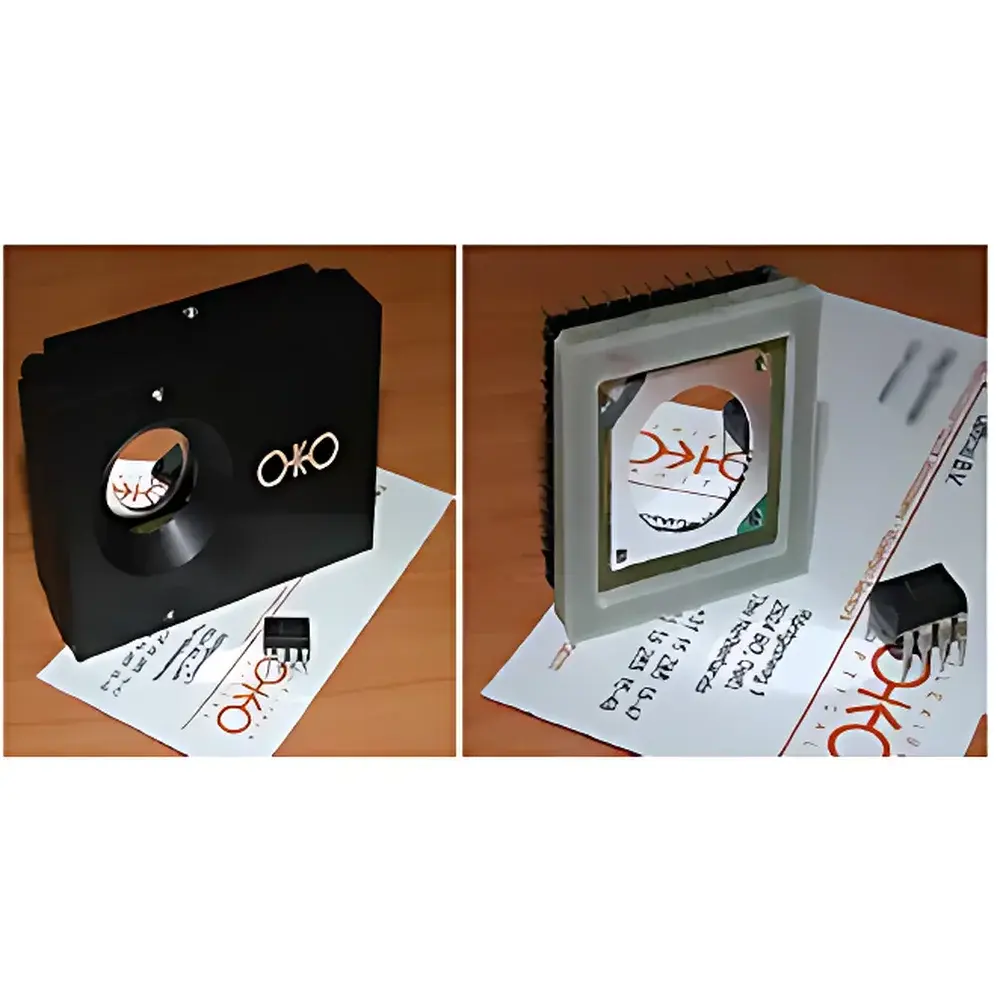
OKO Deformable Mirror
| Brand | AOE Tech |
|---|---|
| Origin | Netherlands |
| Model | OKO Mirrors |
| Type | Electrostatic Membrane Deformable Mirror |
| Actuator Count | 37 to 140 (configurable) |
| Surface Quality | λ/20 RMS (typ.) |
| Clear Aperture | 15 mm to 50 mm (model-dependent) |
| Stroke Range | ±5 µm (peak-to-valley, full scale) |
| Response Time | < 1 ms (90% step response) |
| Coating | Protected Aluminum (R > 90% @ 400–1000 nm), optional UV-enhanced or NIR-optimized variants |
| Interface | Analog voltage input (±10 V per actuator), compatible with standard DAC modules and real-time controllers (e.g., IrisAO, ALPAO, or custom FPGA-based systems) |
Overview
The OKO Deformable Mirror is a high-performance electrostatic membrane-type adaptive optic designed for precise, dynamic wavefront correction in demanding optical systems. Engineered using monolithic silicon membrane technology with embedded electrode arrays, it operates on the principle of electrostatic actuation—applying controlled voltages to individual actuators induces localized surface deformation, enabling real-time modulation of incident wavefront phase profiles. Its low mass, high resonant frequency (>5 kHz), and sub-millisecond temporal response make it especially suitable for closed-loop adaptive optics applications requiring rapid correction of atmospheric turbulence, system aberrations, or sample-induced distortions. Unlike piezoelectric or voice-coil deformable mirrors, the OKO design offers inherently linear stroke-voltage behavior, minimal hysteresis (<0.5% F.S.), and excellent long-term stability—critical attributes for quantitative imaging, metrology, and laser beam control where repeatability and calibration traceability are essential.
Key Features
- Monolithic silicon membrane architecture ensures mechanical robustness, thermal stability, and absence of bonding interfaces that may degrade under vacuum or cycling conditions.
- Configurable actuator layouts: standard configurations include 37-, 69-, and 140-actuator arrays, supporting scalable correction fidelity from low-order Zernike modes to high-spatial-frequency aberrations.
- Surface flatness better than λ/20 RMS (measured at 633 nm) over clear aperture, verified via interferometric calibration prior to shipment.
- Integrated backside alignment fiducials and kinematic mounting features simplify optical alignment and integration into multi-component AO benches.
- Compatible with industry-standard analog control electronics; supports synchronization with camera frame triggers and laser pulse timing for time-resolved wavefront correction.
- No internal power consumption beyond drive voltage—ideal for vacuum-compatible and low-EMI environments such as ultrafast laser labs and space-qualified optical testbeds.
Sample Compatibility & Compliance
The OKO Deformable Mirror is designed for integration into Class 1000 cleanroom-compatible optical setups and functions reliably under ambient, low-vacuum (10⁻³ mbar), and dry-nitrogen purged conditions. Its aluminum coating meets MIL-C-48497A spectral reflectance specifications across the visible and near-infrared (400–1000 nm), and optional coatings extend performance into UV (250–400 nm) or SWIR (1000–1700 nm) bands. While not certified to ISO 13485 or FDA 21 CFR Part 11 as a standalone medical device, the mirror complies with RoHS 2011/65/EU and REACH (EC 1907/2006) material restrictions. When integrated into larger systems—such as ophthalmic retinal imagers or EUV lithography metrology tools—it supports compliance with IEC 61000-6-3 (EMC emissions) and IEC 61000-6-2 (immunity) when paired with appropriately filtered drive electronics.
Software & Data Management
AOE Tech provides a cross-platform SDK (Windows/Linux/macOS) supporting C/C++, Python, and MATLAB APIs for direct actuator addressing, pre-compensation matrix loading, and closed-loop control loop interfacing. The SDK includes factory-measured influence function matrices and Zernike decomposition utilities, enabling rapid deployment of modal or zonal control schemes. All calibration data—including actuator crosstalk maps, voltage-to-displacement linearity curves, and thermal drift coefficients—is stored in HDF5 format with embedded metadata compliant with FAIR (Findable, Accessible, Interoperable, Reusable) principles. For regulated environments, optional audit-trail logging and user-access controls can be enabled to support GLP/GMP-aligned workflows, though final system-level validation remains the responsibility of the integrator.
Applications
- Ophthalmic Imaging: Real-time correction of ocular aberrations in confocal scanning laser ophthalmoscopy (cSLO) and adaptive optics optical coherence tomography (AO-OCT), enabling cellular-resolution imaging of photoreceptor mosaics and retinal pigment epithelium.
- Microscopy: Integration into multiphoton, STED, and light-sheet platforms to compensate for spherical aberration introduced by refractive index mismatches in thick biological specimens.
- Laser Beam Shaping: Dynamic generation of Bessel beams, vortex beams, or programmable intensity profiles for optical trapping, laser material processing, and structured illumination.
- Astronomy & Space Optics: Laboratory emulation of atmospheric turbulence for telescope wavefront sensor testing, and compact AO subsystems for small satellite communication terminals.
- Industrial Metrology: In-line wavefront monitoring and correction in EUV mask inspection tools and high-NA lithography projection optics alignment.
FAQ
What is the typical delivery time for custom-configured OKO mirrors?
Standard configurations ship within 4–6 weeks from order confirmation; custom apertures, coatings, or interface modifications extend lead time to 10–14 weeks.
Can OKO mirrors operate in vacuum?
Yes—they have been validated for continuous operation at pressures down to 10⁻³ mbar without outgassing or performance degradation.
Is there a recommended controller for closed-loop operation?
We recommend pairing with real-time controllers offering ≥16-bit DAC resolution and ≤10 µs channel update latency, such as the IrisAO Real-Time Controller or ALPAO DMC series.
How is surface quality verified and documented?
Each unit undergoes full-aperture phase-shifting interferometry (PSI) at 633 nm; raw interferograms and PV/RMS reports are included in the calibration certificate.
Do you provide OEM integration support?
Yes—AOE Tech offers mechanical CAD models (STEP/IGES), optical prescription files (Zemax .ZBF), and application-specific firmware adaptation services under NDA.




