
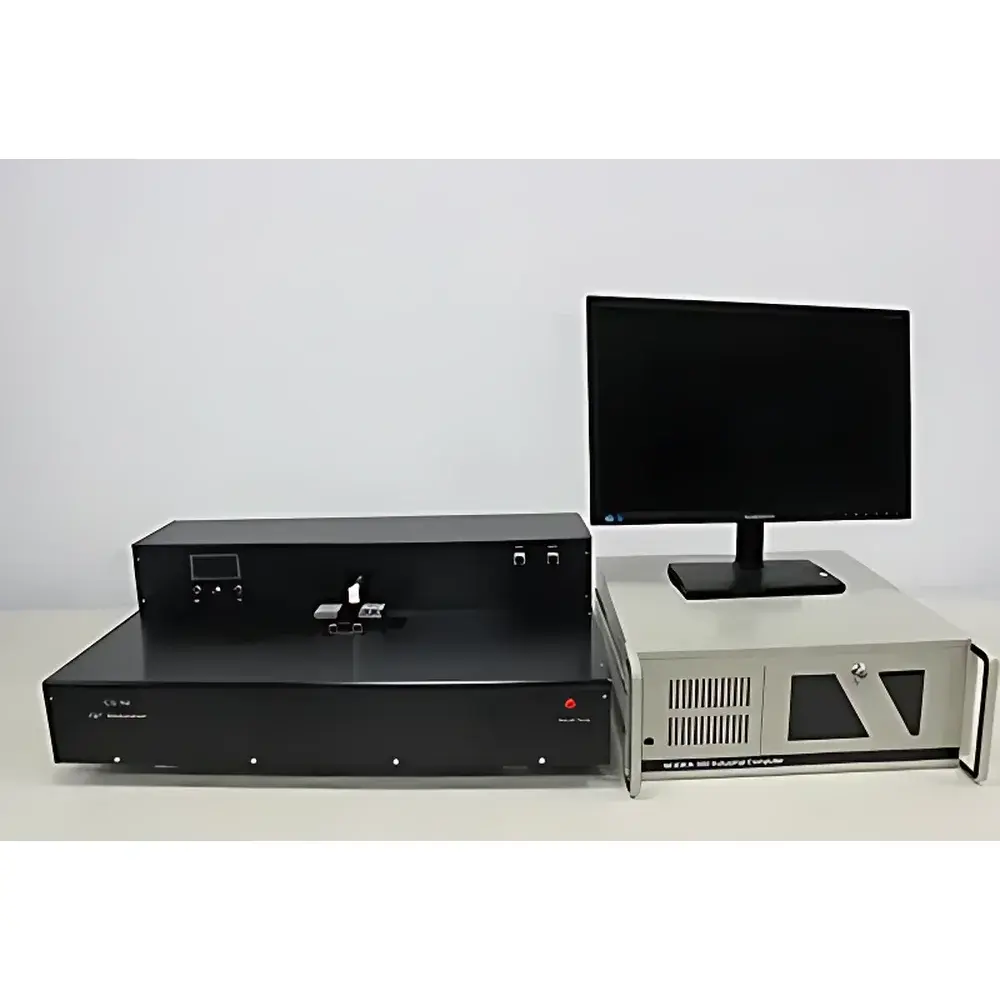
Fused Tapering Machine for Fiber Combiners
| Brand | AOE Tech |
|---|---|
| Origin | Shanghai, China |
| Model | Fused Tapering Machine for Fiber Combiners |
| Application | Fabrication of Pump/Signal Combiners, Couplers, and Tapered Fiber Devices |
| Control Architecture | Integrated PC-based Motion & Thermal Control System |
| Heating Mechanism | Triple-axis (X/Y/Z) Translatable Hydrogen/Oxygen Micro-flame Burner |
| Fiber Fixation | Dual Side-Pressure Grips with Stepper-Motor-Driven 360° Continuous or Stepwise Rotation |
| Platform | Precision Linear Translation Stages with Sub-micron Position Repeatability |
| Upgrade Options | Polarization-Maintaining (PM) Fiber Tapering Mode, Large-Core Multimode (LC-MM) Tapering Configuration, Tapered Fiber Sensor Development Kit |
Overview
The AOE Tech Fused Tapering Machine for Fiber Combiners is an industrial-grade, computer-controlled fusion tapering platform engineered for the reproducible fabrication of high-performance fused fiber devices—including pump/signal combiners, wavelength division multiplexers (WDMs), broadband couplers, and tapered fiber sensors. It operates on the principle of controlled thermal neck-down: two or more optical fibers are aligned, heated via a precisely positioned hydrogen/oxygen micro-flame, and simultaneously stretched under programmable tension to induce evanescent field coupling and adiabatic mode transformation. The system integrates motion control, thermal regulation, real-time optical monitoring (via optional integrated power meters or spectral analyzers), and process logging into a unified architecture compliant with laboratory-scale R&D and low-volume production requirements.
Key Features
- Precision triple-axis flame translation stage (X/Y/Z) enabling micron-level positioning repeatability and dynamic flame trajectory optimization during taper draw—critical for uniform heating across asymmetric fiber bundles (e.g., 6+1 or 7+1 pump combiners).
- Dual independent side-pressure fiber grippers with stepper-motor-driven rotational actuation—supporting both continuous 360° rotation for helical taper geometry and discrete angular stepping for polarization alignment in PM-fiber combiner fabrication.
- Modular mechanical design allowing field-upgradable configurations: PM-fiber tapering kit (with stress-applying rod integration), large-core multimode (≥400 µm) tapering module (with extended grip travel and low-tension calibration), and tapered fiber sensor development package (including strain/temperature feedback interface).
- Real-time process supervision via USB-connected optical power monitors or optional integrated spectrometer input—enabling in-situ coupling ratio tracking and automated endpoint detection based on spectral flatness or insertion loss thresholds.
- Windows-based control software with scriptable workflow sequences (TCL/Lua support), audit-trail logging, and exportable CSV/JSON process metadata—designed for traceability in GLP-compliant optical component development environments.
Sample Compatibility & Compliance
The machine accommodates standard single-mode fibers (SMF-28, HI1060), polarization-maintaining fibers (PANDA, Bowtie), large-core multimode fibers (up to 1000 µm cladding diameter), and specialty active fibers (Yb-doped, Er/Yb co-doped). All mechanical and thermal subsystems conform to IEC 61300-3-1 (fiber device reliability testing), ISO 9001 manufacturing process controls, and EU Machinery Directive 2006/42/EC safety requirements. Flame combustion parameters comply with EN 50178 for electrical equipment in power installations, and firmware supports configurable data retention policies aligned with FDA 21 CFR Part 11 electronic record integrity standards when used in regulated photonics R&D settings.
Software & Data Management
The proprietary AOE TaperControl Suite provides deterministic motion sequencing, closed-loop thermal compensation algorithms, and synchronized optical feedback acquisition. Each taper run generates a timestamped dataset containing positional coordinates, flame temperature estimates (derived from thermocouple calibration curves), motor current profiles, and optional optical transmission spectra. Raw logs are stored in encrypted SQLite databases with SHA-256 hash verification; export formats include IEEE Std 1516-2010 HLA-compliant XML for interoperability with optical simulation platforms (e.g., MODE Solutions, Lumerical). Audit trails capture user login events, parameter modifications, and emergency stop triggers—fully compliant with ISO/IEC 17025 clause 7.10 on result reporting integrity.
Applications
- Fabrication of (6+1)×1 and (7+1)×1 pump combiners for high-power fiber laser systems requiring >95% pump coupling efficiency and <0.3 dB signal insertion loss.
- Development of polarization-dependent combiners for coherent beam combining architectures, leveraging the system’s rotational precision for PM-axis alignment within ±0.5° tolerance.
- Prototyping of tapered fiber Mach-Zehnder interferometers for refractive index and temperature sensing—with sub-nanometer wavelength resolution achievable through controlled taper waist diameters down to 1–2 µm.
- Manufacturing of wavelength-flattened 1×2 and 2×2 couplers for passive optical networks (PON), meeting ITU-T G.671 spectral uniformity specifications over C+L bands.
- Research into adiabatic taper transitions for mode conversion in few-mode fibers—enabled by programmable draw speed ramping and multi-stage heating profiles.
FAQ
What fiber types can be processed on this system?
Standard SMF, PM fibers (PANDA/Bowtie), large-core multimode (up to 1000 µm), and rare-earth-doped active fibers—all supported via configurable grip inserts and thermal profile libraries.
Is flame position calibration traceable to NIST standards?
Yes—X/Y/Z stage encoders are factory-calibrated using laser interferometry; calibration certificates (traceable to PTB/NIM) are provided with each unit.
Can the system integrate with third-party optical test equipment?
Yes—GPIB, USB-TMC, and Ethernet TCP/IP interfaces support seamless communication with optical power meters, OSA units, and polarization analyzers.
What safety certifications does the hydrogen flame system hold?
Certified to EN 60079-0 (explosive atmospheres) and UL 1995 (heating equipment); includes redundant flame-out detection, gas flow interlocks, and automatic shutoff valves.
Is remote operation supported for cleanroom deployment?
Yes—Ethernet-based control allows full functionality from external operator stations; optional fiber-optic isolated I/O modules eliminate ground-loop interference in EMI-sensitive environments.



