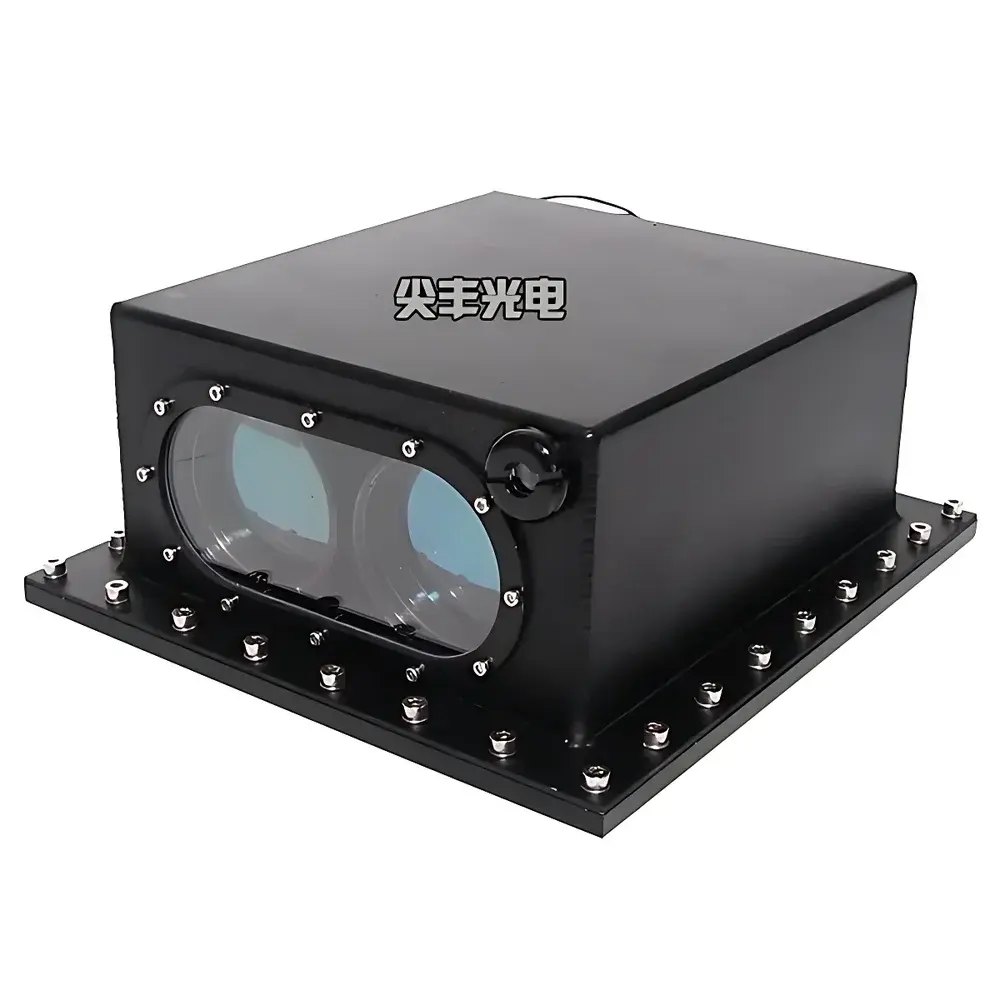
NEWCON LFR MOD 4EC Laser Range Finder
| Origin | Canada |
|---|---|
| Manufacturer Type | Authorized Distributor |
| Origin Category | Imported |
| Model | LFR MOD 4EC |
| Price Range | USD 6,800 – 13,600 (FOB) |
| Product Type | Telescope-Style Laser Rangefinder |
| Operating Principle | Pulsed Time-of-Flight Laser Ranging |
| Measurement Range | 16 – 4000 m |
| Distance Accuracy | ±1 m |
| Telescope Magnification | 7× (fixed optical path, optimized for long-range target acquisition) |
| Integrated Sensor Outputs | Distance, Azimuth (0–6400 mils / 360°), Elevation Angle (±60°), and Velocity (derived via sequential ranging) |
| Environmental Rating | IP66/IP67 |
| Laser Class | Class 1 (IEC 60825-1:2014) |
| Wavelength | 905 nm |
| Beam Divergence | 1 mrad |
| Response Time | 0.5 s |
| Power Supply | 9 V DC (standard alkaline or rechargeable battery pack) |
| Shock & Vibration Resistance | MIL-STD-810G compliant |
| RF Immunity | EN 61326-1:2013 compliant |
| Operating Temperature | −30 °C to +60 °C |
| Dimensions | 230 × 210 × 95 mm |
| Weight | 2.6 kg |
| Interface | RS-232 (asynchronous, 9600 bps default, configurable) |
Overview
The NEWCON LFR MOD 4EC Laser Range Finder is a ruggedized, telescope-style pulsed time-of-flight (ToF) rangefinder engineered for precision distance measurement in demanding field environments. Operating at 905 nm, the device emits low-energy, eye-safe Class 1 laser pulses and calculates distance by measuring the round-trip time between emission and detection of reflected photons. Its fixed 7× optical magnification provides stable visual targeting across extended ranges—critical for integration with unmanned platforms and remote sensing systems. Unlike consumer-grade rangefinders, the MOD 4EC delivers synchronized multi-parameter output: real-time distance, azimuth angle (0–6400 mils, fully scalable to 360°), elevation angle (±60°), and derived velocity data—all acquired within a single 0.5-second measurement cycle. Designed for continuous operation under harsh conditions, it features full IP66/IP67 ingress protection, MIL-STD-810G shock and vibration resistance, and electromagnetic compatibility per EN 61326-1, ensuring reliable performance in military reconnaissance, UAV navigation support, perimeter surveillance, and industrial surveying applications.
Key Features
- Robust mechanical architecture with aluminum alloy housing and elastomeric overmold for drop and impact resilience
- Class 1 eye-safe 905 nm laser source compliant with IEC 60825-1:2014 and FDA 21 CFR 1040.10
- Dual-axis inertial sensor suite (azimuth and elevation) calibrated to ±1 mil (±0.056°) angular accuracy
- RS-232 serial interface with ASCII protocol support; configurable baud rate (up to 115.2 kbps), parity, and data framing
- Integrated quick-mount interface compatible with standard Picatinny rails and OEM optical benches
- Detachable ocular eyepiece and optional video output port (composite NTSC/PAL) for external display or image fusion systems
- Low-power consumption design enabling >8 hours of continuous operation on standard 9 V alkaline batteries
- Wide operational temperature range (−30 °C to +60 °C) validated per MIL-STD-810G Method 501.6
Sample Compatibility & Compliance
The LFR MOD 4EC is validated for use with reflective, semi-reflective, and low-albedo targets—including matte-finish vehicles, unpainted concrete, and natural terrain surfaces—at distances up to 4000 m. Target acquisition reliability is enhanced by adaptive signal thresholding and pulse averaging algorithms. The instrument meets ISO 16610-21 for geometric product specification (GPS) uncertainty reporting and conforms to ASTM E1317-22 for laser-based distance measurement system verification. It supports GLP-compliant data logging when interfaced with validated host software and satisfies key requirements of NATO STANAG 4579 for battlefield rangefinder interoperability. All firmware revisions undergo traceable calibration against NIST-traceable reference standards at accredited third-party laboratories prior to shipment.
Software & Data Management
The MOD 4EC communicates via standardized ASCII command-response protocol over RS-232, enabling seamless integration into custom control architectures—including ROS 2 middleware stacks used in autonomous ground vehicle (UGV) navigation layers. Host-side parsing libraries are available in C++, Python, and LabVIEW (NI). Optional NEWCON DataLink™ software provides real-time telemetry visualization, CSV export with timestamped metadata (including GPS sync input if enabled), and audit-trail generation compliant with FDA 21 CFR Part 11 requirements for electronic records and signatures. Firmware updates are performed via secure signed binary upload using authenticated bootloader mode, preserving configuration integrity during revision cycles.
Applications
- UAV/UGV navigation aid: Provides absolute distance and angular pose feedback for obstacle avoidance and terrain-relative positioning
- Border and critical infrastructure monitoring: Enables long-range target identification and georeferenced alert triggering
- Ballistic fire control support: Supplies slant-range and inclination data for trajectory correction in indirect fire systems
- Industrial asset surveying: Measures clearance distances in confined spaces or elevated structures without physical contact
- Forensic scene documentation: Captures precise spatial relationships between evidence items with angular context
- Environmental monitoring: Tracks vegetation canopy height change over time using repeatable vertical profile scans
FAQ
Is the LFR MOD 4EC certified for use in aviation or airborne platforms?
Yes—when installed per DO-160 Section 21 (lightning-induced transient susceptibility) and operated within its specified temperature and power envelope, the unit complies with RTCA DO-160G for airborne equipment qualification. Certification documentation is available under NDA upon request.
Can the MOD 4EC be integrated with GNSS/INS systems for fused positioning?
Absolutely. Its RS-232 output includes a dedicated synchronization pulse (TTL-level) aligned to each measurement epoch, enabling sub-millisecond temporal alignment with IMU/GNSS timestamps in post-processing or real-time sensor fusion pipelines.
What is the maximum update rate when streaming all parameters (distance, azimuth, elevation)?
The native measurement cycle is fixed at 0.5 s, but burst-mode operation allows up to three consecutive measurements within a 1.5 s window before thermal stabilization is required. Continuous high-rate output is not supported due to laser diode duty-cycle limitations.
Does the device support automatic target tracking?
No—the MOD 4EC is a single-shot, manually aimed rangefinder. Target tracking functionality must be implemented externally via closed-loop servo control using its angular position outputs and host-level prediction algorithms.
How is calibration maintained over time and environmental stress?
Each unit ships with a factory calibration certificate valid for 12 months. Field recalibration requires NEWCON-certified service centers using traceable interferometric reference baselines. Drift compensation algorithms embedded in firmware monitor internal thermal gradients and adjust timing offsets accordingly.