
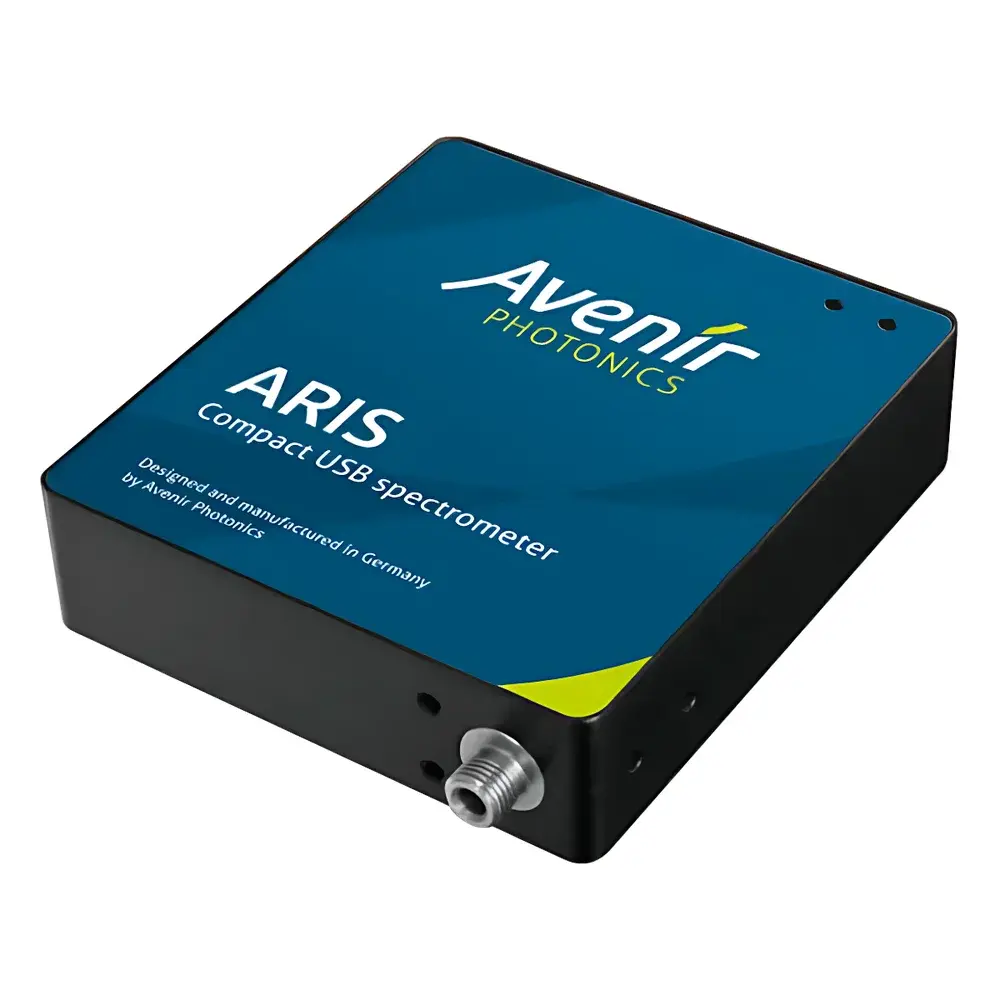
Avenir Aris Miniature Fiber Optic Spectrometer
| Brand | Avenir |
|---|---|
| Origin | Germany |
| Type | Fiber Optic Spectrometer |
| Model | Aris Miniature Spectrometer |
| Spectral Range | 185–970 nm, 185–550 nm, 185–420 nm, 350–840 nm, 510–1020 nm |
| Detector | CCD/CMOS |
| Resolution (FWHM) | 0.33–1.40 nm (typ.) |
| Signal-to-Noise Ratio | 350 or 600 (max., unaveraged) |
| Dynamic Range | 1900:1 or 5000:1 (single-pixel, unaveraged) |
| Stray Light | < 0.08 % |
| Optical Design | Symmetrical Czerny-Turner |
| Focal Length | 50 mm |
| Numerical Aperture | 0.16 |
| Input Slit | User-replaceable, default 20 µm |
| A/D Converter | 16-bit, 2 MHz |
| Interface | USB 2.0 Full-Speed, UART |
| Dimensions | 67.0 × 74.0 × 19.0 mm |
| Weight | 122 g |
| Operating Temperature | −20 to +60 °C |
| Storage Temperature | −40 to +70 °C |
| Humidity | 0–90% RH (non-condensing) |
Overview
The Avenir Aris Miniature Fiber Optic Spectrometer is a high-performance, compact OEM-grade spectrometer engineered for integration into analytical, industrial, and field-deployable instrumentation systems. Based on the symmetrical Czerny-Turner optical architecture with a 50 mm focal length and f/3.1 optics, the Aris delivers laboratory-grade spectral fidelity in a footprint measuring only 67 × 74 × 19 mm. Its core measurement principle relies on dispersed light detection via linear array detectors—CCD or CMOS—coupled with fiber-optic input (SMA 905 interface), enabling precise wavelength-resolved intensity analysis across UV-VIS-NIR bands. Designed for applications demanding robustness under thermal, mechanical, and electrical stress, the Aris operates reliably from −20 °C to +60 °C and features an industry-leading stray light suppression of < 0.08 %—critical for accurate absorbance quantification up to OD 3.0. With onboard microcontroller-based signal processing—including real-time dark/offset/nonlinearity correction, auto-exposure control, and spectral averaging—the device minimizes host computational load while ensuring reproducible, traceable measurements compliant with GLP-aligned workflows.
Key Features
- Modular spectral coverage: Six standard configurations spanning 185–1020 nm, including deep-UV (185–420 nm), UV/VIS (185–550 nm), VIS (350–840 nm), and VIS/NIR (510–1020 nm)
- User-replaceable entrance slits (5–300 µm) enabling trade-off optimization between resolution and throughput
- Three detector options: Toshiba TCD1304DG (3648-pixel CCD), Hamamatsu S11639-01 (2048-pixel CMOS), and Hamamatsu S13496 (4096-pixel CMOS), each with distinct noise, speed, and dynamic range characteristics
- Onboard 16-bit ADC (2 MHz sampling) with < 1 % integral nonlinearity and hardware-accelerated spectral preprocessing
- Dual digital interfaces: USB 2.0 Full-Speed (Type-C) and UART; optional SPI/I²C for embedded system integration
- Industrial I/O suite: TTL-compatible trigger in/out, analog input/output, and configurable GPIOs supporting synchronized multi-sensor acquisition
- Low power consumption (< 70 mW at 5 V) and wide supply tolerance (4.4–5.5 V), suitable for battery-powered or PoE-derived operation
Sample Compatibility & Compliance
The Aris spectrometer supports direct coupling to standard silica-core optical fibers (200–600 µm core), integrating seamlessly with flow cells, cuvette holders, diffuse reflectance probes, and process monitoring manifolds. Its optical interface accepts SMA 905 connectors as standard; FC/PC or custom collimators are available upon request. The instrument complies with CE marking requirements (EMC Directive 2014/30/EU and RoHS 2011/65/EU). While not certified to ISO/IEC 17025 out-of-the-box, its factory calibration report includes NIST-traceable wavelength and irradiance verification data—enabling users to establish metrological traceability per ISO/IEC 17025 Clause 6.4.2. For regulated environments (e.g., pharmaceutical QC), the firmware supports timestamped spectral logging and external trigger synchronization—facilitating alignment with FDA 21 CFR Part 11 audit trail requirements when deployed with validated host software.
Software & Data Management
Avenir provides a cross-platform SDK (Windows/macOS/Linux) with C/C++, Python, and LabVIEW APIs, enabling full low-level register access and real-time spectral streaming. The included SpectraView application supports live plotting, baseline correction, peak integration, and export to CSV, HDF5, or vendor-neutral JCAMP-DX formats. All spectral buffers retain metadata (exposure time, slit width, detector gain, temperature) in embedded headers. Firmware updates are delivered via signed binary packages with SHA-256 checksum verification. Spectral calibration files (.cal) store polynomial coefficients for wavelength mapping and pixel sensitivity correction—editable by users for custom grating or fiber alignment. For automated manufacturing lines, the UART interface supports ASCII command protocol with deterministic response timing (< 100 µs jitter), ensuring synchronization accuracy in PLC-controlled spectroscopic inspection systems.
Applications
- Real-time UV-Vis absorbance monitoring in bioreactors and chemical synthesis reactors
- Portable LIBS (Laser-Induced Breakdown Spectroscopy) spectrometers for elemental analysis
- OEM integration into handheld colorimeters, LED binning systems, and agricultural NIR sensors
- In-line pharmaceutical tablet coating thickness verification via reflectance spectroscopy
- Environmental water quality analyzers measuring nitrate, phosphate, and organic pollutants
- Plasma emission diagnostics in semiconductor etch and deposition tools
- Educational lab modules for teaching optical physics and chemometrics
FAQ
What spectral resolution can be achieved with the Aris spectrometer?
Resolution (FWHM) ranges from 0.33 nm (185–420 nm configuration, 20 µm slit) to 1.40 nm (300–1100 nm configuration, 20 µm slit). Resolution scales linearly with slit width—e.g., switching from 20 µm to 100 µm increases throughput ~5× but degrades resolution proportionally.
Is the Aris spectrometer suitable for GLP or GMP environments?
Yes—when used with validated host software that implements electronic signatures, audit trails, and secure user access controls, the Aris meets foundational requirements for data integrity per ALCOA+ principles. Its onboard timestamping, non-volatile calibration storage, and deterministic trigger behavior support compliance with Annex 11 and USP <1058>.
Can I replace the entrance slit myself?
Yes—the slit module is mechanically accessible and field-replaceable using standard micro-torx tools. Avenier supplies calibrated slit kits (5–300 µm) with documented diffraction-limited performance curves.
Does the spectrometer include stray light correction algorithms?
No hardware-based correction is applied, but the <0.08 % stray light specification ensures minimal spectral crosstalk. Users may apply empirical correction models (e.g., polynomial background subtraction) using the provided SDK and reference spectra.
What is the maximum frame rate for continuous acquisition?
With Hamamatsu S11639-01 detector and 16-bit readout, the minimum cycle time is 2.3 ms (≈435 Hz), limited by ADC settling and internal buffer transfer—not USB bandwidth. Full-spectrum streaming over USB 2.0 achieves sustained rates of ~100 Hz at 16-bit depth.
Related Products






