
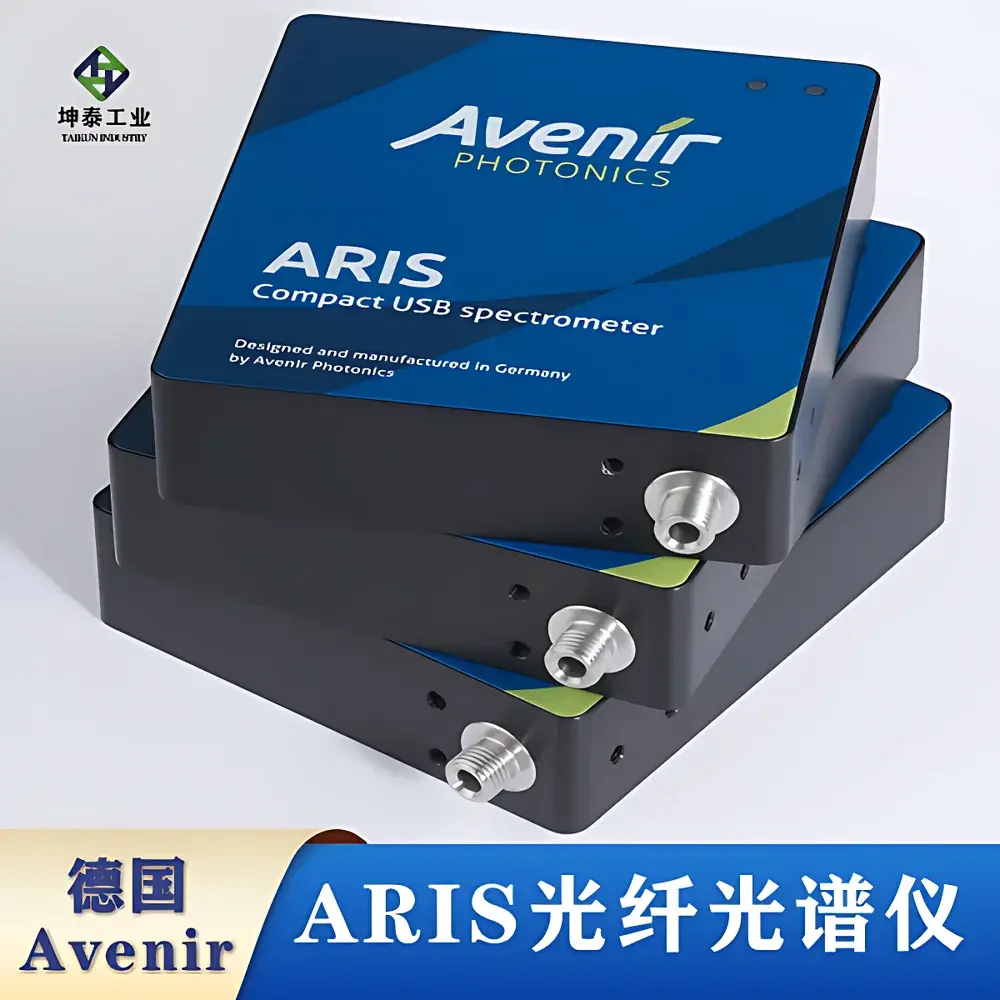
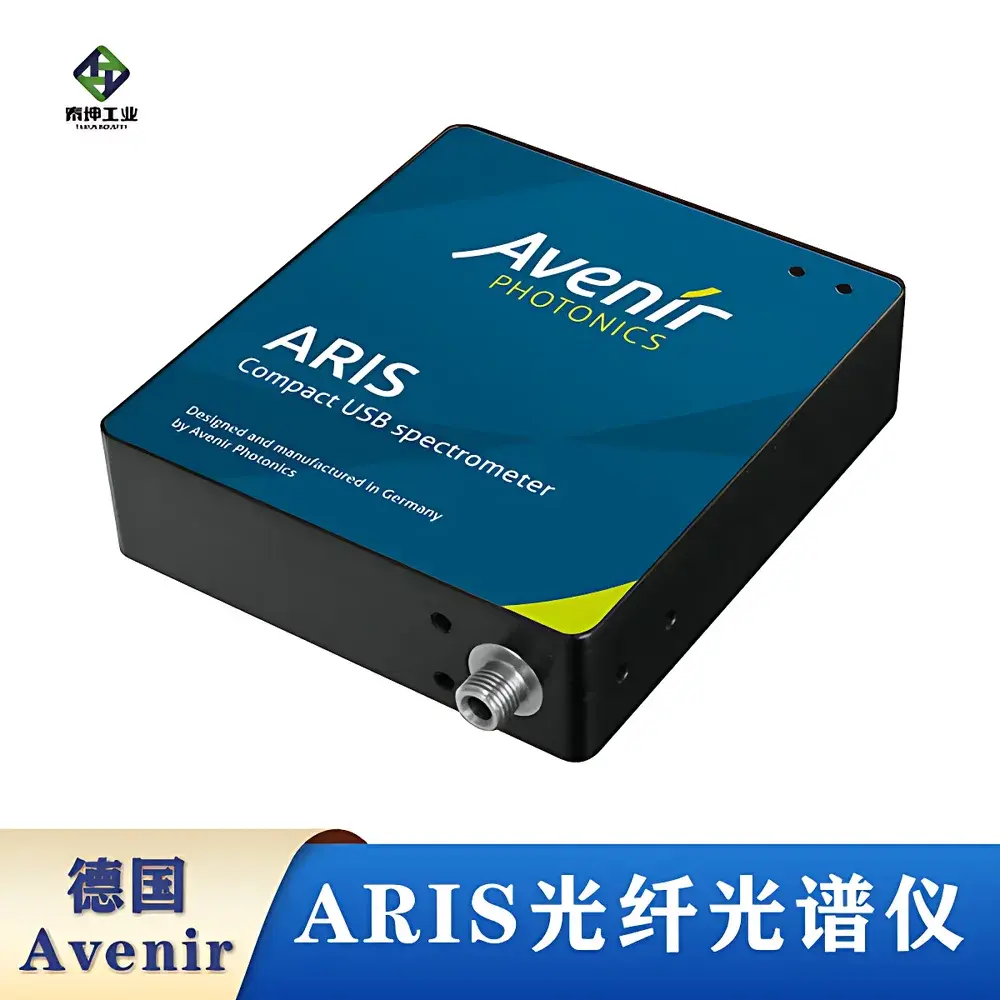
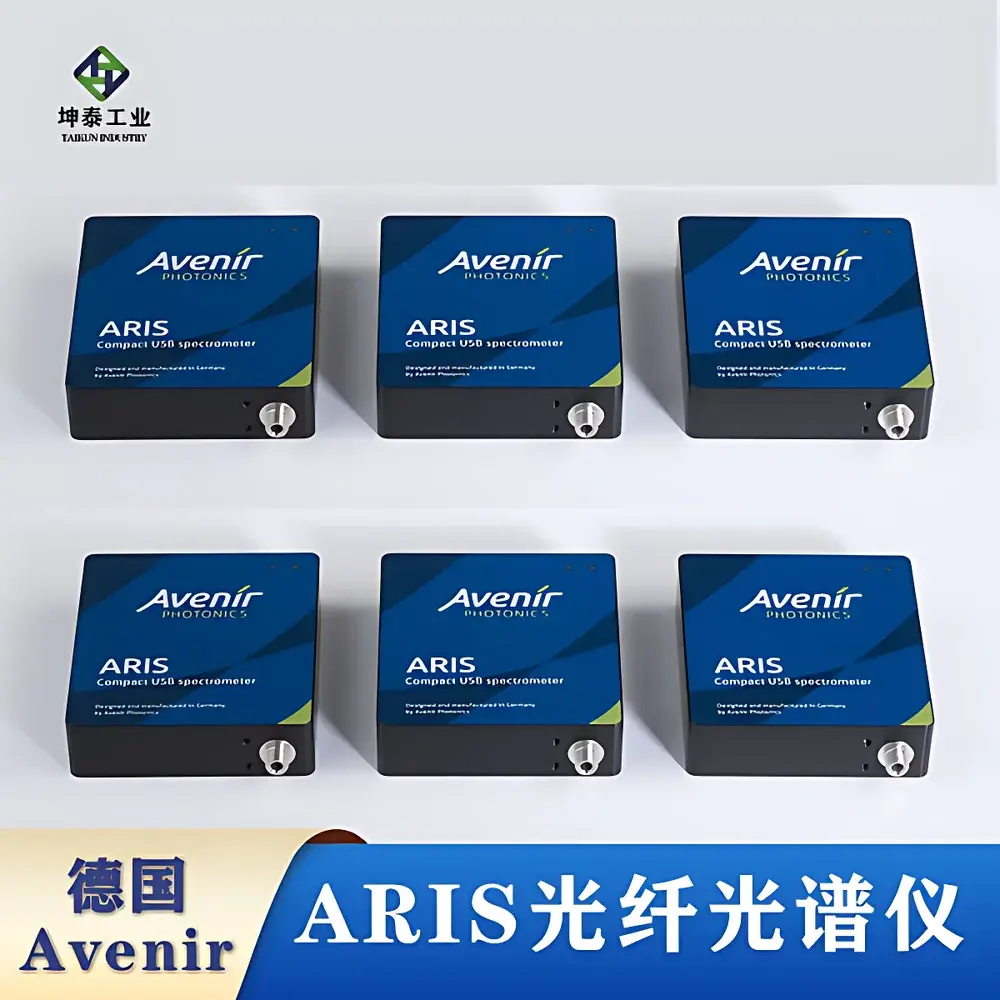
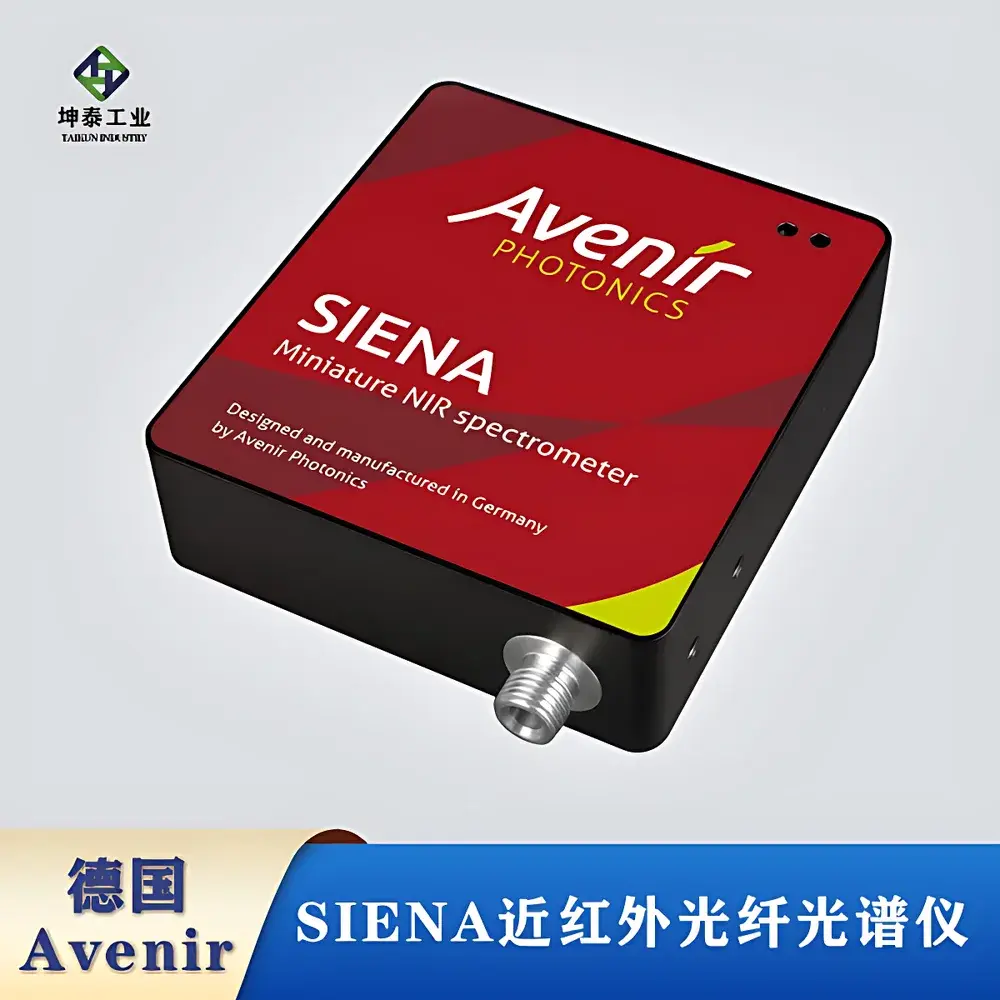
Avenir Photonics Aris Portable Fiber Optic Spectrometer
| Brand | Avenir |
|---|---|
| Origin | Germany |
| Manufacturer Type | Authorized Distributor |
| Import Status | Imported |
| Model | Aris |
| Spectral Range | 185–970 nm, 185–550 nm, 185–420 nm, 350–840 nm, 510–1020 nm |
| Detector Type | CCD |
| Optical Resolution (FWHM) | 0.33–1.40 nm |
| Signal-to-Noise Ratio | 350 or 600 (max, unaveraged) |
| Dynamic Range | 1900:1 or 5000:1 |
| Stray Light | < 0.08 % |
Overview
The Avenir Photonics Aris Portable Fiber Optic Spectrometer is an engineered solution for high-fidelity spectral acquisition in space-constrained, field-deployable, and embedded OEM applications. Based on a symmetric high-throughput Czerny-Turner optical architecture with a 50 mm focal length and f/6.2 numerical aperture (NA = 0.16), the Aris delivers laboratory-grade wavelength accuracy and radiometric stability while maintaining a compact footprint of just 67 × 74 × 19 mm and a mass of 122 g. Its core measurement principle relies on dispersive spectroscopy using ruled or holographic diffraction gratings coupled with linear CCD array detectors—specifically the Toshiba TCD1304DG (3648 pixels) or Hamamatsu S11639-01 (2048 pixels)—enabling precise photon counting across UV-VIS-NIR bands. The instrument supports five standardized spectral ranges, each optimized for distinct application domains including UV photolysis monitoring, LED spectral characterization, water quality sensing, and process analytical technology (PAT) in pharmaceutical manufacturing.
Key Features
- High optical throughput design delivering 2×–4× higher sensitivity than competing spectrometers in its class, validated under identical integration time and slit conditions
- Stray light suppression < 0.08 % (measured with halogen lamp + longpass filter), enabling reliable absorbance measurements up to 3.5 AU without detector saturation
- User-replaceable entrance slits (standard 20 µm; optional wider slits available) for dynamic trade-off between resolution and signal intensity
- Onboard 16-bit ADC (2 MHz sampling), real-time auto-exposure control, spectral averaging, dark/reference correction, and nonlinearity compensation
- Robust environmental rating: operational temperature range −20 °C to +60 °C; storage range −40 °C to +70 °C; IP-rated enclosure compliant with industrial vibration and thermal cycling requirements
- USB 2.0 Full-Speed interface (Type-C connector) with deterministic latency (min. 4 ms inter-scan interval on Toshiba sensor); optional UART, SPI, and I²C digital interfaces for embedded integration
Sample Compatibility & Compliance
The Aris accepts standard SMA-905 fiber-optic input (other connectors available on request), supporting direct coupling to integrating spheres, cuvette holders, flow cells, and remote probes. Its UV-enhanced optics and deep-UV-sensitive CCD arrays ensure stable response down to 185 nm—critical for ozone monitoring, nitrate detection, and UV-curable resin analysis. The device complies with EU directives 2014/30/EU (EMC), 2011/65/EU (RoHS), and REACH SVHC regulations. It meets material traceability requirements per U.S. Conflict Minerals Rule (Dodd-Frank Act §1502). While not certified for GMP environments out-of-the-box, its firmware supports audit-ready data logging and timestamped spectral metadata—facilitating alignment with FDA 21 CFR Part 11 and ISO/IEC 17025 documentation workflows when deployed with validated software protocols.
Software & Data Management
Avenir provides a Windows-native application suite (Windows 7+) featuring real-time spectral visualization, peak identification, baseline correction, and export to CSV, ASCII, and HDF5 formats. The included SDK offers C/C++, Python, and LabVIEW APIs with full register-level access to exposure control, trigger modes, and onboard processing pipelines. All firmware operations—including automatic dark current subtraction, pixel nonlinearity mapping, and reference spectrum normalization—are executed in real time on the integrated microcontroller, minimizing host CPU load. Spectral buffers retain up to 63 consecutive scans (Hamamatsu variant) with hardware timestamping, supporting time-resolved kinetics studies. Raw data integrity is preserved via checksummed binary packet transmission over USB, with no lossy compression applied at acquisition stage.
Applications
- Real-time UV/VIS absorbance monitoring in bioreactors and inline chemical reactors
- Spectral validation of LED lighting systems per IES LM-79 and CIE S 025/E:2015
- Field-portable water quality assessment (COD, NO₃⁻, DOC) using chemometric calibration models
- OEM integration into handheld Raman or LIBS platforms requiring low-SWaP spectral engines
- Academic teaching labs requiring rugged, affordable instrumentation for spectroscopy fundamentals
- Environmental air monitoring for SO₂, NO₂, and O₃ via differential optical absorption spectroscopy (DOAS)
FAQ
What spectral calibration options are available?
Each unit ships with NIST-traceable factory calibration (±0.2 nm wavelength accuracy, ±3 % radiometric uncertainty). Custom calibration using user-provided standards is supported via SDK.
Can the Aris operate in triggered acquisition mode?
Yes—hardware trigger input (TTL-compatible) enables synchronization with external events such as laser pulses or motor encoders; jitter < 10 ns.
Is firmware update capability provided?
Firmware updates are delivered via signed binary packages through the Avenir support portal; field updates require USB connection and verified authentication.
Are there thermal stabilization options?
The base model relies on passive thermal management. For applications demanding sub-pixel wavelength drift (< 0.01 nm/°C), thermoelectrically stabilized variants (Aris-T) are available upon request.
How is stray light quantified?
Stray light is measured per ASTM E275-17 using a 5 nm bandwidth monochromator and calibrated tungsten-halogen source; reported value reflects worst-case performance across all grating configurations.






