
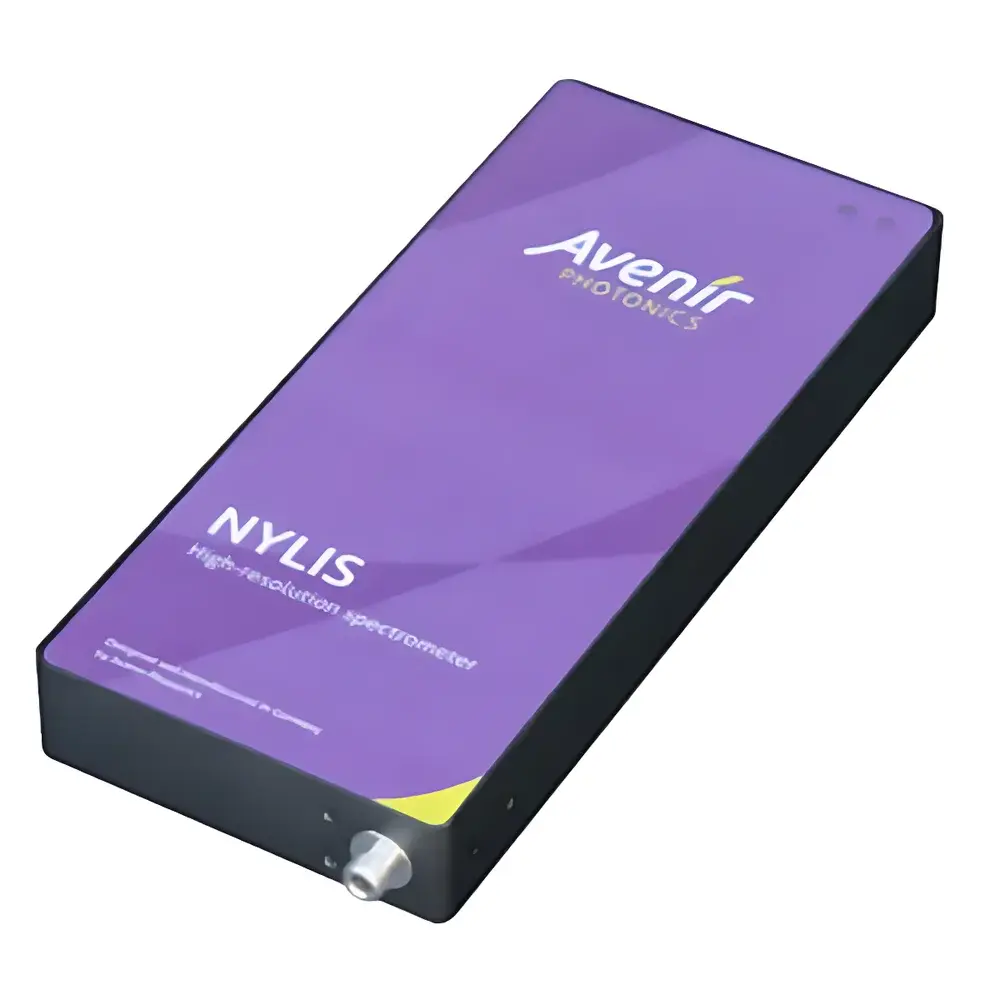
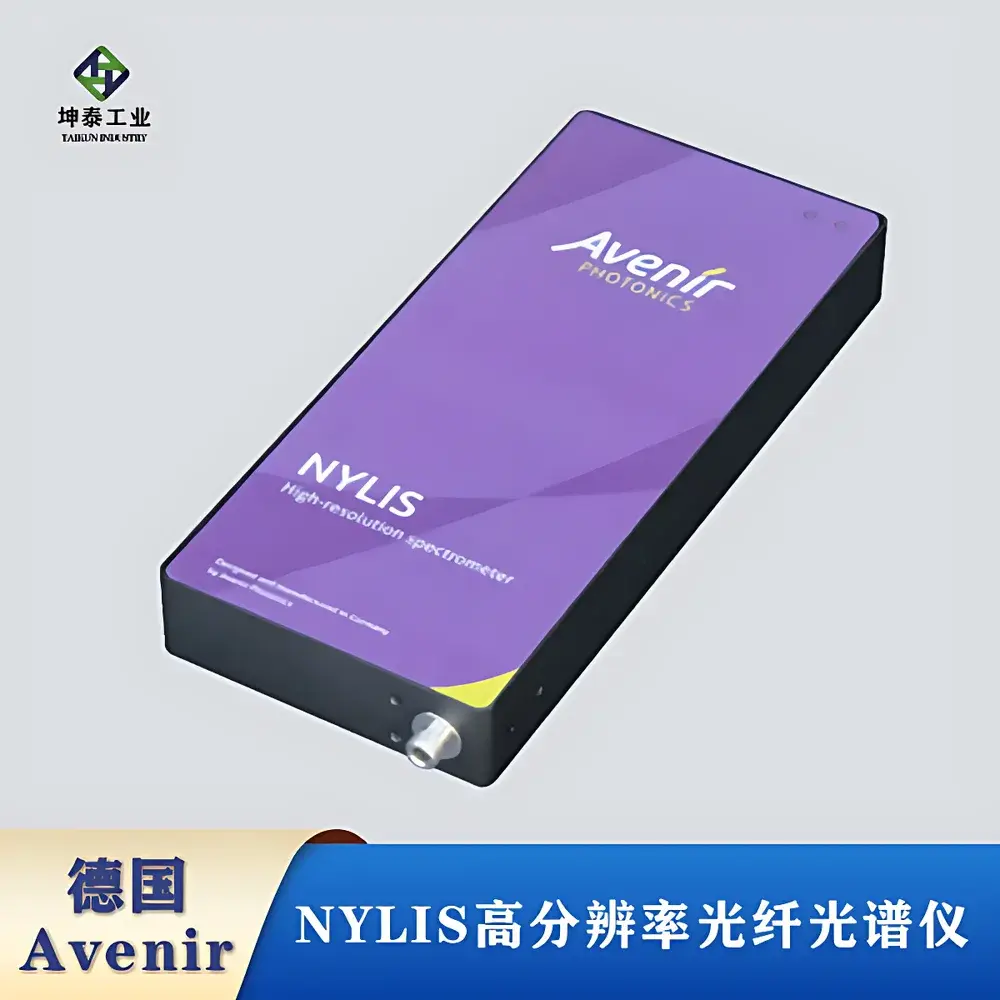
Avenir NYLIS High-Resolution Fiber Optic Spectrometer for High-Speed Laser Characterization
| Brand | Avenir |
|---|---|
| Origin | Germany |
| Manufacturer Type | Authorized Distributor |
| Import Status | Imported |
| Model | NYLIS |
| Spectral Range | 185–970 nm, 185–550 nm, 185–420 nm, 350–840 nm, 510–1020 nm |
| Detector Type | CMOS (Hamamatsu S13496) |
| Optical Resolution (FWHM) | 0.05–1.40 nm (configurable) |
| Sensitivity | 0.05 nm resolution mode |
| Signal-to-Noise Ratio | 350 or 600 (typ.), up to 550 (spec.) |
| dynamic range | 1900:1 or 5000:1 (spec.) |
| Stray Light | < 0.08 % |
| Focal Length | 120 mm |
| Slit Width (standard) | 10 µm |
| Pixel Count | 4096 |
| A/D Converter | 16-bit, 2 MHz |
| Interface | USB 2.0 Full-Speed (Type-C), UART, optional SPI/I²C |
| Dimensions | 67.0 × 150.0 × 19.0 mm |
| Weight | 178 g |
Overview
The Avenir NYLIS High-Resolution Fiber Optic Spectrometer is a compact, research-grade Czerny-Turner array spectrometer engineered for high-fidelity laser spectral characterization where sub-0.1 nm optical resolution is critical. Unlike conventional benchtop spectrometers, the NYLIS leverages a symmetrical Czerny-Turner optical layout with a 120 mm focal length—significantly longer than typical portable designs—to achieve exceptional wavelength dispersion and minimized aberrations. This architecture enables resolution down to 0.05 nm FWHM (full width at half maximum) across narrow, user-selectable spectral windows—e.g., 400–500 nm or 740–810 nm—while maintaining mechanical robustness and thermal stability suitable for integration into OEM laser monitoring systems, R&D labs, and quality control environments. The instrument operates on first-order diffraction principles, with built-in order-sorting filters available to suppress higher-order contributions in UV-VIS-NIR applications. Its native 16-bit digitization, low read noise (11 counts RMS), and sub-microsecond trigger jitter (<1 µs) support time-resolved laser pulse analysis, including Q-switched and mode-locked source profiling.
Key Features
- Sub-0.1 nm optical resolution (FWHM) across 12 standard spectral configurations—down to 0.05 nm in optimized narrow-range modes
- 120 mm focal length Czerny-Turner optical bench with f/14.3 numerical aperture (NA = 0.07), enabling high dispersion and spatial separation of closely spaced emission lines
- Hamamatsu S13496 back-thinned CMOS linear array (4096 pixels) with peak quantum efficiency >80% in UV (200–350 nm) and VIS (400–700 nm)
- Standard 10 µm entrance slit; field-replaceable slits (10–300 µm) allow trade-off tuning between resolution, throughput, and signal-to-noise ratio
- Onboard spectral processing: real-time dark subtraction, nonlinearity correction, reference normalization, and exposure optimization
- USB 2.0 Full-Speed (Type-C) interface with ≤4.4 ms minimum inter-spectrum acquisition time and deterministic trigger synchronization (input/output)
- Compliance-ready firmware architecture supporting audit trails, calibration metadata embedding, and timestamped spectral logging for GLP/GMP-aligned workflows
Sample Compatibility & Compliance
The NYLIS spectrometer is compatible with standard SMA-905 fiber-optic inputs (200–1000 µm core diameters), enabling direct coupling to laser sources, integrating spheres, cuvette holders, or remote sensing probes. Optional accessories—including cosine correctors, collimators, and fiber patch cables—extend its utility in radiometric, photometric, and reflectance measurements per ISO/CIE standards. All factory calibrations are traceable to NIST-certified tungsten-halogen and mercury-argon line sources, with full spectral responsivity curves and wavelength accuracy reports provided. The device meets IEC 61326-1 (EMC for laboratory equipment) and RoHS 2015/863/EU requirements. While not FDA 21 CFR Part 11–certified out-of-the-box, its firmware supports secure user authentication, electronic signatures, and immutable spectral log export—enabling validation under pharmaceutical or medical device QA/QC protocols when deployed with compliant host software.
Software & Data Management
Avenir provides the cross-platform NYLIS Control Suite (Windows/macOS/Linux), featuring real-time spectrum visualization, batch acquisition scripting (Python API included), and automated calibration import/export. Raw spectral data is saved in HDF5 format with embedded metadata (wavelength array, slit width, integration time, temperature, serial number), ensuring FAIR (Findable, Accessible, Interoperable, Reusable) compliance. The SDK includes C/C++, Python, and LabVIEW drivers, with support for third-party platforms such as MATLAB and Igor Pro. For regulated environments, optional NYLIS Validation Pack delivers IQ/OQ documentation templates, performance verification scripts, and audit trail configuration guidance aligned with ISO/IEC 17025 and ASTM E2919-21 (standard practice for spectroscopic instrument qualification).
Applications
- Laser diode and DPSS laser wavelength stabilization and mode-hop detection
- Plasma emission line profiling (e.g., LIBS, ICP-OES pre-screening)
- UV-VIS absorption and fluorescence peak deconvolution in thin-film and nanoparticle characterization
- High-resolution Raman excitation wavelength verification
- OEM integration into laser safety interlock systems requiring real-time spectral validation
- Academic and industrial metrology labs performing spectral irradiance calibration of broadband sources
FAQ
What is the smallest resolvable wavelength difference the NYLIS can detect?
Under optimal conditions (10 µm slit, 400–500 nm range), the instrument achieves 0.05 nm FWHM resolution—corresponding to ~0.025 nm practical discrimination limit per Rayleigh criterion.
Can the NYLIS be used for absolute irradiance measurements?
Yes—when paired with NIST-traceable radiometric calibration (optional add-on), it supports quantitative spectral irradiance (W/m²/nm) and radiance (W/sr/m²/nm) reporting per CIE S 026/E:2019.
Is temperature stabilization required for high-resolution operation?
Not actively: the aluminum housing and low-thermal-drift optics maintain wavelength stability better than ±0.02 nm over –20 to +60 °C ambient range. For sub-pixel repeatability in long-term monitoring, optional Peltier cooling is available.
How does resolution scale with slit width?
Resolution scales linearly with slit width; doubling from 10 µm to 20 µm approximately doubles resolution (e.g., 0.05 nm → 0.10 nm) while increasing signal throughput ~2× and SNR ~√2×.
Does the NYLIS support external triggering for pulsed laser synchronization?
Yes—TTL-compatible trigger input (rising-edge sensitive, <1 µs jitter) and trigger output (programmable delay, 10 ns resolution) enable precise lock-in acquisition synchronized to laser pulses or choppers.




