
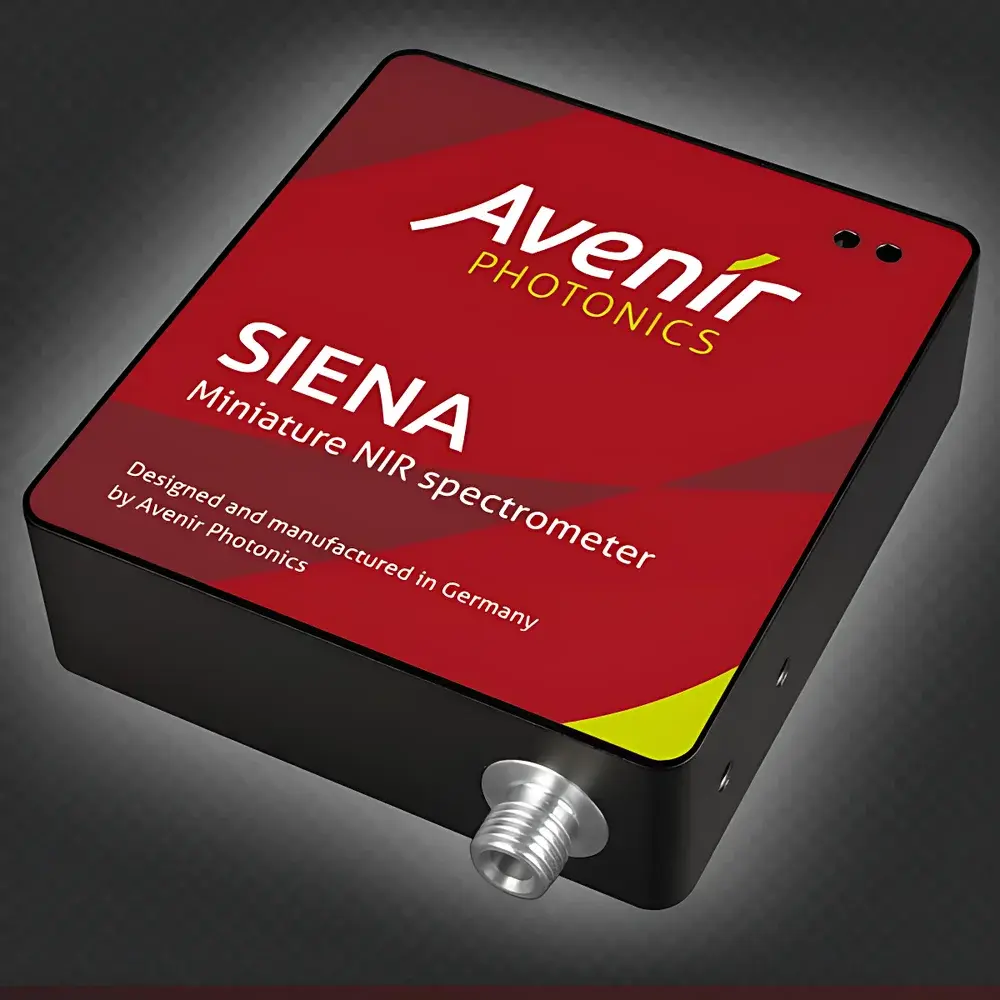
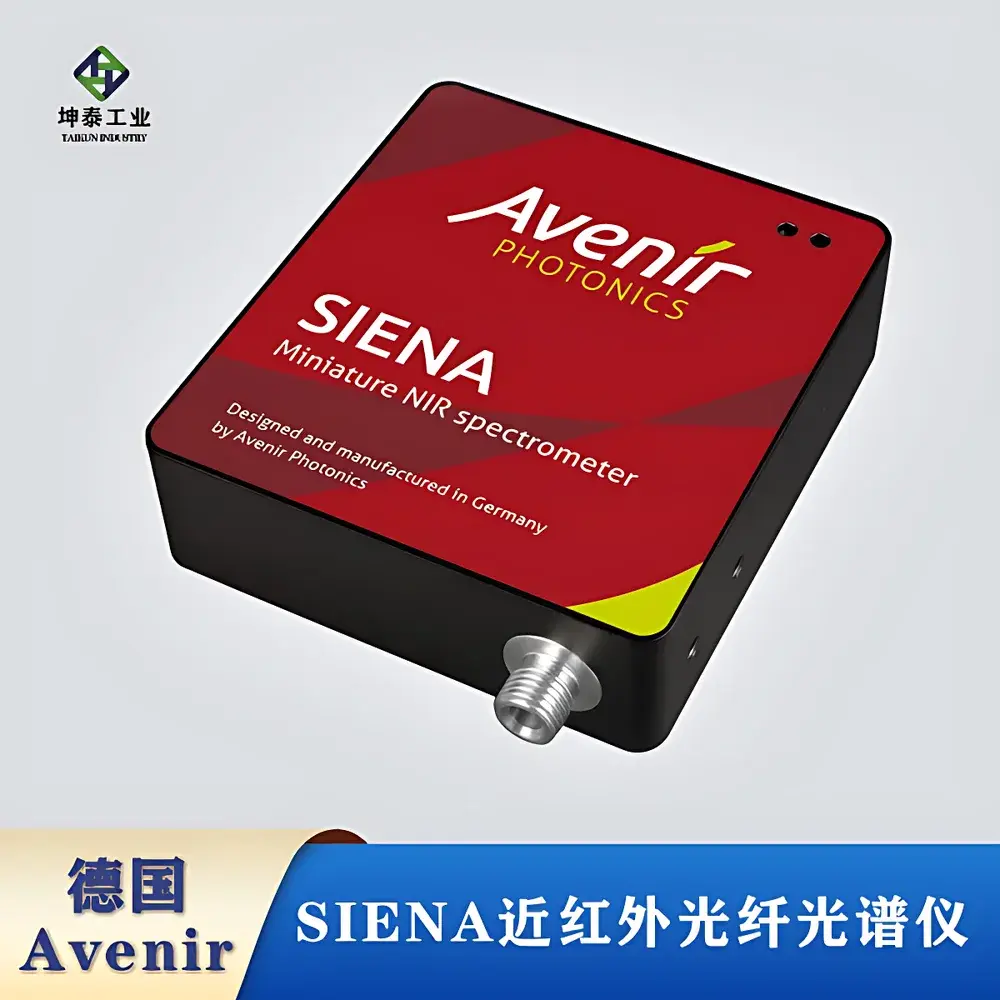
Avenir Siena Miniature Uncooled Near-Infrared Fiber Optic Spectrometer
| Brand | Avenir |
|---|---|
| Origin | Germany |
| Model | Siena |
| Spectral Range | 900–1700 nm, 800–1900 nm, 900–2100 nm |
| Detector Type | InGaAs CCD Linear Array |
| Optical Resolution (FWHM) | 8–15 nm (configurable) |
| Signal-to-Noise Ratio | 1000 (max, unaveraged) |
| Dynamic Range | 12,000:1 |
| Stray Light | < 0.08 % |
Overview
The Avenir Siena is a miniature, uncooled near-infrared (NIR) fiber optic spectrometer engineered for high-performance spectral acquisition in space-constrained, power-sensitive, and cost-driven applications. Unlike conventional cooled InGaAs spectrometers—whose operation beyond 1700 nm necessitates thermoelectric (TEC) cooling—the Siena leverages a proprietary uncooled 256-pixel InGaAs linear array with integrated dark-current compensation. This enables stable, low-noise spectral response up to 2100 nm at ambient temperatures (−20 °C to +60 °C), eliminating the need for active cooling, fans, or complex thermal management. Its optical architecture follows a symmetric Czerny-Turner design with a 30 mm focal length and f/5.3 numerical aperture (NA = 0.19), delivering high throughput and minimal aberration across all standard configurations. The instrument operates on a single 5 V supply (via USB-C or auxiliary connector), consuming ≤60 mW—making it suitable for battery-powered handheld analyzers, embedded OEM sensors, and continuous industrial process monitoring systems where reliability, size, and energy efficiency are critical.
Key Features
- Uncooled InGaAs detection up to 2100 nm—no TEC, no fan, no thermal drift
- Three factory-configured spectral ranges: 800–1900 nm, 900–1700 nm, and 900–2100 nm—with custom range options available
- Configurable entrance slit: standard 20 µm (user-replaceable); optional slits from 10 µm to 300 µm to balance resolution and sensitivity
- Onboard microcontroller enabling real-time auto-exposure, spectral averaging, offset correction, nonlinearity compensation, dark/reference subtraction, and application-specific spectral evaluation
- High dynamic range (12,000:1) and SNR (1000, unaveraged) support accurate quantification across wide absorbance spans (e.g., 0–3 AU)
- Stray light suppression < 0.08 % (measured with halogen lamp + longpass filter), ensuring fidelity in low-transmission measurements
- Compact footprint: 52.0 × 57.0 × 17.0 mm; mass: 80 g—ideal for integration into portable devices and distributed sensor networks
- Dual digital interfaces: USB 2.0 Full-Speed (Type-C) and UART; optional SPI/I²C upon request
- Robust environmental rating: operating temperature −20 to +60 °C; storage −40 to +70 °C; humidity 0–90 % RH (non-condensing)
Sample Compatibility & Compliance
The Siena is compatible with standard SMA-905 optical fiber interfaces (custom connectors available), enabling flexible coupling to transmission cells, diffuse reflectance probes, flow cells, and attenuated total reflectance (ATR) accessories. Its broad NIR coverage supports molecular fingerprinting of C–H, O–H, and N–H overtones and combination bands—enabling quantitative and qualitative analysis of pharmaceuticals, polymers, agricultural products, fuels, and foodstuffs. The spectrometer complies with EU directives 2014/30/EU (EMC), 2011/65/EU (RoHS), and REACH SVHC requirements. It adheres to conflict minerals reporting obligations under the U.S. Dodd-Frank Act Section 1502. While not pre-certified for GMP/GLP environments, its onboard audit-ready features—including timestamped spectral logging, firmware version tracking, and deterministic trigger timing (<1 µs jitter)—support validation pathways aligned with FDA 21 CFR Part 11 when deployed within validated host systems.
Software & Data Management
Avenir provides a Windows-compatible software suite (Windows 7+) featuring real-time spectrum visualization, calibration management, batch measurement scripting, and export to CSV, ASCII, or HDF5 formats. The SDK includes C/C++, Python, and LabVIEW libraries with full API documentation, enabling deep integration into custom analytical platforms. All firmware operations—including exposure control, averaging count, buffer management (426 spectra), and spectral post-processing—are accessible via command-line or programmatic interface. Spectra are transmitted as 32-bit floating-point values over USB in ≤6 ms (full 256-point spectrum), supporting high-throughput applications such as real-time blend uniformity monitoring or inline quality control. On-device processing ensures minimal host dependency: dark/reference spectra are stored persistently; nonlinearity and pixel-response corrections are applied in hardware-accelerated firmware.
Applications
- Portable NIR analyzers for raw material identification (APIs, excipients) per USP & Ph. Eur. monographs
- In-line concentration monitoring in chemical reactors and bioreactors
- Moisture, fat, and protein quantification in grain, dairy, and meat processing lines
- Hydrocarbon composition analysis in refinery streams and fuel blending
- Plastic sorting and polymer identification in recycling facilities
- Embedded spectral engines for smart agriculture sensors (e.g., leaf nitrogen estimation, soil organic carbon mapping)
- Research-grade NIR spectroscopy in university labs requiring compact, low-power instrumentation
FAQ
Does the Siena require external cooling to operate up to 2100 nm?
No. The Siena uses an uncooled InGaAs linear array with patented dark-current compensation, enabling stable operation from −20 °C to +60 °C without thermoelectric cooling.
Can I change the spectral resolution after purchase?
Resolution is primarily determined by entrance slit width and grating selection. While the default 20 µm slit yields 8–15 nm FWHM depending on configuration, users may replace it with optional slits (10–300 µm) to trade resolution for sensitivity.
Is the Siena compliant with FDA 21 CFR Part 11 for regulated environments?
The device itself is not individually certified, but its deterministic firmware behavior, timestamped data logging, and secure USB communication support integration into Part 11–compliant host systems with appropriate procedural controls.
What is the minimum integration time, and how fast can spectra be acquired?
Minimum exposure time is 4 µs; minimum cycle time (including readout and transfer) is 0.34 ms. Full-spectrum USB transfer takes ≤6 ms.
Are calibration files traceable to NIST standards?
Each unit ships with a factory calibration report including wavelength accuracy (±0.5 nm typical), radiometric linearity, and stray light characterization. NIST-traceable recalibration services are available through Avenir-authorized labs.





