
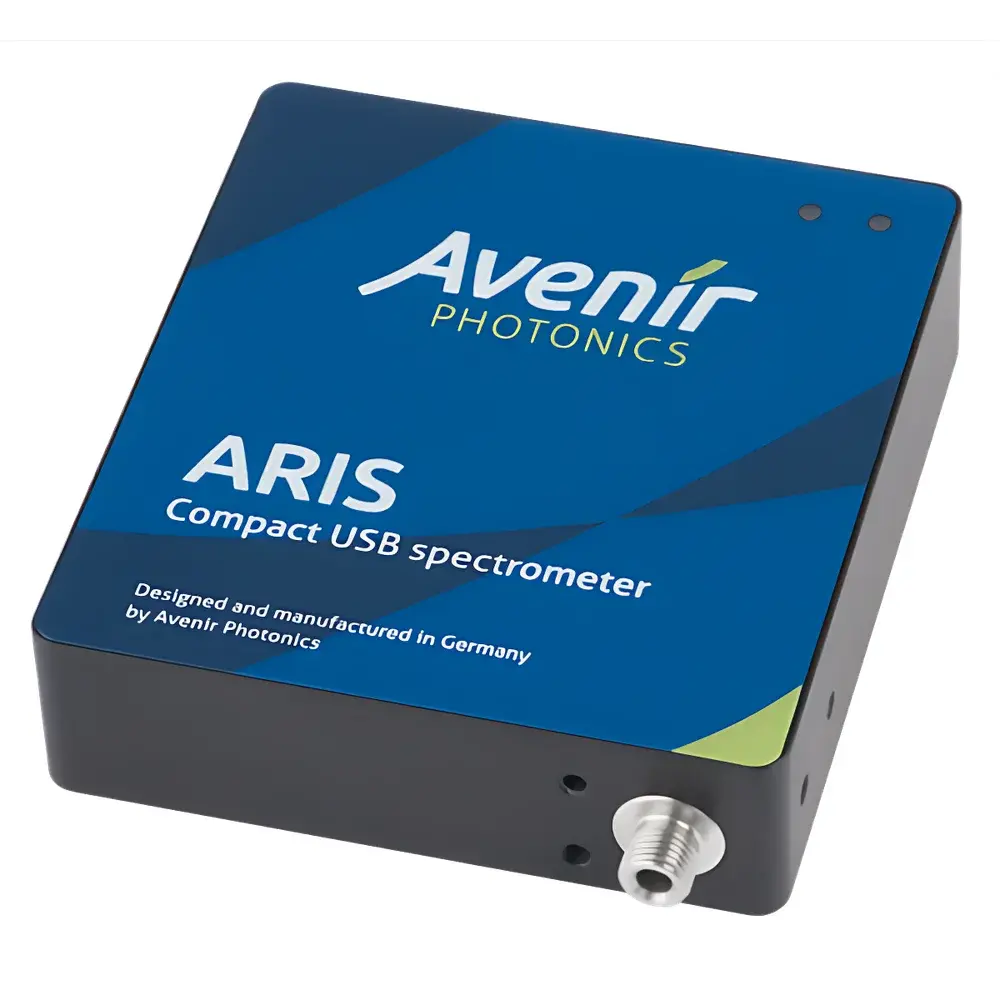
Avenir Aris VIS Portable Fiber Optic Spectrometer (350–840 nm)
| Brand | Avenir |
|---|---|
| Origin | Germany |
| Detector Type | CCD |
| Spectral Range | 350–840 nm |
| Resolution (FWHM) | 0.65 nm (typ.), 0.80 nm (max.) |
| Signal-to-Noise Ratio | 350 (Toshiba TCD1304DG), 600 (Hamamatsu S11639-01) |
| Dynamic Range | 1900:1 (Toshiba), 5000:1 (Hamamatsu) |
| Stray Light | < 0.08 % |
| Optical Design | Symmetric Czerny-Turner, f = 50 mm, NA = 0.16 |
| Input Slit | User-replaceable 20 µm (standard) |
| Interface | USB 2.0 Full-Speed (Type-C), SMA fiber port |
| Dimensions | 67.0 × 74.0 × 19.0 mm |
| Weight | 122 g |
| Operating Temperature | −20 to +60 °C |
| Compliance | EU EMC Directive 2014/30/EU, RoHS, REACH SVHC, U.S. Conflict Minerals Act |
Overview
The Avenir Aris VIS Portable Fiber Optic Spectrometer (350–840 nm) is a compact, high-performance spectrometer engineered for field-deployable and embedded spectroscopic applications requiring laboratory-grade spectral fidelity in a robust, low-power platform. Based on a symmetric Czerny-Turner optical architecture with a 50 mm focal length and numerical aperture of 0.16, the instrument delivers high optical throughput and exceptional stray light suppression (< 0.08 %), enabling reliable absorbance measurements up to 3.5 AU without saturation or detector nonlinearity artifacts. Its core measurement principle relies on dispersive diffraction using user-selectable gratings, coupled with linear CCD array detection—either the Toshiba TCD1304DG (3648 pixels) or Hamamatsu S11639-01 (2048 pixels)—to resolve spectral features across the visible spectrum with sub-nanometer resolution. Designed for integration into OEM systems or standalone portable use, the Aris operates entirely from 5 V USB power, consumes ≤70 mW, and maintains thermal stability across −20 to +60 °C ambient conditions—making it suitable for industrial process monitoring, environmental sensing, LED characterization, and educational spectroscopy where size, reliability, and reproducibility are critical.
Key Features
- Compact form factor (67 × 74 × 19 mm, 122 g) optimized for handheld, drone-mounted, or embedded instrumentation
- User-replaceable entrance slit (20 µm standard; optional wider slits available for sensitivity/resolution trade-off)
- On-board 16-bit ADC with 2 MHz sampling, real-time auto-exposure control, spectral averaging, dark/reference subtraction, and nonlinearity correction
- Dual-detector compatibility: Toshiba TCD1304DG (3648 px, 3 µs–35 min exposure) and Hamamatsu S11639-01 (2048 px, 54 µs–35 min exposure), each with distinct SNR and dynamic range profiles
- Integrated order-sorting filter and SMA fiber interface (custom connectors available upon request)
- Full USB 2.0 Full-Speed (Type-C) interface with onboard spectral buffering (35 spectra for Toshiba, 63 for Hamamatsu) and minimal inter-scan dead time (as low as 2.5 ms)
- Robust mechanical and thermal design validated for operation in industrial environments, including vibration resistance and condensation-free humidity tolerance (0–90 % RH)
Sample Compatibility & Compliance
The Aris VIS spectrometer accepts optical input exclusively via fiber-coupled illumination—compatible with standard 200–600 µm core multimode fibers terminated with SMA-905 connectors. It supports both continuous and pulsed light sources (e.g., halogen lamps, LEDs, laser diodes) and accommodates external triggering for time-resolved measurements. The instrument complies with EU Electromagnetic Compatibility Directive 2014/30/EU, RoHS Directive 2011/65/EU, REACH Regulation (SVHC list), and the U.S. Dodd-Frank Conflict Minerals Act. While not certified for GLP/GMP environments out-of-the-box, its traceable factory calibration report—including wavelength accuracy (±0.3 nm typical, derived from 1/3 of FWHM), photometric linearity (<1 % deviation), and spectral responsivity curves—supports audit-ready documentation when integrated into regulated workflows. Optional accessories such as cosine correctors, collimators, and calibrated reference lamps extend its applicability to reflectance, irradiance, and radiance measurements per ISO/CIE standards.
Software & Data Management
Avenir provides a Windows-based application suite (Windows 7 or later) featuring real-time spectral acquisition, overlay comparison, peak identification, and export to CSV, TXT, or HDF5 formats. The included Software Development Kit (SDK) offers native C/C++, Python, MATLAB, and LabVIEW APIs with full access to all hardware registers—including exposure time, gain, buffer depth, and trigger configuration—enabling deterministic control for automated QA/QC systems. All firmware and spectral processing algorithms reside on the device’s microcontroller, ensuring consistent behavior independent of host OS latency. Audit-trail functionality is supported via timestamped metadata embedding (acquisition time, detector temperature, integration time, calibration ID), satisfying baseline requirements for 21 CFR Part 11–aligned deployments when paired with appropriate electronic signature protocols.
Applications
- LED and display colorimetry (CIE 1931 xy, CCT, CRI calculation)
- In-line UV-Vis absorbance monitoring in pharmaceutical and chemical manufacturing
- Environmental water quality assessment (nitrate, chlorophyll-a, dissolved organic carbon via spectral deconvolution)
- Portable material identification using spectral fingerprint libraries (e.g., plastics, pigments, coatings)
- Educational labs for teaching Beer-Lambert law, grating dispersion, and detector physics
- OEM integration into handheld analyzers, agricultural sensors, and UAV-based remote sensing payloads
FAQ
What spectral calibration options are available?
Each unit ships with NIST-traceable wavelength and intensity calibration certificates. Custom calibrations (e.g., irradiance, radiance, or reflectance) can be performed using optional reference sources and accessories.
Can the spectrometer operate without a PC?
Yes—the onboard microcontroller supports autonomous acquisition, averaging, and spectral buffering. Triggered acquisition and data streaming require USB connection, but internal storage is not provided; host transfer is mandatory for persistent retention.
Is the 0.65 nm resolution guaranteed across the entire 350–840 nm range?
No—the specified resolution (FWHM) is typical under standard conditions: 20 µm slit, Toshiba detector, and optimal grating alignment. Actual resolution varies slightly with wavelength due to optical aberrations and may degrade at band edges; users should consult the detailed resolution map in the technical manual.
How is stray light performance verified?
Stray light is measured per ASTM E275-22 using a deep-ultraviolet cutoff filter (e.g., 254 nm Hg lamp + 320 nm longpass) and quantified as the ratio of out-of-band signal to in-band peak response. Reported <0.08 % meets ISO 17025-compliant validation thresholds for routine UV-Vis analysis.
Are firmware updates supported in the field?
Yes—firmware upgrades are delivered via USB using Avenir’s signed update utility. Updates preserve user calibration coefficients and do not require re-certification unless optical or detector hardware changes are introduced.




