
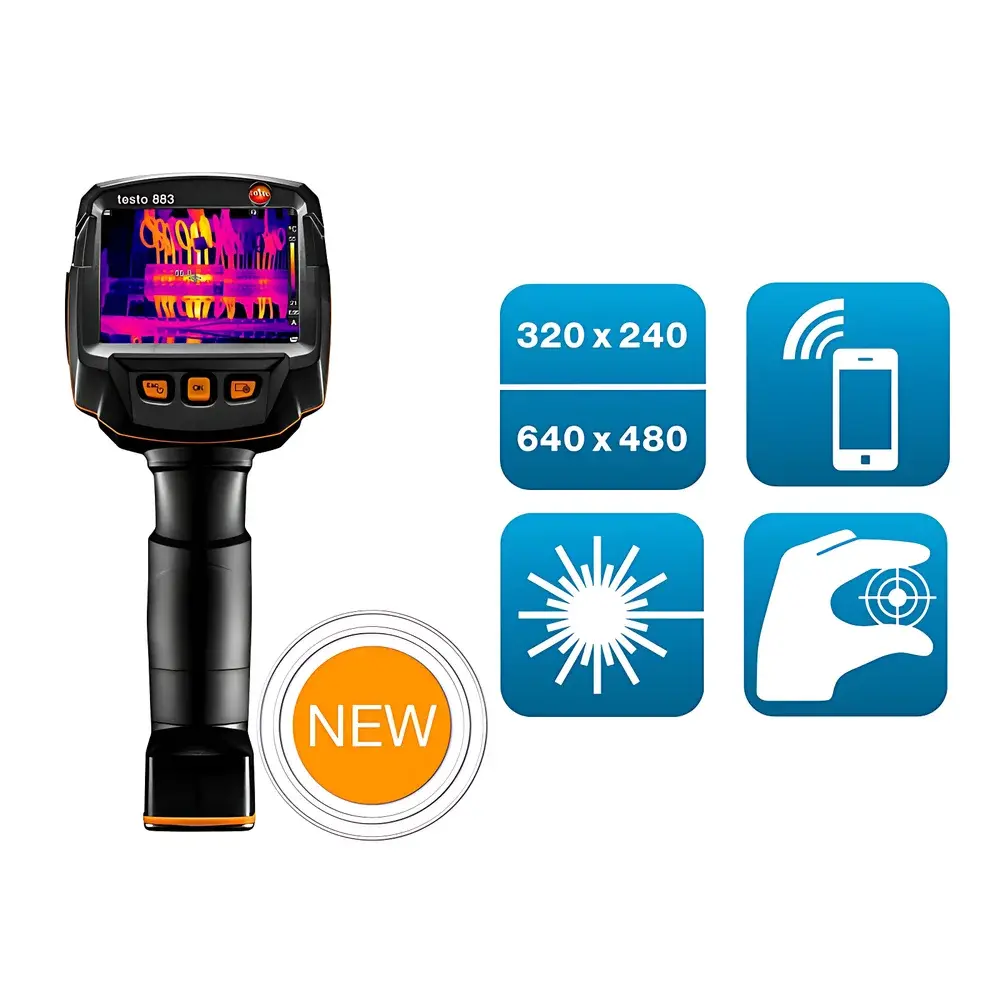
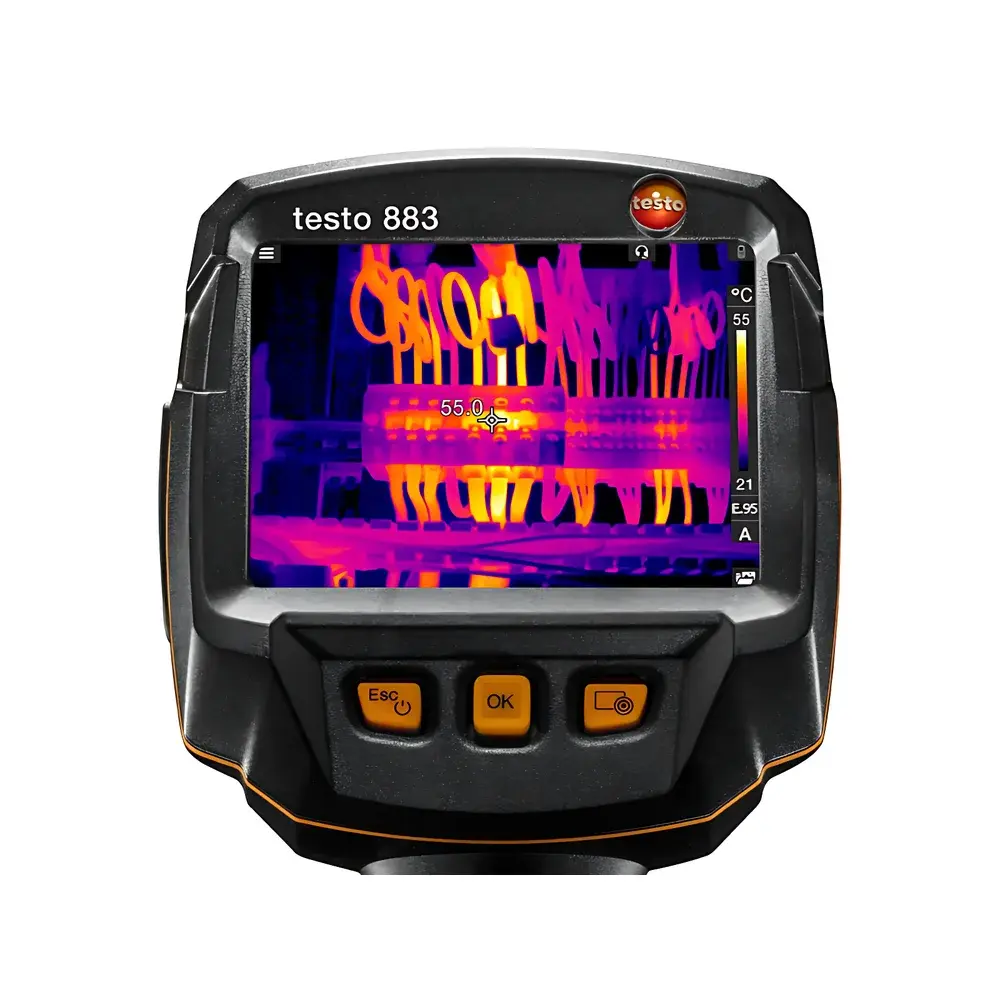
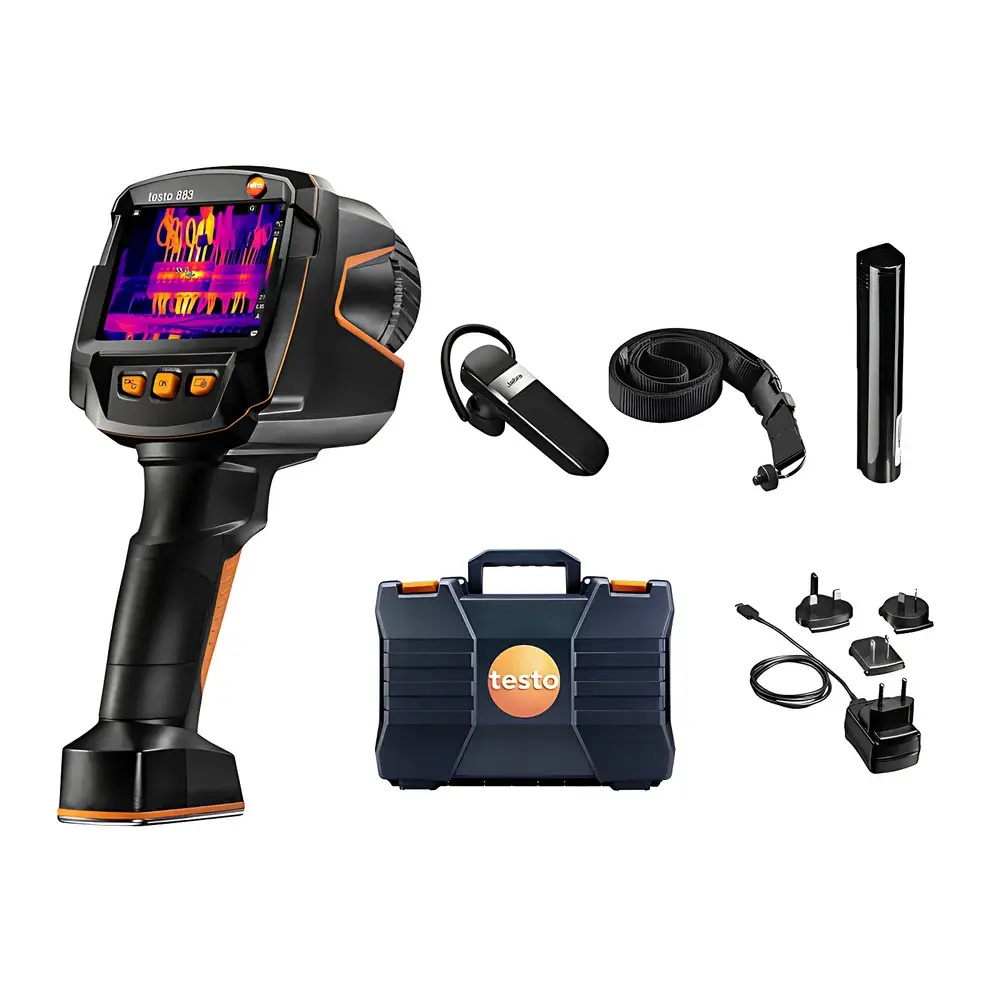
testo 883 Advanced Infrared Thermal Imaging Camera (320 × 240 IR Resolution, Manual Focus, Bluetooth/Wi-Fi Enabled)
| Brand | testo |
|---|---|
| Origin | Germany |
| Model | 0560 8832 |
| Detector Type | Uncooled Microbolometer FPA (Scanning-Type) |
| Spectral Range | 7.5–14 µm |
| IR Resolution | 320 × 240 pixels (SuperResolution up to 640 × 480) |
| Thermal Sensitivity (NETD) | < 0.04 °C |
| Temperature Range | −30 to +650 °C |
| Accuracy | ±2 °C or ±2 % of reading (whichever is greater) |
| Field of View (Standard Lens) | 30° × 23° |
| IFOV (Standard Lens) | 1.7 mrad |
| Minimum Focus Distance | < 0.1 m |
| Frame Rate | 27 Hz (EU-compliant |
| Display | 3.5" capacitive touchscreen (QVGA, 320 × 240) |
| Image Storage | Internal 2.8 GB memory (.bmt, .jpg, .png, .csv, .xls export) |
| Battery Life | ≥ 5 h |
| IP Rating | IP54 |
| Operating Temperature | −15 to +50 °C |
| Weight | 824 g |
| Compliance | RED 2014/53/EU, EMC 2014/30/EU, WEEE 2012/19/EU, RoHS 2011/65/EU + 2015/863, REACH 1907/2006 |
Overview
The testo 883 Advanced Infrared Thermal Imaging Camera is an industrial-grade, uncooled microbolometer-based thermal imager engineered for precision non-contact temperature measurement and thermographic analysis in technical maintenance, facility management, and building energy auditing applications. Operating within the long-wave infrared (LWIR) spectral band (7.5–14 µm), it detects minute thermal emissions from surfaces without physical contact—enabling safe, rapid, and repeatable assessment of thermal anomalies in electrical systems, mechanical components, HVAC installations, and building envelopes. Its core architecture integrates a high-sensitivity focal plane array (FPA) detector with a manually adjustable optical system, ensuring optimal spatial resolution across variable working distances—from close-up diagnostics at ≤10 cm to extended-range inspections using optional telephoto lenses. The device complies fully with EU regulatory frameworks including RED, EMC, RoHS, and REACH directives, and is designed to support GLP-aligned documentation workflows through traceable calibration (supplied certificate) and audit-ready data export.
Key Features
- True 320 × 240 pixel infrared resolution, enhanced via testo SuperResolution technology to deliver interpolated 640 × 480 equivalent detail—improving edge definition and defect localization without interpolation artifacts.
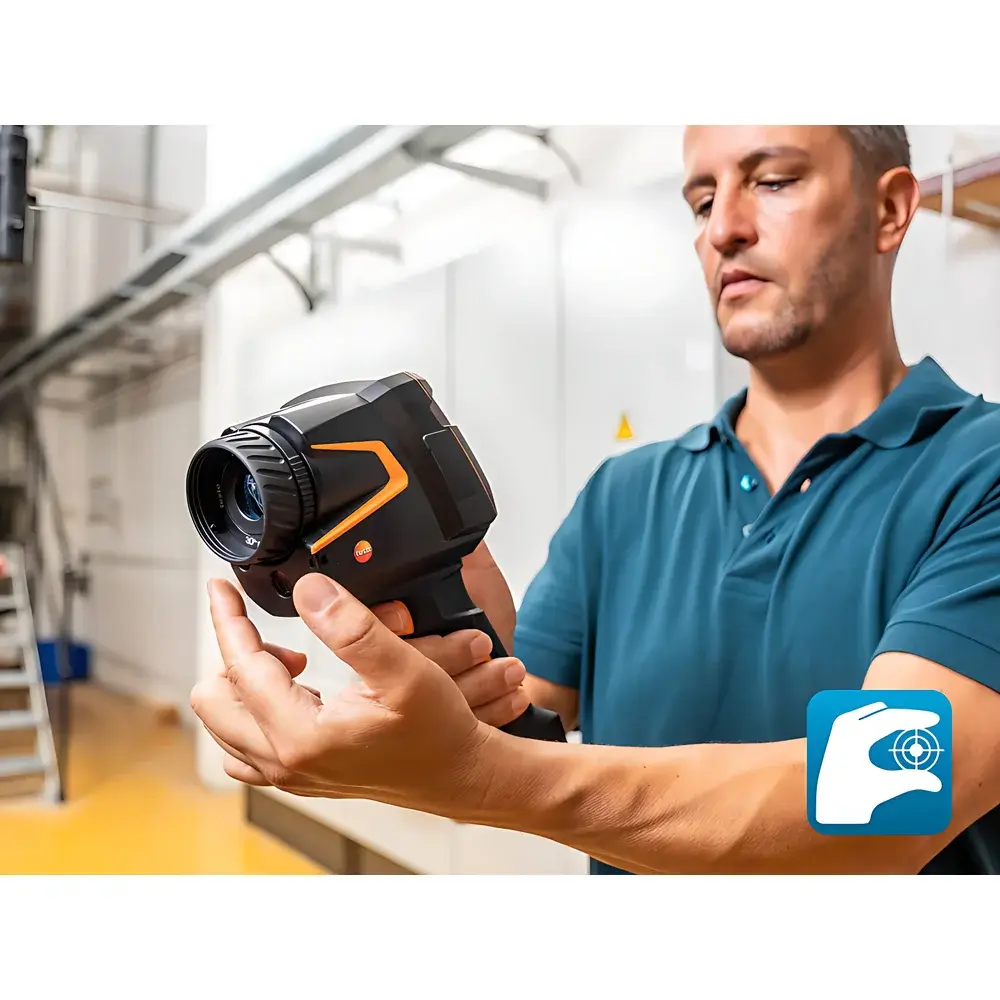
- Manual focus mechanism with sub-10 cm minimum focusing distance, enabling sharp thermal imaging of small components (e.g., PCB traces, terminal blocks, insulation seams) under constrained access conditions.
- Thermal sensitivity (NETD) < 0.04 °C at 30 °C ambient, supporting reliable detection of subtle thermal gradients indicative of early-stage insulation degradation, loose connections, or moisture ingress.
- Integrated 5 MP visible-light camera synchronized with IR capture, facilitating precise overlay alignment and contextual annotation of thermal findings.
- testo ScaleAssist automatic contrast optimization algorithm—dynamically adjusts level/span settings per image to maintain consistent visual interpretation across sequential measurements and multi-user deployments.
- Dual-band wireless connectivity (Bluetooth 5.0 + Wi-Fi 2.4 GHz) enables real-time streaming to mobile devices and bidirectional data exchange with compatible peripherals (e.g., testo 770-3 clamp meter, testo 605i thermo-hygrometer).
- IP54-rated ruggedized housing with reinforced PC-ABS enclosure, rated for operation between −15 °C and +50 °C and resistant to dust and low-pressure water jets—suitable for field use in industrial plants, utility substations, and construction sites.
Sample Compatibility & Compliance
The testo 883 is optimized for heterogeneous sample types encountered in technical service environments: metallic conductors, composite insulation materials, concrete façades, glazing assemblies, and HVAC ductwork. Its emissivity adjustment range (0.01–1.00) and ε-Assist function support accurate temperature quantification across low-emissivity surfaces (e.g., polished copper busbars, aluminum enclosures) when combined with reflected temperature compensation. All firmware and software components adhere to ISO/IEC 17025-relevant data integrity principles. Exported reports and raw thermal datasets (.bmt) retain embedded metadata—including timestamp, GPS coordinates (when enabled), lens ID, and calibration traceability—ensuring compliance with internal quality management systems and external audit requirements such as ISO 50002 (energy audits) and EN 13187 (building thermography). Radio-frequency modules are certified per regional authorizations (EU, EFTA, US, CA, AU, TR), documented in product-specific regulatory dossiers.
Software & Data Management
testo IRSoft (Windows 7/8/10 compatible) provides full post-processing capability: quantitative ROI analysis, isotherm mapping, ΔT calculations, multi-point trending, and customizable reporting templates compliant with DIN EN 13187 and ASTM C1060 guidelines. Raw thermal files preserve radiometric integrity for retrospective re-analysis. The testo Thermography App transforms iOS and Android devices into remote viewing terminals and field reporting stations—supporting live streaming, voice annotations (via Bluetooth headset), on-device report generation (PDF/XLS), and cloud-synced project libraries. SiteRecognition functionality leverages QR codes (DataMatrix, Code 128, or proprietary testo 2D format) to auto-assign thermal images to predefined asset IDs or inspection locations—eliminating manual file sorting and reducing administrative overhead by >70% in large-scale facility surveys. All exported spreadsheets (.xls) retain structured metadata columns for integration into CMMS or ERP platforms.
Applications
- Electrical Infrastructure Maintenance: Detection of overloaded circuits, corroded terminations, phase imbalance, and failing breakers via comparative thermography—per IEC 60270 and NFPA 70B recommendations.
- Mechanical Systems Diagnostics: Identification of bearing overheating, misalignment-induced friction, steam trap failures, and refractory wear in industrial furnaces.
- Building Envelope Assessment: Quantification of thermal bridging, air leakage paths, insulation voids, and moisture accumulation—aligned with ISO 6781-3 and ASHRAE Guideline 12-2020 protocols.
- Energy Auditing: Baseline thermal mapping for retrofit prioritization, post-intervention verification, and compliance reporting under ISO 50002 and local energy code requirements (e.g., DOE Commercial Buildings Energy Consumption Survey).
- Preventive Maintenance Programs: Integration into reliability-centered maintenance (RCM) workflows with scheduled thermal scans, trended anomaly tracking, and automated alert thresholds.
FAQ
What is the effective spatial resolution (IFOV) with the standard lens?
The instantaneous field of view (IFOV) is 1.7 mrad with the included 30° × 23° lens, corresponding to ~1.7 mm spot size at 1 m distance.
Does the testo 883 support FDA 21 CFR Part 11-compliant electronic signatures?
While testo IRSoft does not natively implement Part 11 controls, its audit trail features (user login logs, timestamped edits, immutable raw file export) serve as foundational elements for organizations implementing supplementary validation protocols.
Can thermal images be geotagged?
Yes—when paired with a smartphone running the testo Thermography App and enabled GPS, location metadata is embedded in exported JPEGs and synchronized .bmt files.
Is the calibration certificate NIST-traceable?
The supplied factory calibration certificate references testo’s accredited internal standards, which are maintained against national metrology institute (NMI) references per ISO/IEC 17025; full NIST-traceable recalibration is available through authorized service centers.
How is humidity data integrated into thermal analysis?
Optional wireless hygrometry modules (e.g., testo 605i) transmit ambient RH and temperature readings in real time; these values populate the “humidity risk palette” overlay, applying color-coded thresholds (green/yellow/red) to highlight condensation-prone zones directly on the thermal image.






