
testo 868 Advanced Wireless Thermal Imaging Camera (160 × 120 IR Resolution)
| Brand | testo |
|---|---|
| Origin | Germany |
| Model | 0560 8681 |
| Detector Type | Uncooled Microbolometer FPA (Scanning-Type) |
| Spectral Range | 7.5–14 µm |
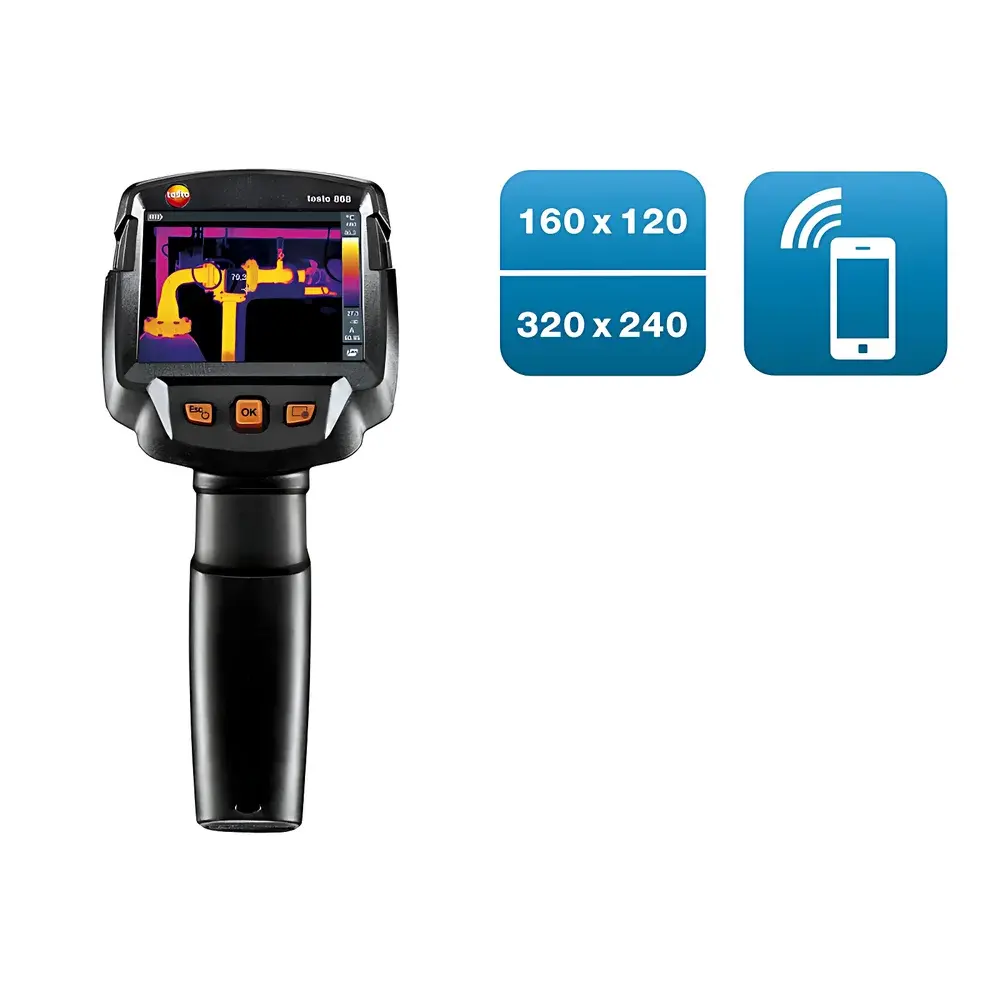
| IR Resolution | 160 × 120 pixels |
| SuperResolution (via testo SuperPixel) | 320 × 240 pixels |
| Thermal Sensitivity (NETD) | ≤ 0.10 °C |
| Field of View (FOV) | 31° × 23° |
| Instantaneous Field of View (IFOV) | 3.4 mrad (standard lens) |
| Frame Rate | 9 Hz |
| Temperature Range | −30 to +100 °C |
| Accuracy | ±2 °C or ±2 % of reading (whichever is greater) |
| Emissivity Adjustment | 0.01–1.00 (with ε-Assist automatic calibration) |
| Reflected Apparent Temperature Compensation | Yes (RTC-assisted) |
| Focus | Fixed-focus optimized for ≥0.5 m |
| Visible Light Camera | ≥3.1 MP, co-registered with IR |
| Display | 3.5″ LCD, 320 × 240 px |
| Storage | Internal 2.8 GB |
| Battery Life | Up to 4 h (rechargeable Li-ion) |
| Environmental Rating | IP54 |
| Operating Temperature | −15 to +50 °C |
| Weight | 510 g |
| Dimensions | 219 × 96 × 95 mm |
| Compliance | EMC Directive 2014/30/EU |
Overview
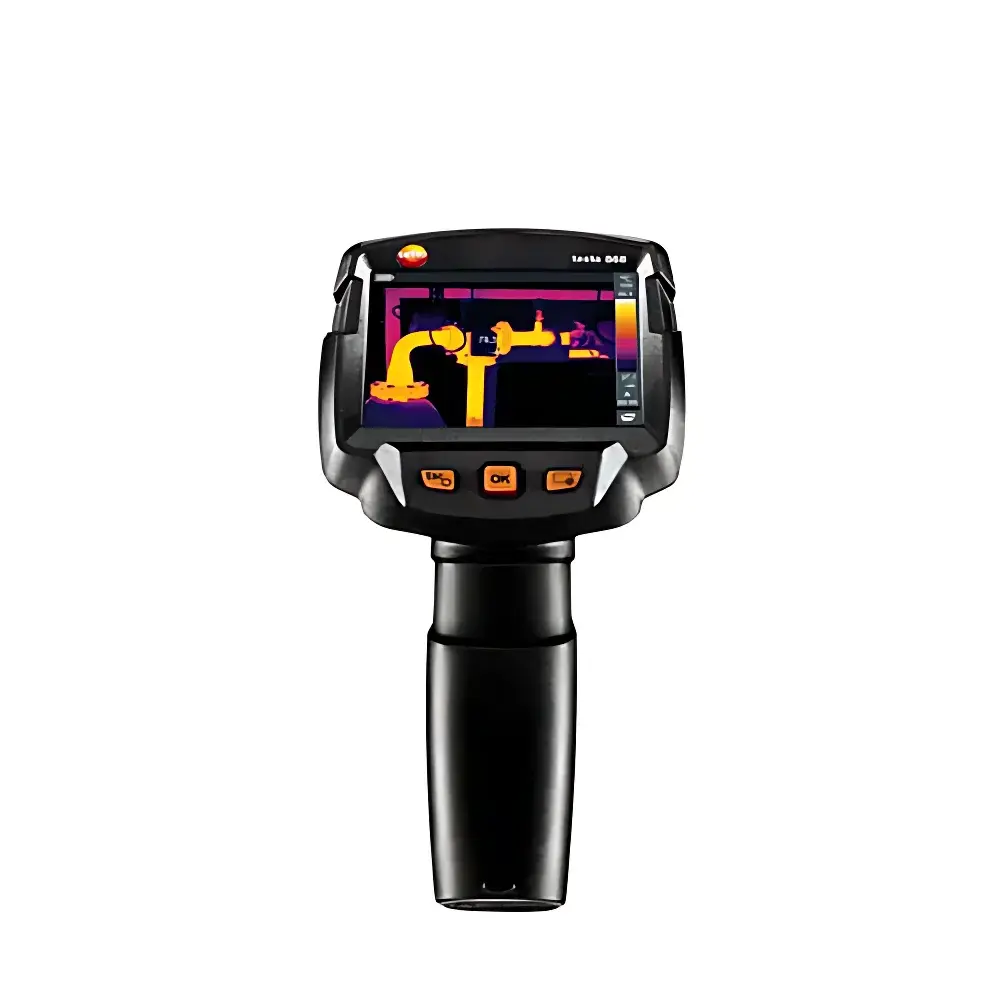
The testo 868 Advanced Wireless Thermal Imaging Camera is a professional-grade, uncooled microbolometer-based infrared imaging system engineered for precision thermography in industrial maintenance, building diagnostics, and electrical infrastructure inspection. Operating within the long-wave infrared (LWIR) spectral band (7.5–14 µm), it detects thermal radiation emitted by objects and converts it into high-fidelity temperature maps—enabling non-contact, real-time surface temperature assessment without physical intervention. Its core architecture employs a 160 × 120 pixel focal plane array (FPA), enhanced via testo’s proprietary SuperPixel interpolation algorithm to deliver an effective resolution of 320 × 240 pixels—significantly improving spatial definition and edge contrast while preserving measurement integrity. With a thermal sensitivity (NETD) of ≤0.10 °C and a frame rate of 9 Hz, the instrument supports dynamic thermal monitoring under field conditions, including transient fault detection in electrical panels or evolving moisture ingress in building envelopes.
Key Features
- Integrated dual-sensor imaging: Simultaneous capture of co-registered infrared and visible-light images (≥3.1 MP) for contextual interpretation and report annotation.
- Intelligent measurement assistance suite: ε-Assist automatically determines optimal emissivity and reflected apparent temperature (RTC) based on ambient conditions and material context—critical for repeatable, traceable measurements in heterogeneous environments such as façade inspections or HVAC duct assessments.
- ScaleAssist technology dynamically adjusts color scale limits to maximize contrast across regions of interest—ensuring consistent visual interpretation across sequential scans during longitudinal condition monitoring.
- IFOV (Instantaneous Field of View) warning indicator overlays real-time spot size estimation directly onto the thermal image, preventing misinterpretation due to distance-induced spatial averaging—a common source of error in thermographic surveys per ISO 18436-7 and ASTM E1934.
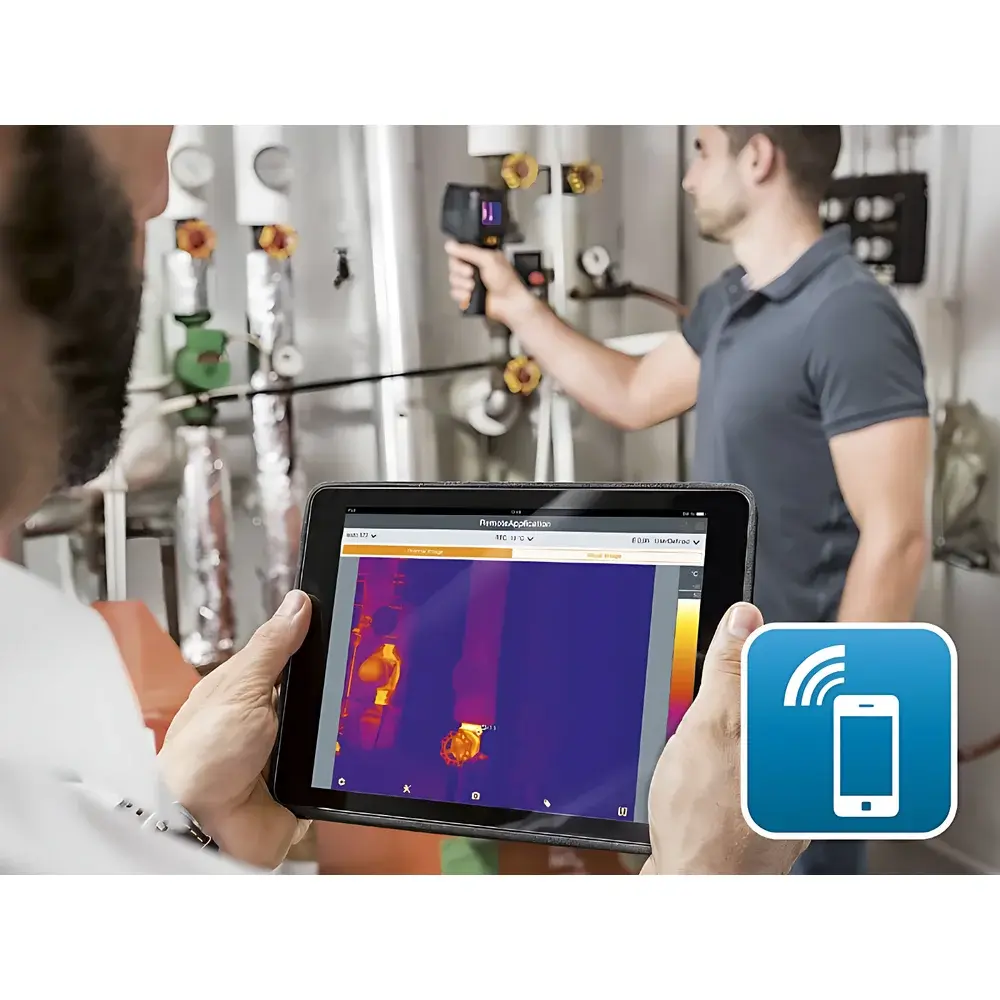
- Wireless connectivity via integrated WLAN and Bluetooth modules enables seamless data streaming to iOS and Android devices using the official testo Thermography App—supporting live remote viewing, on-device reporting, and secure cloud synchronization compliant with GDPR-aligned data handling protocols.
- Fixed-focus optical design optimized for working distances ≥0.5 m ensures rapid deployment without manual focusing delays, while maintaining geometric fidelity across the full 31° × 23° FOV.
Sample Compatibility & Compliance
The testo 868 is designed for broad compatibility with thermally emissive surfaces encountered in mechanical, electrical, and civil infrastructure applications—including painted metals, concrete, insulation materials, roofing membranes, and composite claddings. Its adjustable emissivity range (0.01–1.00) and RTC compensation accommodate reflective, low-emissivity targets—such as polished copper busbars or aluminum heat sinks—when used with testo ε-Labels or reference emissivity patches. The device conforms to EU Electromagnetic Compatibility (EMC Directive 2014/30/EU) and Radio Equipment Directive (RED 2014/53/EU) standards. While not certified for intrinsically safe (ATEX/IECEx) or medical-grade use, its IP54 ingress protection rating validates suitability for indoor/outdoor field operation in dusty or lightly humid environments (20–80 % RH, non-condensing). It supports audit-ready workflows aligned with ISO 55001 asset management frameworks and GLP-compliant documentation when paired with testo’s PC analysis software.
Software & Data Management
Thermal data acquisition, post-processing, and reporting are supported through two complementary platforms: the mobile testo Thermography App (iOS/Android) and desktop testo IRSoft (Windows 10/8/7). The app enables real-time image annotation, hotspot/coldspot auto-detection, customizable report templates (PDF/Excel export), and encrypted cloud backup. IRSoft provides advanced analytical functions—including multi-point trend analysis, delta-T comparisons across time-series datasets, emissivity mapping, and radiometric video playback. All thermal images are stored in native .bmt format (radiometric metadata embedded), with export options to JPEG, BMP, PNG, CSV, and XLS for integration into CMMS or enterprise analytics systems. Both platforms maintain full traceability: each measurement includes timestamp, GPS coordinates (when enabled), device serial number, calibration status, and user-defined tags—facilitating compliance with internal QA procedures and external regulatory audits.
Applications
The testo 868 serves as a primary diagnostic tool across multiple technical domains:
- Electrical Maintenance: Identification of loose connections, overloaded circuits, and failing breakers via comparative thermal profiling—prioritizing interventions before catastrophic failure.
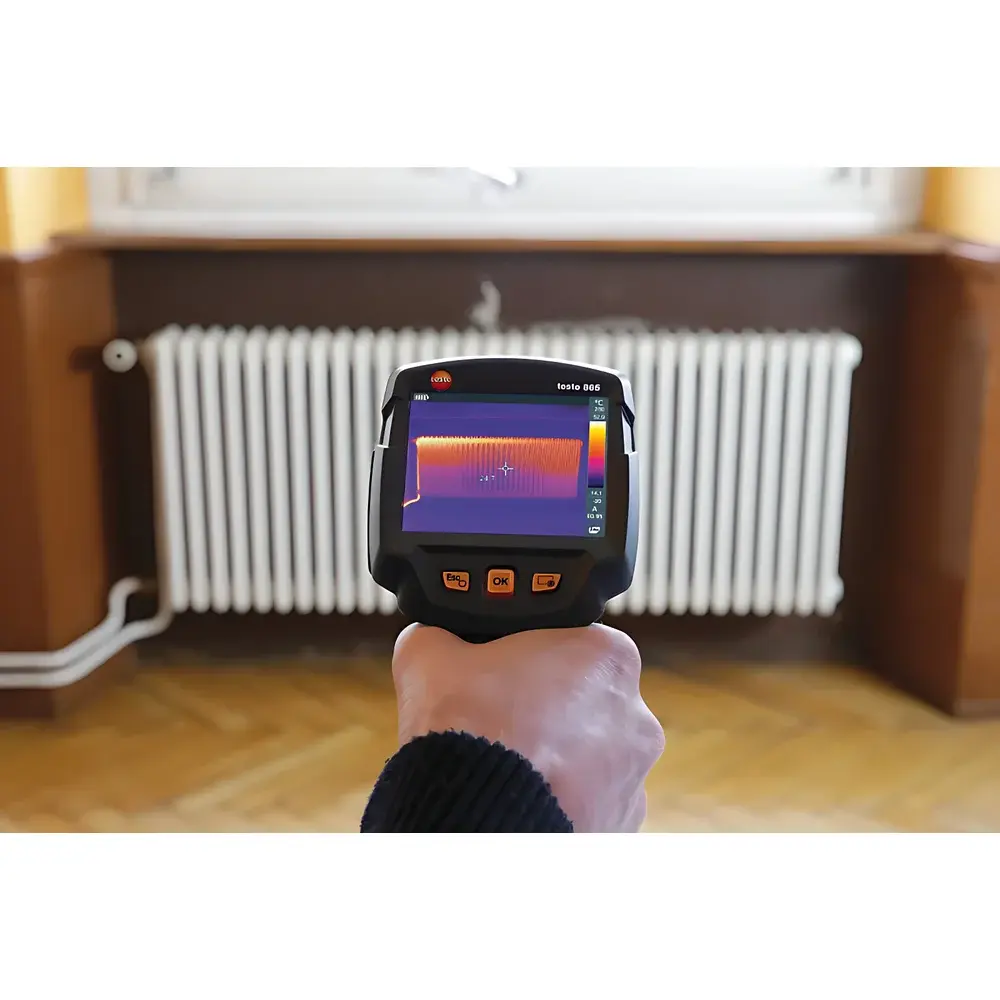
- Building Envelope Diagnostics: Detection of thermal bridging, missing insulation, air leakage paths, and moisture accumulation behind finishes—supporting energy audits per ISO 50002 and ASHRAE Guideline 12.
- Mechanical Systems Monitoring: Assessment of bearing temperatures, steam trap functionality, heat exchanger fouling, and refractory degradation in industrial process equipment.
- HVAC Commissioning: Verification of ductwork integrity, coil performance, and airflow distribution using quantitative thermal gradient analysis.
- Fault Localization in R&D Prototypes: Rapid visualization of thermal dissipation patterns in PCBs, battery packs, and power electronics—accelerating thermal design validation cycles.
FAQ
What is the effective spatial resolution at 1 meter distance?
At 1 m working distance, the standard IFOV (3.4 mrad) yields a measurement spot size of approximately 3.4 mm. In SuperPixel mode (2.1 mrad), the effective spot size reduces to ~2.1 mm—enhancing defect localization capability.
Does the testo 868 support radiometric video recording?
Yes—radiometric video (.bmt format) can be recorded internally and exported for frame-by-frame temperature analysis in IRSoft.
Is firmware update capability available over-the-air?
Firmware updates are delivered via USB or WLAN through the testo Thermography App or IRSoft—ensuring continuous alignment with evolving measurement standards and feature enhancements.
Can measurement data be imported into third-party analytics platforms?
CSV and XLS exports contain full radiometric data per pixel, enabling ingestion into MATLAB, Python (NumPy/Pandas), or enterprise BI tools for statistical process control or predictive maintenance modeling.
What calibration documentation is included?
Each unit ships with a factory calibration certificate traceable to national standards (DAkkS-accredited lab), documenting verification points across the full temperature range and NETD performance at time of shipment.




