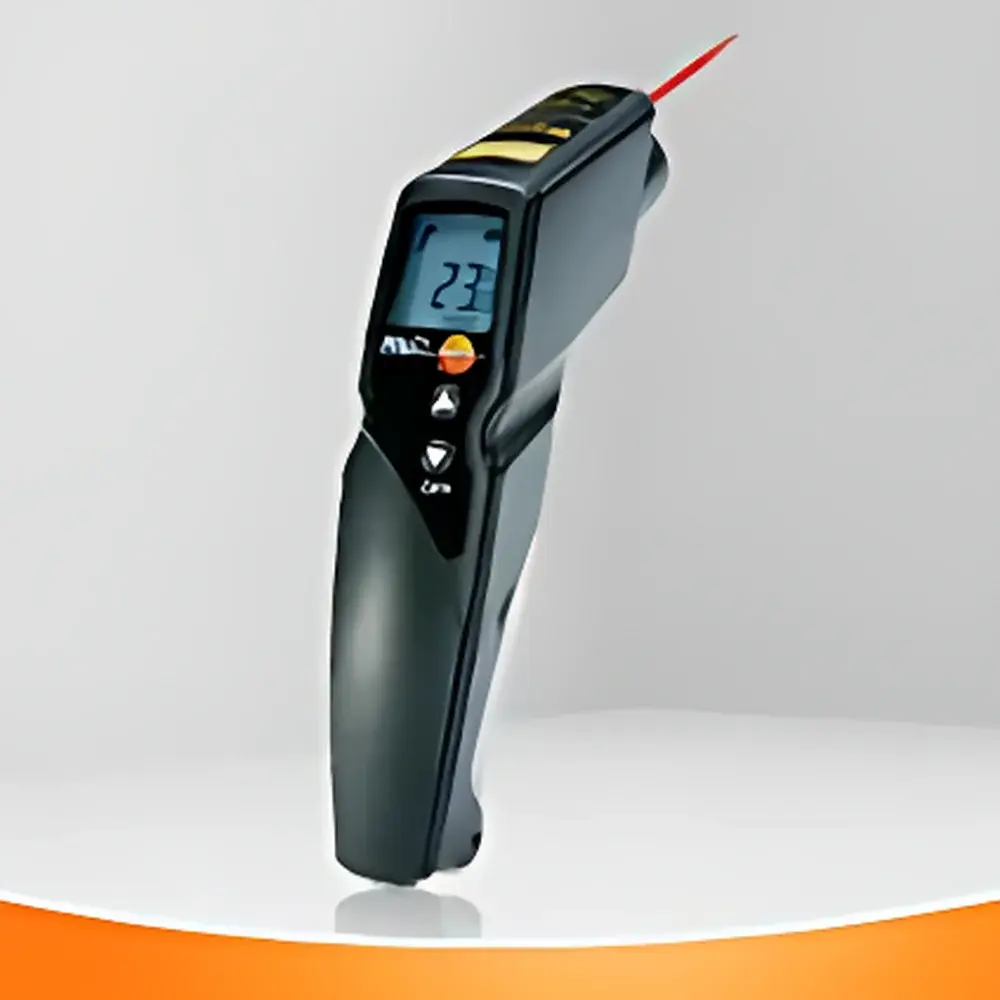
testo 830-T1 Infrared Thermometer
| Brand | testo |
|---|---|
| Model | 830-T1 |
| Type | Portable Infrared Thermometer |
| Temperature Range | -30 to +400 °C |
| Accuracy | ±1.5 °C or ±1.5 % of reading (0.1 to +400 °C) |
| Optical Resolution | 10:1 |
| Response Time | 0.5 s |
| Resolution | 0.1 °C |
| Emissivity Adjustment | 0.10–1.00 (adjustable in 0.01 steps) |
| Measurement Frequency | 2 Hz |
| Display | Backlit LCD with Max/Min/Hold functions |
| Alarm | Dual user-defined limit thresholds with audible and visual alert |
| Weight | 200 g |
| Dimensions | 190 × 75 × 38 mm |
| Operating Temperature | -20 to +50 °C |
| Storage Temperature | -40 to +70 °C |
| Housing Material | ABS |
| Power Supply | 9 V alkaline battery |
| Battery Life | Approx. 15 hours |
Overview
The testo 830-T1 Infrared Thermometer is a precision-engineered, handheld non-contact temperature measurement instrument designed for rapid, reliable surface temperature assessment across industrial maintenance, HVAC, food safety, electrical inspection, and laboratory environments. Utilizing calibrated infrared detection technology operating in the 8–14 µm spectral band, the device captures thermal radiation emitted from object surfaces and converts it into accurate temperature readings via a high-stability thermopile sensor and integrated digital signal processor. Its 10:1 optical resolution enables precise targeting at moderate distances—e.g., measuring a 10 mm spot at 100 mm distance—ensuring minimal spatial averaging error. The instrument complies with international performance standards for portable IR thermometers, including DIN EN 60584-1 (thermocouple reference tables) and ISO 18434-1 (condition monitoring — thermography), supporting traceable, repeatable measurements under field conditions.
Key Features
- Adjustable emissivity (0.10–1.00 in 0.01 increments) for accurate compensation across diverse surface materials—from polished metals (ε ≈ 0.1–0.3) to oxidized steel (ε ≈ 0.8), painted surfaces (ε ≈ 0.9), and organic substances.
- Single-point laser sighting system for intuitive aiming and improved targeting confidence without parallax error.
- High-speed measurement capability: two readings per second (2 Hz), enabling dynamic process monitoring and efficient survey workflows.
- 0.1 °C temperature resolution across the full -30 to +400 °C range, optimized for detecting subtle thermal gradients in predictive maintenance and quality control applications.
- Dual programmable alarm thresholds with simultaneous audible beep and visual LED indicator—configurable for upper/lower limits to support pass/fail inspection protocols.
- Max/Min value tracking and Hold function (manual freeze of last stable reading) for documentation and comparative analysis without external logging.
- Ergonomic pistol-grip design with textured ABS housing, enabling single-hand operation and reduced operator fatigue during extended use.
- Backlit LCD display with automatic brightness adjustment ensures readability in low-light or high-glare environments, including indoor machinery enclosures and outdoor daylight exposure.
Sample Compatibility & Compliance
The testo 830-T1 is intended for non-contact surface temperature measurement of solid and semi-solid materials. It is not suitable for transparent media (e.g., glass, plastics below 1 mm thickness), highly reflective untreated metals without emissivity correction or auxiliary surface treatment (e.g., matte tape or high-emissivity paint), or moving targets exceeding 1 m/s relative velocity. For low-emissivity surfaces (<0.4), application of testo’s optional reflective tape (Art. No. 0554 0051) is recommended to establish a known ε = 0.95 reference area. The instrument meets CE marking requirements under the EU Electromagnetic Compatibility Directive 2014/30/EU and the RoHS Directive 2011/65/EU. While not certified to IEC 61000-4-x immunity standards for harsh industrial EMI environments, its robust analog front-end and digital filtering ensure stable operation in typical workshop and facility settings.
Software & Data Management
The testo 830-T1 operates as a standalone field instrument with no built-in data storage or PC interface. All measurement values are displayed in real time and retained only in volatile memory until overwritten or powered off. For audit-ready documentation, users may manually record readings or integrate the device into structured inspection routines compliant with ISO 9001:2015 clause 7.1.5 (monitoring and measuring resources) and ASTM E1933-19 (standard test methods for measuring and compensating for emissivity using infrared thermometers). When used in regulated environments (e.g., pharmaceutical cleanroom HVAC validation or food processing line monitoring), the device supports GLP-aligned practices through documented calibration records, user-defined emissivity settings logged in procedural SOPs, and periodic verification against NIST-traceable blackbody sources (e.g., testo 925 or equivalent).
Applications
- Electrical infrastructure: Thermal scanning of circuit breakers, busbars, transformer connections, and switchgear to identify overheating faults prior to failure.
- HVAC commissioning & diagnostics: Surface temperature profiling of ductwork, heat exchangers, refrigerant lines, and insulation integrity verification.
- Food service & processing: Spot-checking holding temperatures of cooked foods, cold chain verification at receiving docks, and equipment surface sanitation validation (e.g., steam traps, ovens).
- Mechanical maintenance: Bearing temperature trending, motor winding hot-spot detection, and lubrication condition assessment via thermal signature analysis.
- Building diagnostics: Detection of thermal bridging, moisture-induced thermal anomalies in walls/roofs, and radiant floor heating system uniformity checks.
- Research & education: Introductory thermography experiments, emissivity comparison studies, and heat transfer demonstration labs requiring quantitative IR measurement.
FAQ
What is the minimum spot size measurable with the testo 830-T1 at 1 meter distance?
At 1 m, the 10:1 optical resolution yields a measurement spot diameter of approximately 100 mm. For smaller targets, reduce distance proportionally—e.g., 50 mm spot at 500 mm.
Can the testo 830-T1 measure through glass or plastic windows?
No. Standard glass and most clear plastics are opaque in the 8–14 µm IR band. Measurements taken through such barriers reflect the window’s surface temperature, not the underlying object.
How often should the instrument be calibrated?
Annual calibration is recommended for routine industrial use. More frequent verification (e.g., pre-shift checks against a stable reference source) is advised in critical applications or after mechanical shock.
Is the 9 V battery rechargeable?
No—the device uses standard 9 V alkaline batteries. Rechargeable NiMH variants are not supported due to voltage regulation constraints.
Does the testo 830-T1 comply with FDA 21 CFR Part 11 for electronic records?
No. As a standalone readout-only instrument without audit trail, electronic signature, or data export capabilities, it does not meet Part 11 requirements. It may serve as a primary measurement tool within broader validated systems where manual entry into compliant software is performed.