
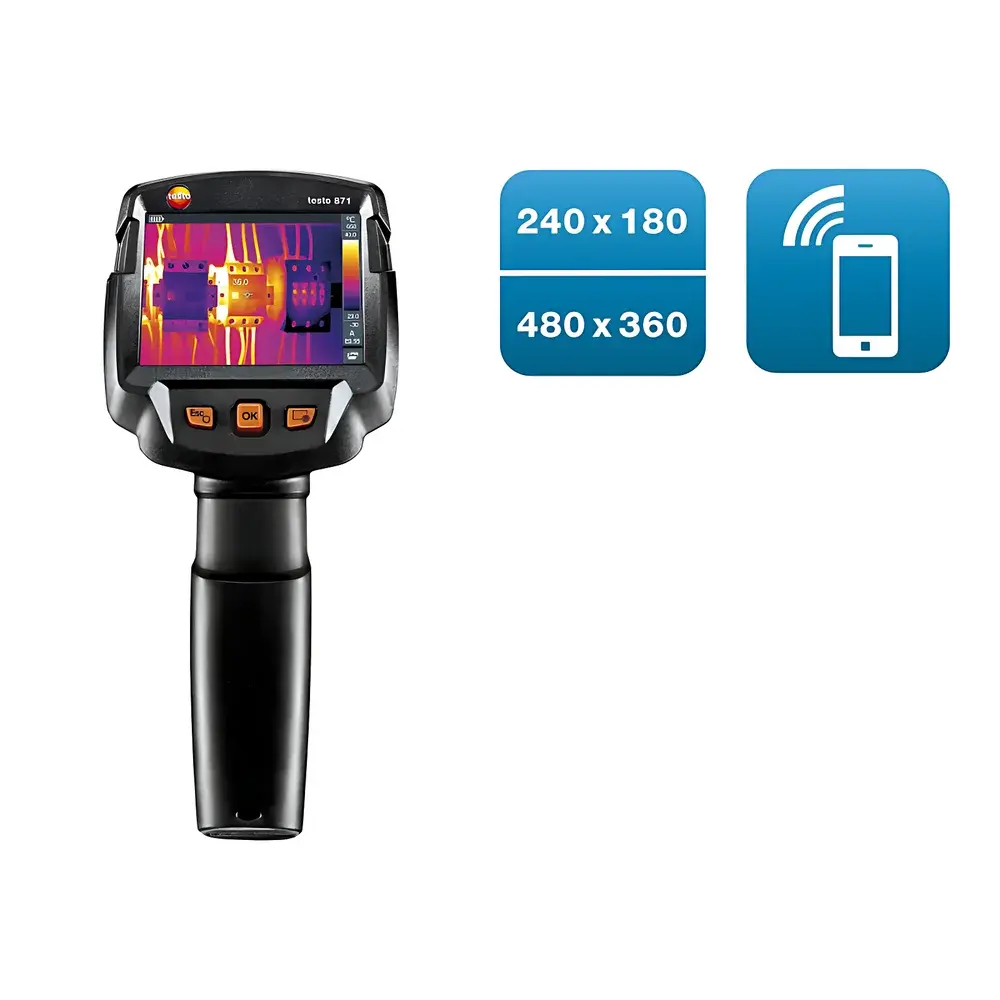
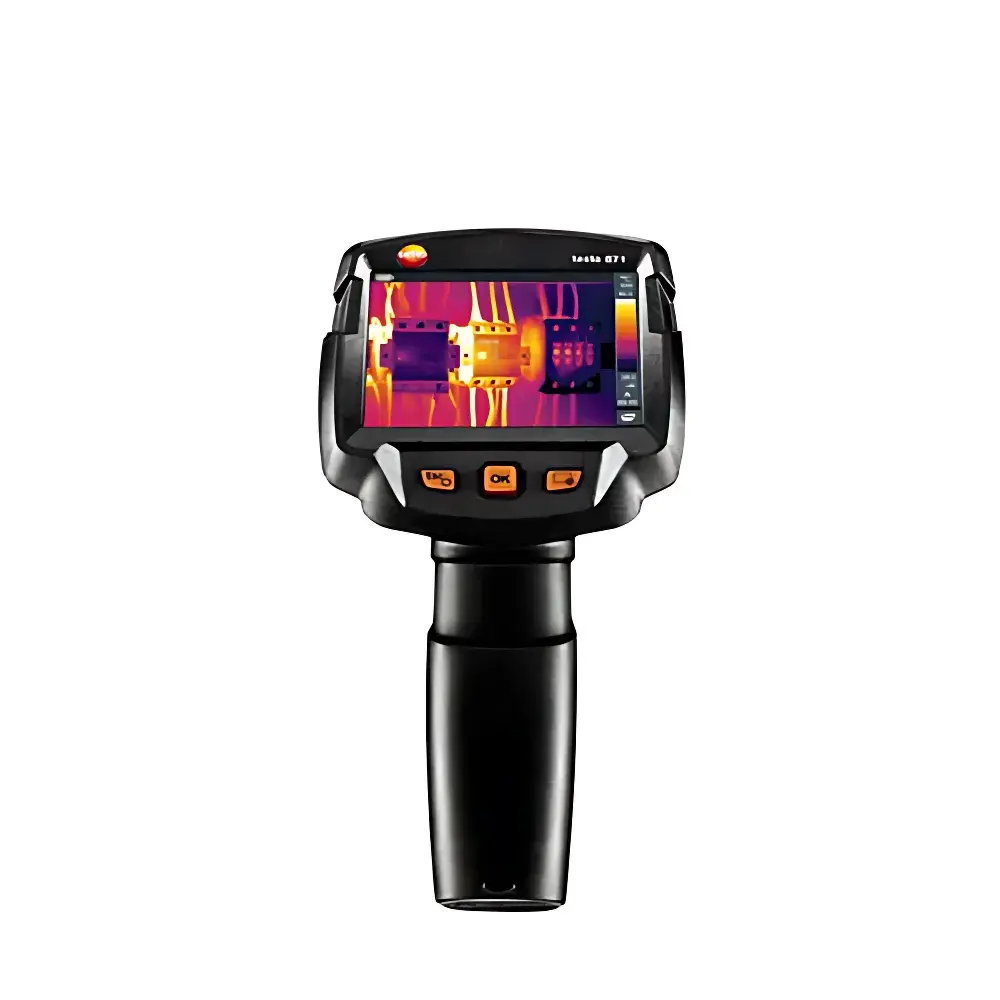
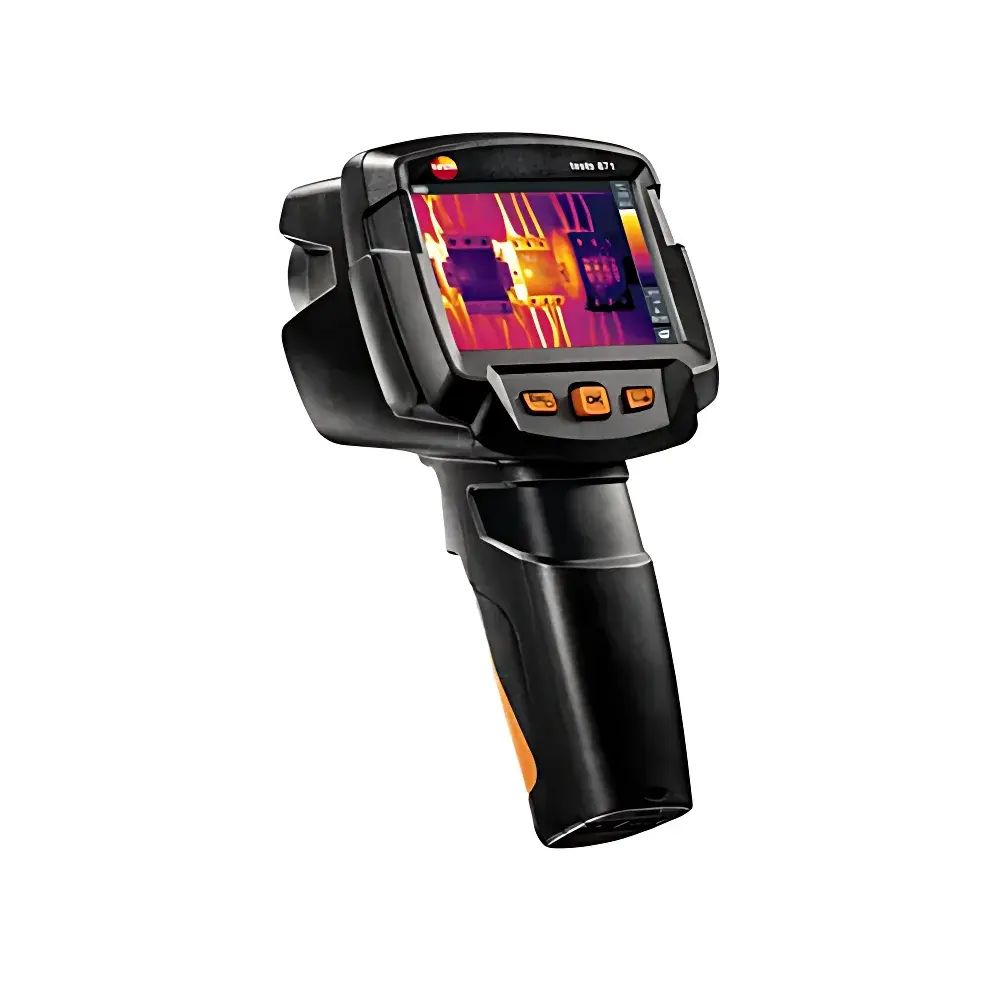
testo 871 Advanced Infrared Thermal Imaging Camera (240 × 180 IR Pixels)
| Brand | testo |
|---|---|
| Origin | Germany |
| Model | 0560 8712 |
| Detector Type | Scanning Focal Plane Array |
| Spectral Range | 7.5–14 µm |
| IR Resolution | 240 × 180 pixels |
| SuperResolution (via testo PixelBoost) | 480 × 360 pixels |
| Thermal Sensitivity (NETD) | ≤ 0.09 °C |
| Field of View | 35° × 26° |
| IFOV | 2.6 mrad (standard), 1.6 mrad (with PixelBoost) |
| Frame Rate | 9 Hz |
| Focus | Fixed-focus lens (min. distance < 0.5 m) |
| Temperature Range | −30 to +100 °C |
| Accuracy | ±2 °C or ±2 % of reading (whichever is greater) |
| Emissivity Adjustment | 0.01–1.00, with ε-Assist automatic calibration |
| Reflective Temperature Compensation | RTC-assisted |
| Measurement Modes | Hot/Cold Spot Detection, ΔT, Area Avg, Solar Mode |
| Image Output | IR + visible-light overlay (≥3.1 MP digital camera) |
| Display | 3.5″ LCD, 320 × 240 px |
| Storage | Internal 2.8 GB (BMT, JPEG, PNG, BMP, CSV, XLS) |
| Connectivity | Bluetooth 4.2 + Wi-Fi (IEEE 802.11 b/g/n), USB 2.0 Micro-B |
| Environmental Rating | IP54 |
| Operating Temp. | −15 to +50 °C |
| Battery Life | Up to 4 h (rechargeable Li-ion) |
| Compliance | RED Directive 2014/53/EU, EMC Directive 2014/30/EU |
Overview
The testo 871 Advanced Infrared Thermal Imaging Camera is a professional-grade, non-contact thermographic instrument engineered for precision diagnostics in building science, electrical maintenance, HVAC commissioning, and industrial preventive maintenance. Utilizing uncooled microbolometer technology operating within the long-wave infrared (LWIR) spectral band (7.5–14 µm), the device captures thermal radiation emitted from surfaces and converts it into high-fidelity temperature maps. Its core detector delivers native infrared resolution of 240 × 180 pixels—equivalent to 43,200 independent measurement points per frame—and leverages testo’s proprietary PixelBoost algorithm to synthetically enhance spatial resolution to 480 × 360 pixels, significantly improving edge definition and defect localization without compromising measurement integrity. With a thermal sensitivity (NETD) of ≤ 0.09 °C and fixed-focus optics optimized for working distances down to 0.5 m, the testo 871 ensures reproducible, field-deployable performance under variable ambient conditions.
Key Features
- Integrated dual-sensor architecture: Simultaneous capture of LWIR thermal data and ≥3.1 MP visible-light imagery for precise georeferencing and contextual annotation.
- Intelligent on-device assistance tools: ε-Assist automatically determines optimal emissivity and reflected apparent temperature (RTC) based on surface geometry and ambient conditions; ScaleAssist dynamically adjusts color scale contrast to maximize thermal gradient visibility—critical for building envelope analysis and insulation assessment.
- IFOV (Instant Field of View) indicator overlays real-time measurement spot size directly onto the thermal image, preventing misinterpretation due to distance-related spatial averaging errors.
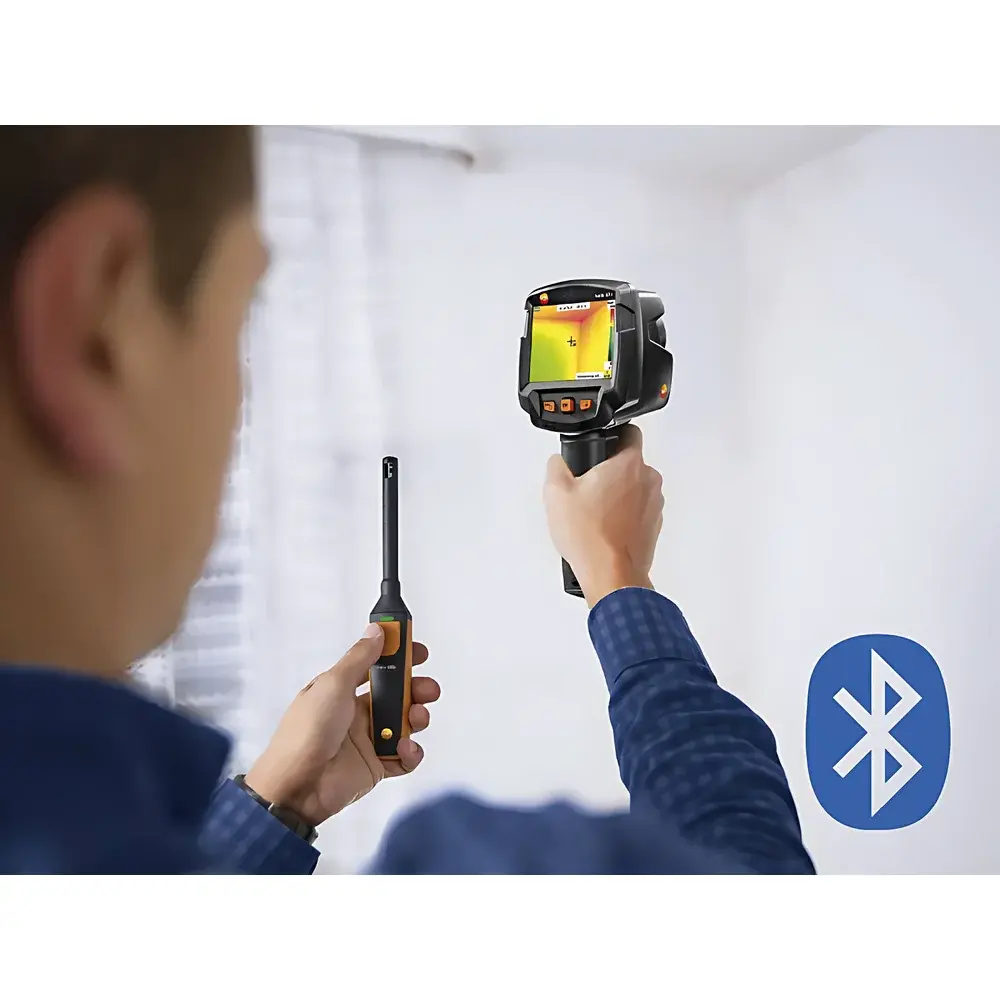
- Dual-band wireless connectivity: Bluetooth 4.2 and IEEE 802.11 b/g/n enable secure pairing with iOS/Android mobile devices running the official testo Thermography App, supporting remote control, live streaming, and synchronized multi-sensor data fusion.
- Modular interoperability: Seamless wireless integration with testo 770-3 clamp meter (for simultaneous current/voltage/power overlay on thermal images) and testo 605i hygrometer (for concurrent ambient humidity and air temperature input during moisture risk evaluation).
- Ruggedized industrial design: IP54-rated enclosure, ABS/PC housing (219 × 96 × 95 mm), 510 g mass, and −15 to +50 °C operational range ensure reliability across indoor and outdoor inspection environments.
Sample Compatibility & Compliance
The testo 871 is designed for non-destructive, surface-temperature evaluation of diverse material classes—including concrete, plasterboard, metal cladding, PVC piping, electrical busbars, and composite roofing membranes—without requiring surface preparation or contact. It complies fully with EU regulatory frameworks: Radio Equipment Directive (RED) 2014/53/EU and Electromagnetic Compatibility (EMC) Directive 2014/30/EU. While not certified to ISO/IEC 17025 or ASTM E1934 for metrological traceability in accredited laboratories, its measurement accuracy (±2 °C or ±2 % of reading) aligns with common field-service requirements defined in ASTM C1060 (Standard Practice for Thermographic Inspection of Insulation Installations), ISO 6781-3 (Building components — Qualitative detection of thermal irregularities), and EN 13187 (Thermal performance of buildings — Qualitative detection of thermal irregularities). The device supports GLP-aligned documentation workflows through timestamped, geo-tagged image export and audit-ready report generation.
Software & Data Management
Thermal imaging data is managed via two complementary platforms: the cloud-enabled testo Thermography App (iOS/Android) and desktop-based IRSoft Professional (Windows 10/8/7). The mobile app enables real-time image acquisition, annotation, hotspot/coldspot marking, emissivity correction, and one-click PDF report generation with embedded metadata (GPS coordinates, ambient conditions, operator ID). All reports comply with internal QA protocols and can be exported in PDF, JPEG, PNG, BMP, CSV, or XLS formats. IRSoft extends analytical capabilities with advanced post-processing functions—including line profiles, isotherm mapping, emissivity masking, and comparative delta-T analysis across time-series datasets. Both platforms enforce immutable data integrity: no image or measurement parameter can be altered post-capture without generating a new file hash. While the system does not implement FDA 21 CFR Part 11 electronic signature controls, its audit trail functionality—including user login logs, timestamped edits, and version history—supports GxP-aligned documentation practices where required.
Applications
The testo 871 serves as a primary diagnostic tool across multiple technical disciplines. In building diagnostics, it identifies thermal bridges, missing insulation, air leakage paths, and latent moisture accumulation correlated with mold risk. For electrical infrastructure, it detects overloaded connections, imbalanced phase loads, and deteriorating terminations prior to failure—particularly when fused with real-time current data from the testo 770-3. In mechanical systems, it verifies heat exchanger efficiency, refractory integrity, steam trap operation, and bearing temperature anomalies. HVAC technicians use it to assess duct leakage, coil fouling, and zoning performance. Its portability, rapid startup (< 5 s), and intuitive interface make it suitable for first-response inspections, third-party energy audits, and in-house predictive maintenance programs governed by ISO 55001 asset management standards.
FAQ
What is the effective spatial resolution at 1 meter distance?
At 1 m, the standard IFOV (2.6 mrad) yields a minimum resolvable spot size of approximately 2.6 mm; with PixelBoost active (1.6 mrad), this improves to ~1.6 mm.
Does the device support radiometric video recording?
No—the testo 871 captures still-frame radiometric images only; video output is non-radiometric (live preview stream).
Can emissivity be locked per material type?
Yes—users may save and recall up to 10 custom emissivity presets, each associated with material category (e.g., oxidized steel, painted drywall, PVC) and surface condition.
Is external power supply supported during extended field use?
Yes—AC adapter operation is supported concurrently with battery charging, enabling uninterrupted operation during prolonged inspections.
How is calibration traceability documented?
Each unit ships with an EU-accredited factory calibration certificate referencing DIN EN ISO/IEC 17025 procedures; recalibration is recommended every 24 months or after mechanical shock.



