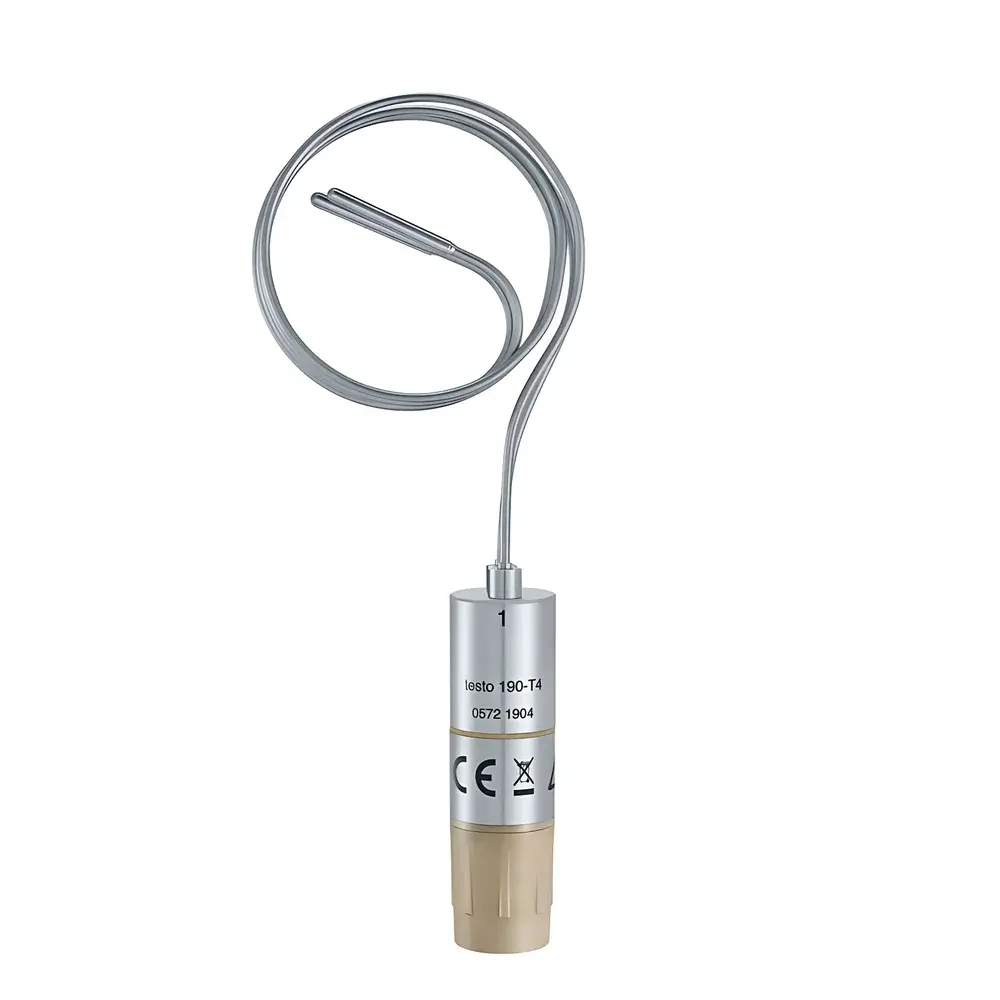

testo 190-T4 CFR Temperature Data Logger with Two Flexible Long Probes
| Brand | testo |
|---|---|
| Origin | Germany |
| Model | 0572 1904 |
| Probe Length | 775 mm (each) |
| Probe Diameter | 1.5 mm |
| Operating Temperature Range | -50 °C to +140 °C |
| Measurement Accuracy | ±0.1 °C (-40 °C to +140 °C), ±0.2 °C (-50 °C to -40 °C) |
| Resolution | 0.01 °C |
| Response Time (t₉₀) | 6 s |
| Memory Capacity | 30,000 readings per channel |
| IP Rating | IP68 |
| Enclosure Material | Stainless steel housing with PEEK battery cap |
| Battery | 1/2 AA lithium |
| Battery Life | 2,500 h (10 s sampling at +121 °C) |
| Dimensions | Ø20 × 72 mm |
| Compliance | Designed for FDA 21 CFR Part 11–compliant validation workflows |
Overview
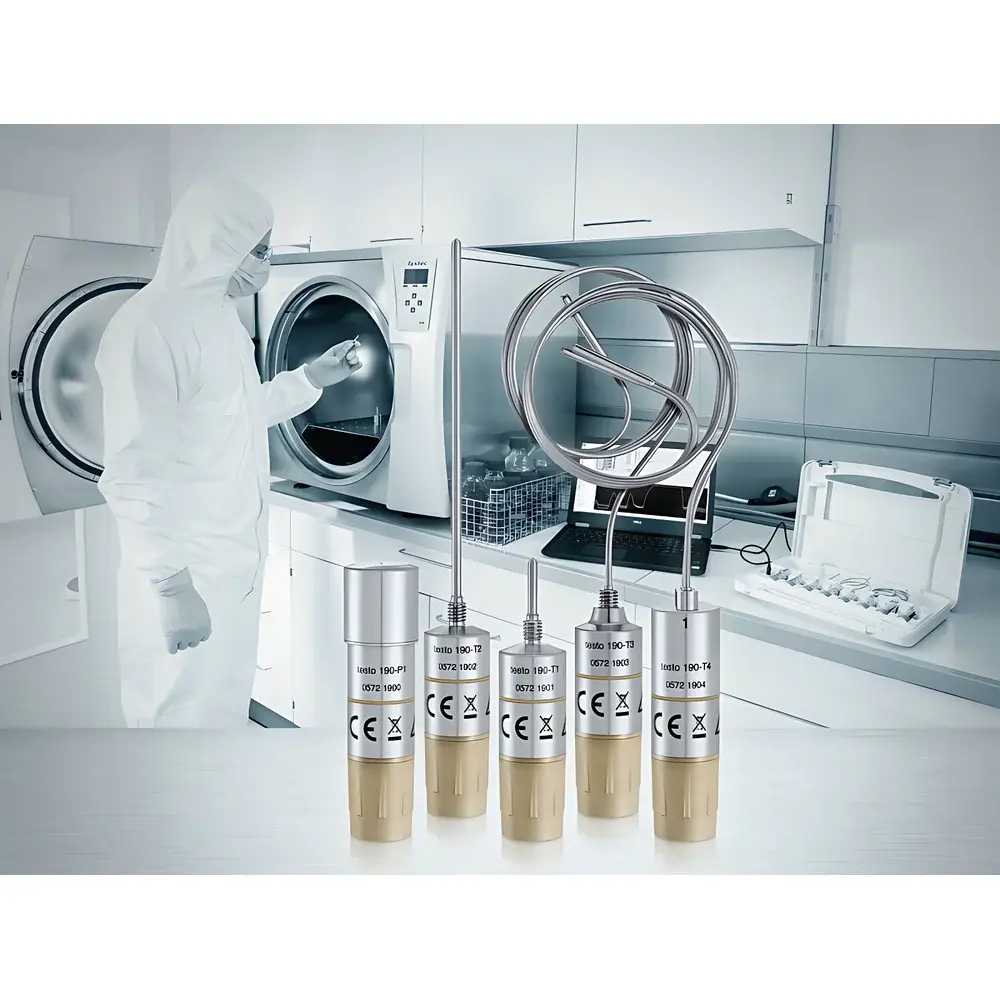
The testo 190-T4 CFR Temperature Data Logger is an FDA-compliant, Class I medical device-grade validation instrument engineered specifically for critical thermal process monitoring in regulated pharmaceutical manufacturing environments. It operates on the principle of high-stability Pt1000 resistance temperature detection, delivering traceable, NIST-traceable (via included calibration certificate) measurements across a wide operational range of –50 °C to +140 °C. Its dual-channel architecture—paired with two independently calibrated, ultra-thin (Ø1.5 mm), 775 mm flexible stainless-steel probe sheaths—enables simultaneous core and surface temperature profiling in autoclaves, lyophilizers, sterilization trays, and vessel jackets. The device meets the stringent physical and data integrity requirements of Annex 1 (EU GMP), ISO 13485, and USP , supporting both installation qualification (IQ), operational qualification (OQ), and performance qualification (PQ) protocols. Its compact cylindrical form factor (Ø20 × 72 mm) ensures unobtrusive placement in confined geometries—including lyophilizer shelves, filter housings, and narrow tubing manifolds—without perturbing thermal mass or airflow dynamics.
Key Features
- Dual independent Pt1000 sensor channels with factory-calibrated accuracy of ±0.1 °C from –40 °C to +140 °C and ±0.2 °C at cryogenic temperatures down to –50 °C
- Two 775 mm flexible stainless-steel probe sheaths (Ø1.5 mm) with 3 mm spherical tip geometry, optimized for rapid thermal response (t₉₀ ≤ 6 s) and mechanical resilience during repeated steam sterilization cycles
- Hermetically sealed stainless-steel main body with PEEK-coated, tool-free rotating battery cap—maintains full IP68 ingress protection even after battery replacement
- Modular battery configuration: supports both compact 1/2 AA lithium cells (for space-constrained deployments) and extended-life variants (included) for low-temperature freeze-dry monitoring
- On-device memory capacity of 30,000 timestamped readings per channel, with user-configurable logging intervals from 1 second to 24 hours
- Integrated real-time clock with ±10 ppm stability over –20 °C to +50 °C storage range, ensuring audit-ready time synchronization without external GPS or network dependency
Sample Compatibility & Compliance
The testo 190-T4 is validated for direct contact with stainless-steel surfaces, silicone gaskets, aluminum heat-transfer plates, and pharmaceutical-grade elastomers used in lyophilization chambers and SIP systems. Its PEEK-coated battery cap and passivated 316L stainless-steel housing withstand repeated exposure to saturated steam (121 °C, 15–30 min), hydrogen peroxide vapor (VHP), and ethylene oxide (EtO) sterilization cycles. All firmware and hardware design elements conform to IEC 62304 (Class B), and the device is CE-marked under the EU Medical Device Regulation (MDR 2017/745). When paired with the optional testo 190 CFR software, it fully satisfies FDA 21 CFR Part 11 requirements—including electronic signatures, audit trails with immutable timestamps, role-based access control, and data encryption (AES-256) during transfer and archival.
Software & Data Management
Data acquisition, configuration, and reporting are managed exclusively through the testo 190 CFR software—a validated, 21 CFR Part 11–compliant application designed for GxP-regulated laboratories. The software enables batch-level parameter assignment (e.g., start/stop triggers, alarm thresholds, linearization corrections), parallel readout and programming of up to eight 190-T4 units via the multifunctional docking station, and automated generation of IQ/OQ/PQ-compliant PDF reports with embedded metadata (device ID, calibration status, operator signature, environmental conditions). Audit trail records capture every user action—including configuration changes, data export events, and report generation—with tamper-proof hashing and retention for ≥25 years per ALCOA+ principles. Raw .tdf files are stored in vendor-neutral, open-format binary structures compatible with third-party LIMS and MES integrations.
Applications
- Steam sterilization cycle mapping in autoclaves and SIP systems (ISO 17665-1)
- Lyophilizer shelf temperature uniformity and chamber mapping (USP , PDA TR 60)
- Freeze-drying product temperature profiling using thermocouple-compatible probe adapters
- Validation of cold chain logistics containers and ultra-low temperature freezers (–80 °C)
- Thermal load studies for depyrogenation tunnels and dry-heat ovens
- Environmental monitoring of cleanroom HVAC ductwork and HEPA filter banks
FAQ
Is the testo 190-T4 compliant with FDA 21 CFR Part 11 out of the box?
Yes—when used with the validated testo 190 CFR software and configured according to the manufacturer’s documented setup procedures, the system fulfills all technical and procedural requirements for electronic records and signatures.
Can the probes be autoclaved repeatedly without degradation?
Yes—the 775 mm flexible probes are constructed from medical-grade stainless steel and rated for ≥1,000 cycles of saturated steam sterilization at 121 °C.
What is the maximum allowable logging interval for long-term stability studies?
The device supports configurable intervals from 1 second to 24 hours; for accelerated stability testing per ICH Q1, typical configurations use 1–5 minute intervals with full memory retention for >20 days.
Does the unit require annual recalibration?
Per ISO/IEC 17025 and internal quality agreements, testo recommends recalibration every 12 months—or before each critical validation campaign—using accredited reference standards traceable to national metrology institutes.
How is battery replacement performed without compromising data integrity or seal integrity?
The PEEK-coated rotating cap employs a dual O-ring sealing system; torque verification marks and tactile feedback ensure proper resealing, and the device automatically logs battery replacement events with timestamps and operator IDs in the audit trail.