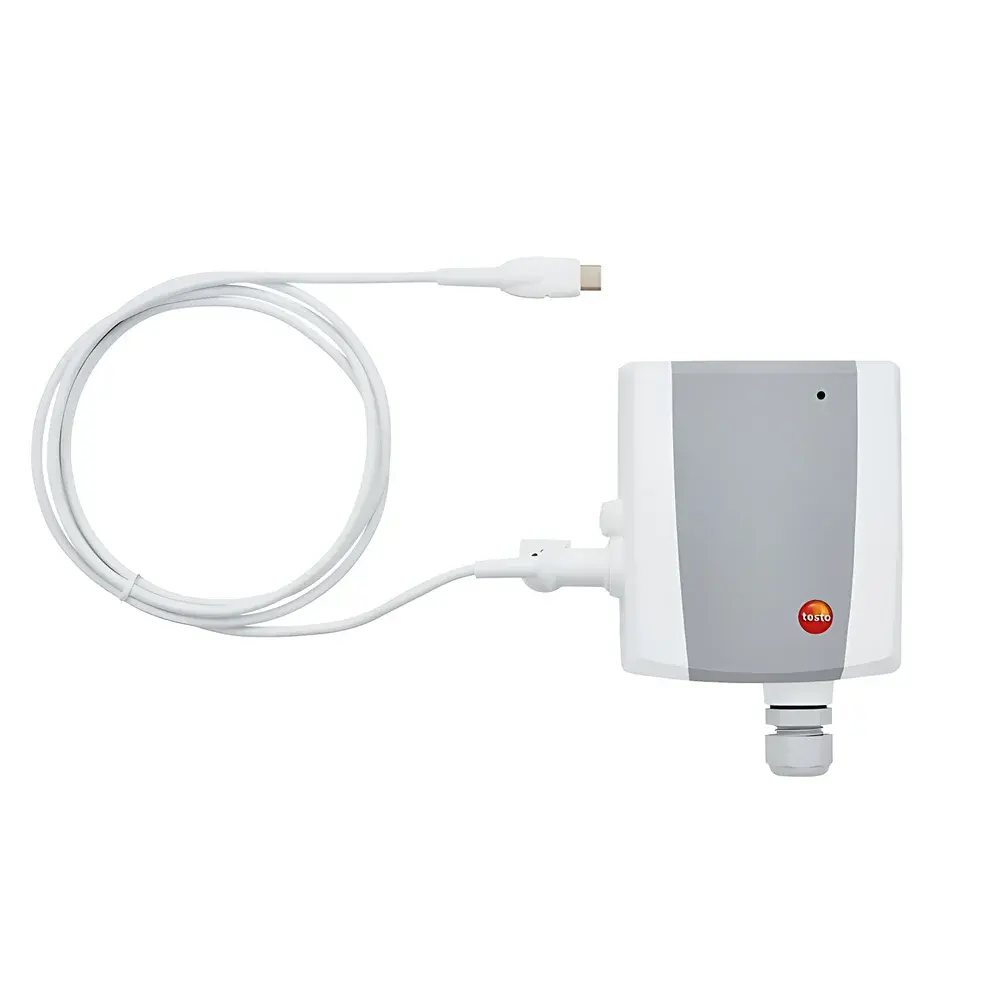
Testo Digital-Analog Coupler 0572 2166 for Saveris Pharma Environmental Monitoring System
| Brand | Testo |
|---|---|
| Origin | Germany |
| Model | 0572 2166 |
| Input Interface | 4–20 mA / 0–10 V analog signals |
| Output Interface | Digital communication via TUC bus to testo 150 TUC4 Data Logger |
| Channel Capacity | Multi-channel (up to 8 analog inputs per coupler) |
| Compliance | Designed for GxP environments, supports audit trail-ready data acquisition per FDA 21 CFR Part 11 and EU Annex 11 requirements |
| Integration | Native component of testo Saveris Pharma platform |
| Communication | WLAN, LAN, or UltraRange radio-enabled via connected testo 150 TUC4 unit |
Overview
The Testo Digital-Analog Coupler 0572 2166 is a precision signal interface module engineered for seamless integration of third-party analog sensors into the testo Saveris Pharma environmental monitoring ecosystem. It operates on the principle of high-fidelity analog-to-digital conversion, accepting standardized industrial current (4–20 mA) and voltage (0–10 V) signals from external transmitters—such as differential pressure, CO₂, airflow, or relative humidity sensors—and converting them into calibrated, time-stamped digital values. These values are transmitted via the proprietary TUC (Testo Universal Coupling) bus protocol to the testo 150 TUC4 data logger, enabling synchronized, multi-parameter logging across distributed monitoring points. Unlike generic signal conditioners, the 0572 2166 is fully validated within the Saveris Pharma architecture, ensuring traceable calibration paths, deterministic sampling intervals, and deterministic latency—critical attributes for regulated pharmaceutical, biotech, and medical device manufacturing environments governed by ISO 14644, EU GMP Annex 1, and USP .
Key Features
- Native TUC bus compatibility with testo 150 TUC4—no firmware modification or custom configuration required
- Simultaneous support for up to eight independent analog input channels (4–20 mA or 0–10 V), each configurable with user-defined engineering units and scaling factors
- Integrated cold-junction compensation and 16-bit ADC resolution for stable signal digitization under varying ambient conditions
- Galvanic isolation between analog inputs and TUC bus interface, minimizing ground-loop interference in electrically noisy production facilities
- Pre-validated hardware design compliant with IEC 61000-6-2 (immunity) and IEC 61000-6-4 (emission) standards
- Zero-drift calibration retention over temperature range –10 °C to +50 °C, verified per EN 60751 Class B specifications
Sample Compatibility & Compliance
The 0572 2166 couples seamlessly with any transmitter outputting industry-standard analog signals—including but not limited to Vaisala HMP series, Sensirion SCD4x CO₂ modules, Setra 230 differential pressure transducers, and Honeywell HIH-4000 humidity sensors. As a core subsystem of the testo Saveris Pharma platform, it inherits full compliance with regulatory frameworks governing data integrity: raw analog-to-digital conversion timestamps are cryptographically signed and stored with immutable metadata; all configuration changes generate electronic audit trails meeting FDA 21 CFR Part 11 Subpart B requirements; and system-level validation documentation (IQ/OQ/PQ protocols, risk assessments per ISO 14971) is provided by testo upon request. The coupler itself carries CE marking, RoHS compliance, and is manufactured in testo’s ISO 9001-certified facility in Lenzkirch, Germany.
Software & Data Management
Data from the 0572 2166 flows directly into the Saveris Cloud-based software suite without intermediate gateways or protocol translation layers. Each analog channel appears as a native sensor object with configurable alarm thresholds, hysteresis settings, and statistical process control (SPC) parameters—including moving averages, standard deviation bands, and trend detection algorithms. All data is stored in encrypted, tamper-evident containers with SHA-256 hashing and versioned backups retained for ≥30 days. Role-based access control (RBAC), electronic signatures for critical actions (e.g., alarm acknowledgment, calibration verification), and automated report generation (PDF/CSV) aligned with ALCOA+ principles are natively supported. Exported datasets include embedded metadata describing sensor type, calibration certificate ID, TUC bus address, and coupler firmware revision—ensuring full analytical traceability.
Applications
- Continuous environmental monitoring of Grade A/B cleanrooms per ISO 14644-1 and EU GMP Annex 1
- Real-time tracking of warehouse temperature excursions during pharmaceutical logistics (WHO Technical Report Series No. 961)
- Multi-point differential pressure mapping across HVAC systems to verify unidirectional airflow integrity
- CO₂ concentration trending in incubators and stability chambers for cell culture and accelerated aging studies
- Integration of legacy analog infrastructure into modern digital quality management systems (QMS) without sensor replacement
FAQ
Does the 0572 2166 require separate power supply?
No—it draws operating power directly from the TUC bus via the testo 150 TUC4 logger.
Can multiple 0572 2166 units be daisy-chained on one TUC bus?
Yes—up to 16 couplers can be addressed uniquely on a single TUC segment, supporting scalable deployments across large facilities.
Is firmware update capability available remotely?
Firmware updates are performed exclusively through the Saveris Cloud interface and require administrative authentication; no local USB or serial access is provided to maintain security boundaries.
What is the maximum allowable cable length between the coupler and analog transmitter?
For 4–20 mA loops, maximum recommended distance is 300 m using shielded twisted-pair cable (AWG 22); voltage inputs are limited to 30 m to minimize noise coupling.
How is calibration traceability maintained for analog input channels?
Each coupler ships with a factory calibration certificate referencing national metrology institute (PTB) standards; field recalibration is performed using testo’s certified reference calibrators (e.g., testo 175-T3) and documented within the Saveris audit trail.