
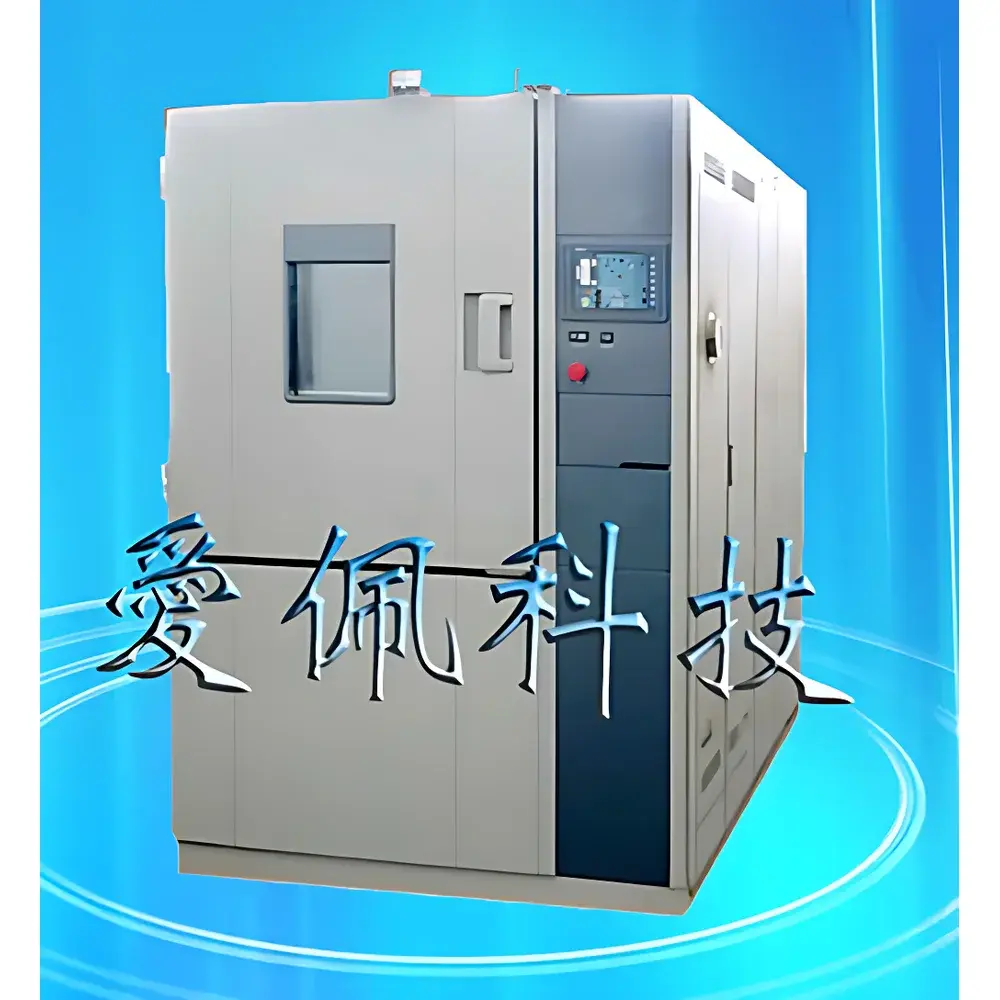
Apkji AP-KS-B1 Mobile Rapid Thermal Cycling Chamber
| Brand | Apkji |
|---|---|
| Origin | Guangdong, China |
| Manufacturer Type | OEM/ODM Manufacturer |
| Country of Origin | China |
| Model | AP-KS-B1 |
| Pricing | Upon Request |
| Temperature Range | −85 °C to +150 °C (configurable variants: −60/−50/−40/−20 °C to +150 °C) |
| Thermal Ramp Rate | 2–15 °C/min (linear or non-linear average) |
| Temperature Uniformity | ±1.5 °C |
| Temperature Stability | ±0.5 °C |
| Temperature Deviation | ≤±2 °C |
| Internal Volume Options | 80–1000 L |
| Internal Material | SUS304 mirror-finish stainless steel |
| Insulation | Polyurethane rigid foam + glass wool |
| Cooling System | Imported hermetic or semi-hermetic compressors (USA/EU origin), R404A/R23 zero-ozone-depletion refrigerant |
| Heating System | Stainless steel finned-tube heaters |
| Air Circulation | Dual-axis adjustable centrifugal blower with horizontal/vertical louvered ducting |
| Controller | TEMI 880 or OYO 7756 color touch-screen PID controller (100 programs × 1000 segments, 999 cycles/segment, adjustable backlight, GLP-compliant audit trail optional) |
| Compliance | GB/T 2423.1, GB/T 2423.2, GB/T 2423.22, IEC 60068-2-1, IEC 60068-2-2, IEC 60068-2-14, GJB 1032 |
Overview
The Apkji AP-KS-B1 Mobile Rapid Thermal Cycling Chamber is an engineered environmental test system designed for high-fidelity thermal shock and rapid temperature transition testing in compliance with international reliability qualification standards. It operates on the principle of forced-air convection with precision-controlled dual-stage refrigeration and resistive heating, enabling programmable linear or non-linear thermal profiles across a wide operational envelope (−85 °C to +150 °C). Unlike stationary walk-in chambers, the AP-KS-B1 integrates structural mobility—equipped with heavy-duty casters, reinforced base frame (standardized angle iron and channel steel), and compact footprint—making it suitable for cross-lab deployment, production line integration, and field-based stress screening without permanent installation. Its primary function is to assess product resilience under accelerated thermal transients, simulating real-world operational extremes encountered during aerospace deployment, automotive under-hood cycling, military equipment storage-to-operation transitions, and electronics power-on/off thermal fatigue.
Key Features
- Modular mobile chassis with industrial-grade locking casters and anti-vibration base structure for safe relocation between test bays or manufacturing cells.
- Dual-axis adjustable centrifugal air distribution system with horizontal/vertical louvers ensures uniform airflow and eliminates thermal stratification—validated to ±1.5 °C spatial uniformity per IEC 60068-2-14 Annex B.
- Imported hermetic or semi-hermetic compressors (USA/EU-sourced), paired with R404A/R23 zero-ozone-depleting refrigerants and capillary tube-based automatic capacity modulation, deliver stable cooling performance and extended service life.
- SUS304 mirror-finish stainless steel interior chamber and reinforced outer casing (SUS304 or powder-coated cold-rolled steel) ensure corrosion resistance and long-term dimensional stability under repeated thermal cycling.
- Triple-layer heated vacuum-coated observation window (45 × 30 cm) with integrated high-luminance fluorescent lighting enables real-time visual monitoring without condensation interference—even at extreme dew-point differentials.
- Comprehensive multi-layer safety architecture: independent electronic overtemperature cut-off, compressor high-pressure/low-oil-pressure protection, phase-loss detection, dry-heater overcurrent interrupt, and fuseless overload sensing.
- Low-noise operation (≤65 dB(A) at 1 m) achieved via optimized blower acoustics, vibration-damped mounting, and acoustic insulation using PU rigid foam and glass wool composite layers.
Sample Compatibility & Compliance
The AP-KS-B1 accommodates test specimens ranging from PCB assemblies and automotive ECUs to medical device enclosures and aerospace avionics modules. Standard internal volumes span 80 L to 1000 L (AP-KS-80L through AP-KS-1000L), with customizable test port configurations (e.g., one 50 mm diameter port standard, expandable per user requirement). All models conform to mandatory environmental test standards including GB/T 2423.1 (cold), GB/T 2423.2 (dry heat), GB/T 2423.22 (temperature change), IEC 60068-2-1 (Test A), IEC 60068-2-2 (Test B), and IEC 60068-2-14 (Test N). The system supports Environment Stress Screening (ESS) per GJB 1032–90 and is compatible with MIL-STD-810H thermal shock methodology when configured with appropriate ramp rates and dwell times. Optional calibration documentation aligns with ISO/IEC 17025 traceability requirements.
Software & Data Management
Equipped with either the Korean TEMI 880 or Japanese OYO 7756 microprocessor-based controller, the AP-KS-B1 provides full graphical programming capability via a 5.7″ or 10.4″ color LCD touchscreen interface. Each unit stores up to 100 test programs, with 1000 programmable segments per program—each supporting independent ramp rate, dwell time (up to 99 h 59 min), cycle count (up to 999), and PID parameter tuning. Real-time data logging (temperature only, or optional humidity if hybrid model) is retained onboard with timestamped records. For regulated environments, optional firmware upgrades support 21 CFR Part 11-compliant electronic signatures, audit trails, and role-based access control—enabling use in FDA-regulated pharmaceutical stability studies or GMP-aligned component qualification workflows.
Applications
- Aerospace & defense: Thermal shock validation of flight-critical sensors, radar housings, and satellite subsystems per MIL-STD-810H Method 503.5.
- Automotive electronics: Accelerated life testing of ADAS controllers, battery management systems (BMS), and infotainment units under ISO 16750-4 thermal cycling profiles.
- Consumer electronics: Reliability screening of smartphones, wearables, and IoT gateways per JEDEC JESD22-A104 thermal cycling specifications.
- Medical devices: Verification of sterilization-resistant enclosures and diagnostic imaging components per IEC 60601-1 Clause 11.2.2 environmental testing requirements.
- Industrial automation: Qualification of PLCs, motor drives, and HMI panels operating in uncontrolled ambient conditions across seasonal extremes.
FAQ
What is the difference between thermal cycling and thermal shock testing?
Thermal cycling involves controlled, gradual transitions between defined temperature extremes with dwell periods; thermal shock uses near-instantaneous transfer between chambers or extreme ramp rates (>15 °C/min). The AP-KS-B1 supports both modes via programmable ramp rate selection and dwell configuration.
Can the AP-KS-B1 be integrated into an automated test cell?
Yes—standard RS485/Modbus RTU and optional Ethernet/IP or Profibus-DP interfaces enable seamless SCADA and MES integration for batch-level test orchestration and data aggregation.
Is remote monitoring supported?
With optional LAN-enabled controller firmware, users can access real-time chamber status, active profile data, alarm history, and export CSV logs via secure HTTPS web interface.
Does the system meet GLP/GMP documentation requirements?
When equipped with audit-trail-enabled firmware and calibrated per ISO/IEC 17025-accredited procedures, the AP-KS-B1 satisfies GLP Annex 3 and GMP Annex 11 data integrity expectations for regulated testing environments.
What maintenance intervals are recommended for long-term reliability?
Compressor oil analysis every 2,000 operating hours, refrigerant leak inspection annually, air filter replacement quarterly, and full system calibration biannually—per Apkji’s documented Maintenance Protocol AP-MP-004.



