
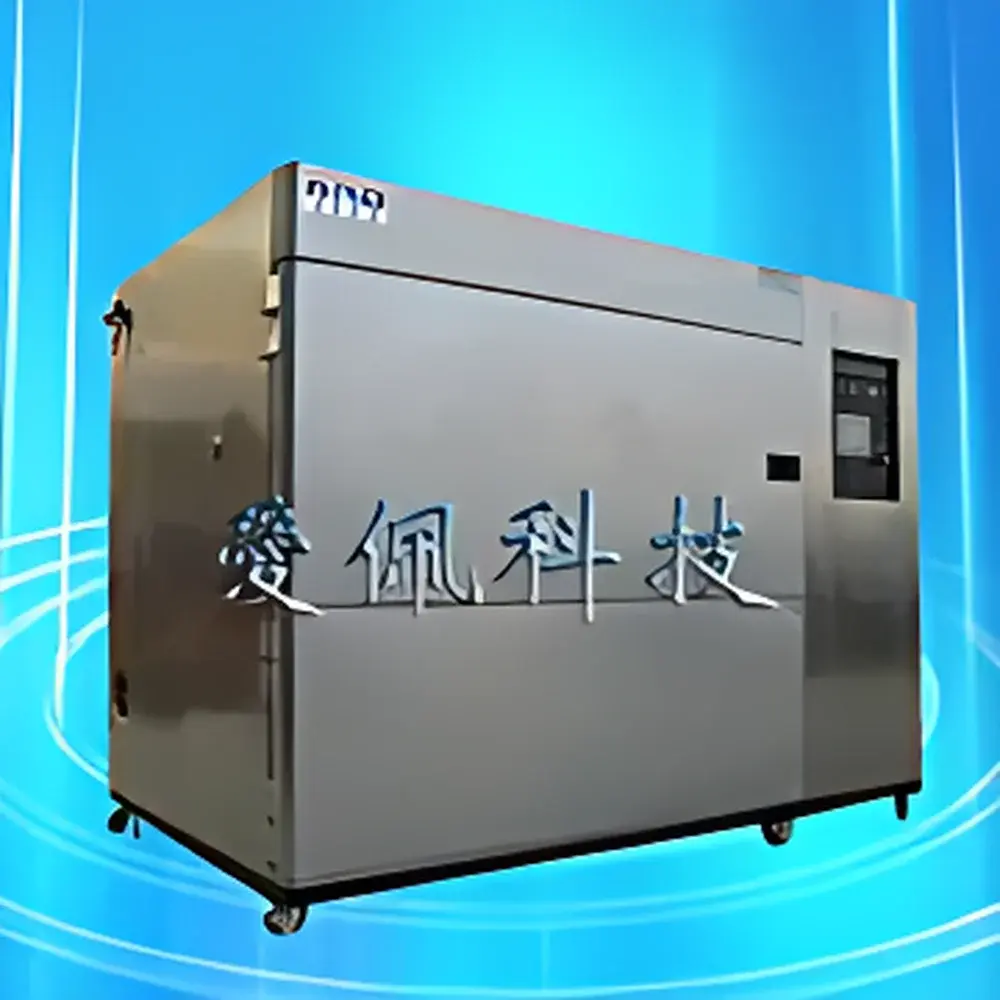
APKJ AP-CJ-10 Three-Zone Thermal Shock Test Chamber
| Brand | APKJ |
|---|---|
| Origin | Guangdong, China |
| Manufacturer Type | Manufacturer |
| Product Category | Domestic |
| Model | AP-CJ-10 |
| Pricing | Upon Request |
Overview
The APKJ AP-CJ-10 Three-Zone Thermal Shock Test Chamber is an engineered environmental test system designed for high-reliability thermal cycling validation of electronic components, automotive modules, polymer materials, and precision mechanical assemblies. It operates on a three-chamber architecture—comprising independent high-temperature, low-temperature, and test zones—to deliver rapid, repeatable, and precisely controlled thermal transitions without subjecting specimens to mechanical vibration or displacement. Unlike liquid-nitrogen-assisted systems, this chamber achieves thermal shock via pneumatic air-transfer switching between conditioned zones, eliminating occupational hazards associated with cryogenic gas handling (e.g., asphyxiation risk from LN₂ vapor accumulation) and reducing consumable dependency. The system conforms to core thermal shock testing principles defined in IEC 60068-2-14, MIL-STD-810H Method 503.7, and JESD22-A104, supporting both qualification and reliability screening protocols under GLP-compliant laboratory environments.
Key Features
- Three-zone segregated design: independent high-temp zone (up to +150 °C), low-temp zone (down to −70 °C), and static test chamber—ensuring zero specimen movement during transition
- 5.7″ TFT true-color LCD touchscreen controller with intuitive HMI interface, real-time PID auto-tuning, and energy-efficient operation
- Dual-stage cascade refrigeration system with imported high-efficiency compressors; water-cooled condensation for stable, rapid cooling performance
- Positive-pressure uniform airflow duct system achieving ±0.5 °C temperature uniformity across the test zone (per IEC 60068-3-5)
- Automated defrost cycle with programmable frequency and duration—reducing maintenance downtime and extending system uptime
- Comprehensive safety architecture: over-temperature, over-pressure, compressor discharge/liquid line protection, phase failure detection, and door interlock monitoring
- Full diagnostic logging: fault code display with contextual troubleshooting guidance, operational status visualization, and real-time temperature curve plotting
- Flexible test sequencing: supports up to 9999 cycles, individual dwell times per zone (0–999 hours), start-from-hot/cold selection, and scheduled activation
Sample Compatibility & Compliance
The AP-CJ-10 accommodates standard test specimens up to 300 mm × 300 mm × 300 mm (W×D×H) with dedicated external cable ports for powered or monitored devices under test (DUTs). Its static-test configuration meets requirements for semiconductor packaging qualification (JEDEC J-STD-020), PCB assembly stress testing (IPC-9701), and automotive electronics AEC-Q200 compliance verification. All thermal profiles are traceable and auditable—supporting 21 CFR Part 11-compliant electronic records when integrated with validated data acquisition software. The unit complies with CE marking directives (2014/30/EU EMC, 2014/35/EU LVD), RoHS 2011/65/EU, and ISO 17025-aligned calibration traceability pathways.
Software & Data Management
The embedded controller supports USB export of time-stamped temperature logs (CSV format), including setpoint, actual, deviation, and alarm timestamps. Optional Ethernet connectivity enables remote monitoring via Modbus TCP or custom SCADA integration. Audit trail functionality records all user actions—including parameter changes, cycle initiation, and manual defrost triggers—with operator ID and timestamp. For regulated environments, APKJ provides IQ/OQ documentation packages aligned with GMP Annex 15 and ISO/IEC 17025 requirements, including uncertainty budgets for temperature measurement (±0.3 °C at 23 °C, ±0.8 °C across full range).
Applications
- Failure mode analysis of solder joint integrity in BGA and QFN packages under repeated thermal expansion mismatch
- Qualification of conformal coatings and encapsulants for aerospace-grade avionics housings
- Evaluation of thermal fatigue resistance in MEMS sensors and optoelectronic modules
- Validation of adhesive bond strength in multi-material automotive lighting assemblies
- Reliability screening of lithium-ion battery cells and module-level thermal management interfaces
- Material science research on phase-transition behavior in shape-memory alloys and thermoplastic elastomers
FAQ
Does the AP-CJ-10 require liquid nitrogen or CO₂ for operation?
No. It utilizes a self-contained dual-refrigeration cascade system with forced-air thermal transfer—eliminating cryogen dependency, associated safety risks, and recurring consumable costs.
What is the maximum allowable test specimen weight and dimensional envelope?
The standard test chamber accommodates loads up to 20 kg with internal dimensions of 300 mm × 300 mm × 300 mm. Custom configurations support larger volumes upon request.
Can the system be integrated into an existing lab data management platform?
Yes. Native Modbus TCP support enables seamless integration with LabVantage, Thermo Fisher SampleManager, or custom MES environments. Full API documentation is provided with enterprise licensing.
Is calibration certification included with shipment?
A factory-issued NIST-traceable calibration report covering temperature uniformity, stability, and transition rate verification is supplied standard. UKAS-accredited third-party calibration is available as an optional service.
What maintenance intervals are recommended for long-term reliability?
Preventive maintenance is advised every 6 months, including refrigerant pressure verification, condenser coil cleaning, sensor validation, and safety circuit functional testing—all documented in the included maintenance logbook.



