
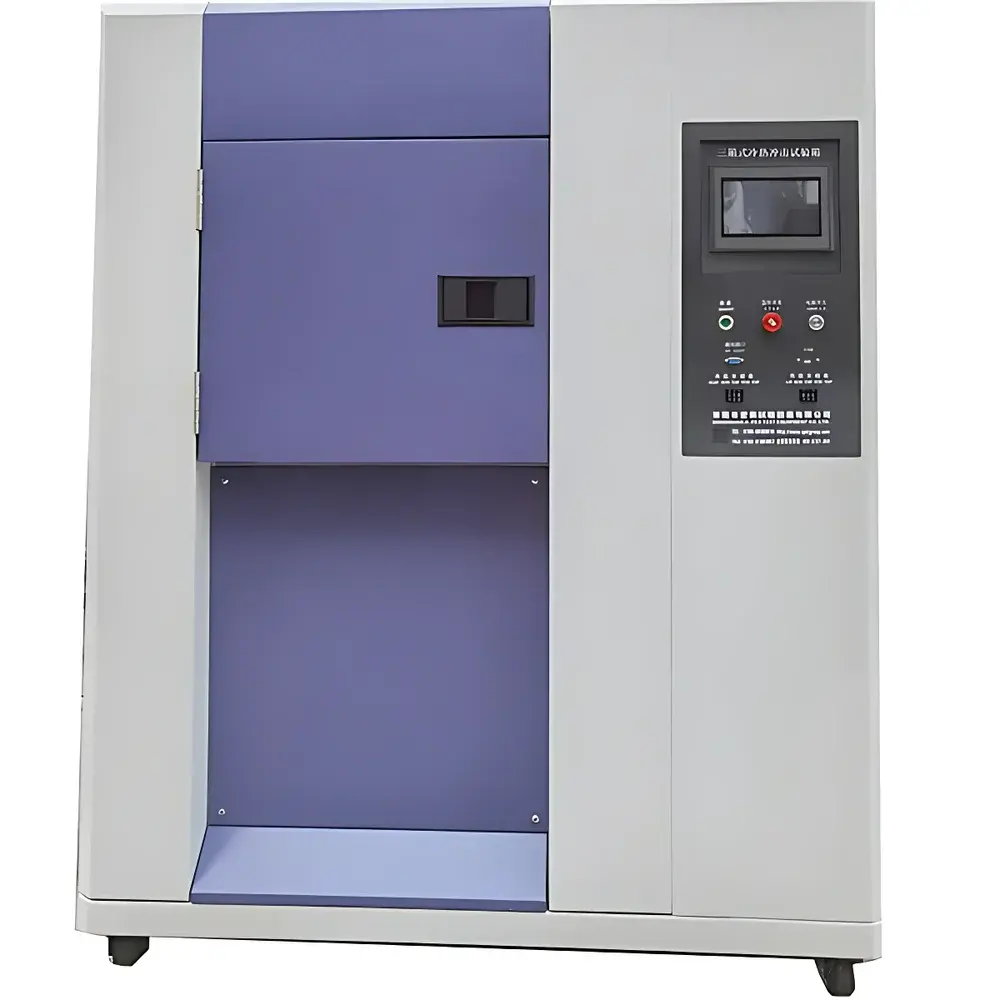
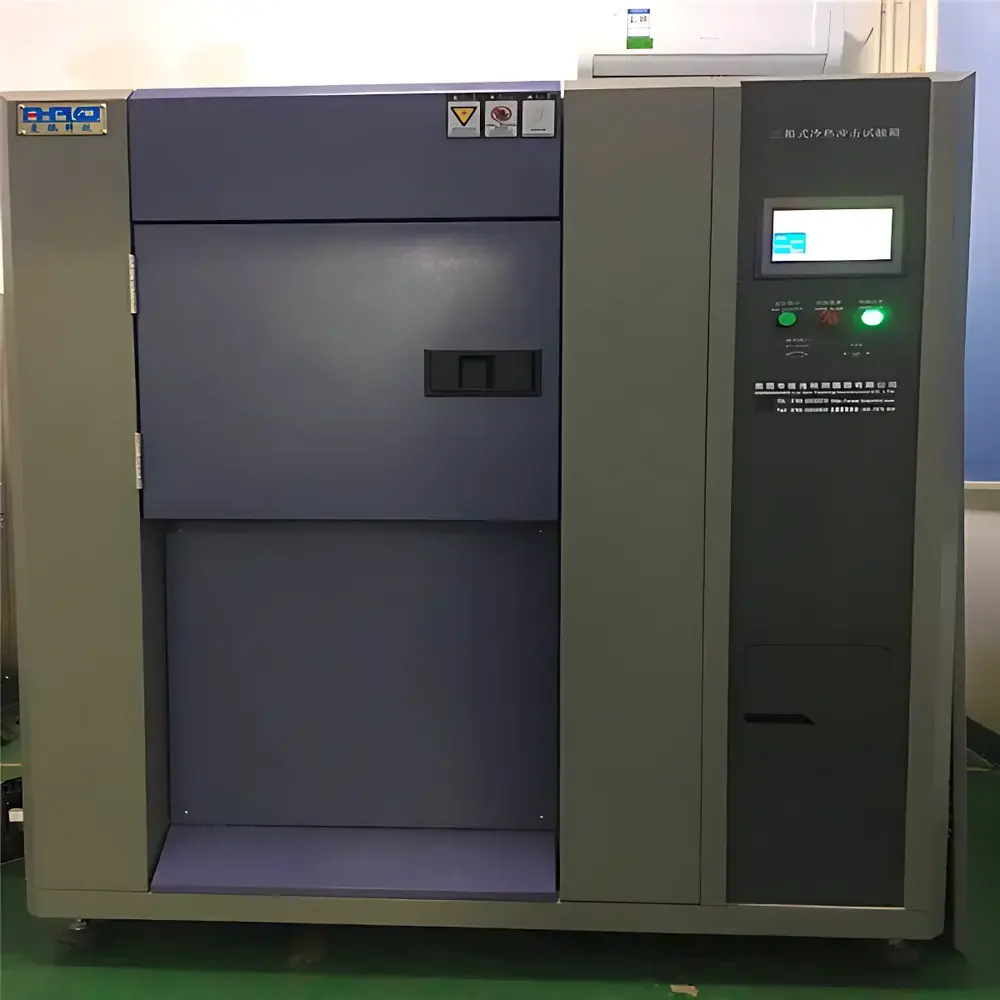
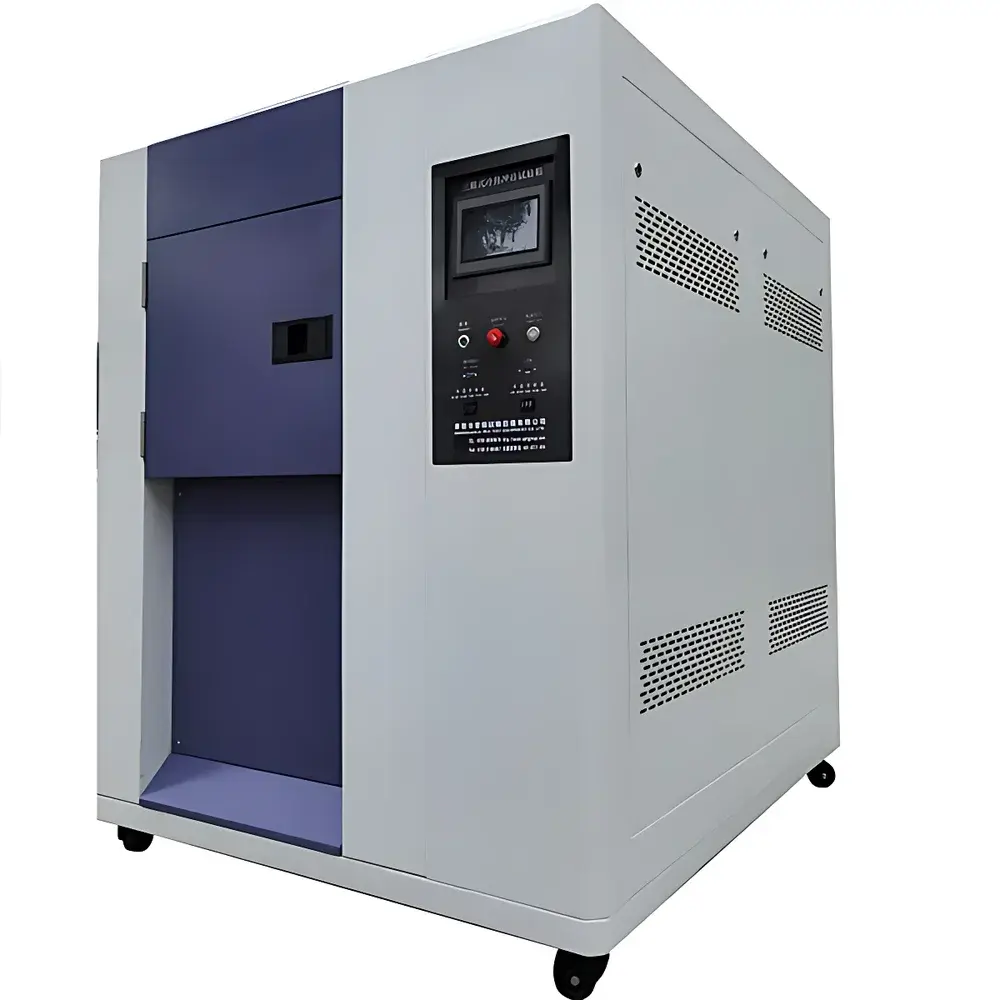
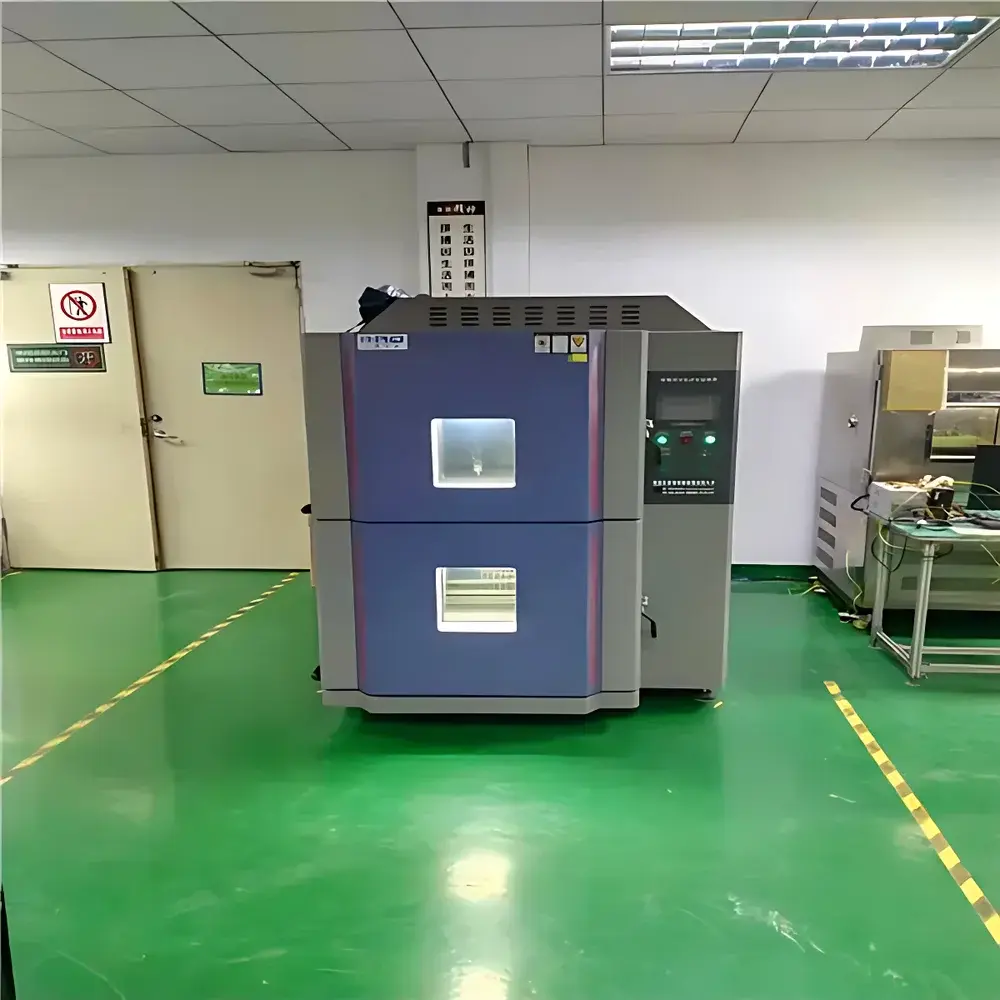
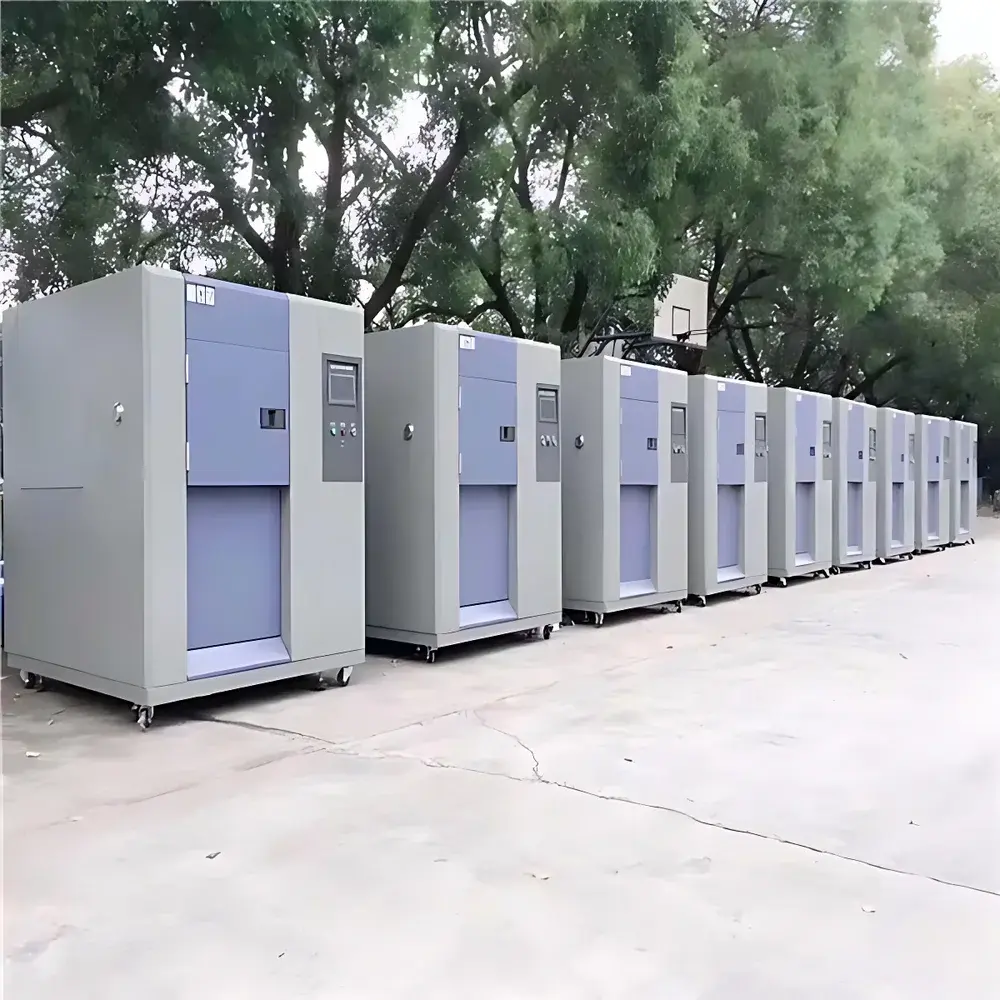
Apkji 3-Zone Thermal Shock Test Chamber AP-CJ-150C
| Brand | Apkji |
|---|---|
| Origin | Guangdong, China |
| Manufacturer Type | Direct Manufacturer |
| Model | AP-CJ-150C |
| High-Temperature Range | +60 °C to +180 °C |
| Low-Temperature Range | −20 °C to −75 °C |
| Thermal Shock Range | −65 °C to +150 °C |
| Temperature Stability | ±2.0 °C |
| Heating Rate | ≤5 °C/min |
| Cooling Rate | ≤5 °C/min |
| Internal Dimensions (W×H×D) | 500×600×500 mm |
| External Dimensions (W×H×D) | 1020×1470×1080 mm |
| Temperature Uniformity | ±2.0 °C |
| Temperature Fluctuation | ±0.5 °C |
| High-Temp Preheat Range | RT to +180 °C |
| Low-Temp Precool Range | RT to −75 °C |
| Temperature Recovery Time | ≤5 min |
| Transfer Time Between Zones | ≤10 s |
Overview
The Apkji AP-CJ-150C is a three-zone thermal shock test chamber engineered for high-fidelity evaluation of material and component reliability under rapid, repetitive temperature transitions. Unlike single- or dual-chamber systems, its dedicated hot, cold, and test zones operate independently—enabling precise, programmable exposure to extreme thermal gradients without cross-contamination or residual thermal inertia. The chamber employs a balanced temperature and humidity control (BTHC) system with PID-driven SSR output, ensuring stable setpoint maintenance across the full operational range of −65 °C to +150 °C. Designed in accordance with international environmental testing standards—including GB/T 2423.22 (IEC 60068-2-14), MIL-STD-810H Method 503.5, and JIS Z 8702—the AP-CJ-150C delivers repeatable thermal shock profiles essential for qualification testing in aerospace, automotive electronics, semiconductor packaging, and medical device manufacturing.
Key Features
- Triple independent zone architecture: isolated high-temperature (+180 °C max), low-temperature (−75 °C min), and ambient test chambers—eliminating thermal carryover and enabling true step-change shock profiles
- High-efficiency refrigeration system featuring imported semi-hermetic compressors and eco-friendly refrigerant (R404A/R23 cascade configuration), optimized for sustained operation at cryogenic conditions
- Insulation composed of rigid polyurethane foam (≥150 mm thickness) combined with glass wool layers—achieving thermal resistance >0.8 m²·K/W and minimizing external surface temperature rise
- Stainless steel #304 mirror-finish interior (electropolished grade) and powder-coated cold-rolled steel exterior—resistant to corrosion, condensation, and cleaning agents used in regulated labs
- Triple-layer vacuum-insulated observation window with low-emissivity coating and integrated energy-efficient fluorescent lighting—ensuring optical clarity without defogging or mechanical wipers
- Comprehensive safety suite including high-pressure refrigerant cut-off, over-temperature limit switches, phase failure protection, ceramic fuses, water-level monitoring for humidification systems, and audible/visual fault alerts
Sample Compatibility & Compliance
The AP-CJ-150C accommodates samples up to 150 L volume (500×600×500 mm internal cavity), with two adjustable stainless steel shelves and a standard Ø50 mm cable/port access on the left side. Its structural integrity and thermal performance comply with multiple national and industry-specific requirements: GB 6529–1986 (Textiles—Standard atmospheres for conditioning and testing), GB 50176–1993 (Thermal design code for civil buildings), GB 50222–1995 (Code for fire prevention in interior decoration), and JGJ 73–1991 (Construction quality acceptance standard for architectural decoration). While not inherently certified to ISO/IEC 17025 or ASTM E1525, the chamber’s repeatability (±0.5 °C fluctuation, ±2.0 °C uniformity) and traceable calibration pathways support GLP-compliant validation when integrated into laboratory quality management systems.
Software & Data Management
Equipped with the imported TEMI controller series (Korean origin), the system supports multi-segment ramp-soak-shock programming, real-time curve display, data logging at user-defined intervals (1–600 s), and USB export of CSV-formatted temperature/time records. Audit trail functionality logs all operator actions—including parameter changes, start/stop events, and alarm acknowledgments—with timestamp and user ID. For regulatory environments, optional software modules provide 21 CFR Part 11 compliance features: electronic signatures, role-based access control, and immutable data archiving. All firmware updates are delivered via secure encrypted firmware packages; no cloud connectivity is embedded by default, preserving network isolation per ITAR and internal lab security policies.
Applications
- Qualification of PCB assemblies and solder joints per IPC-9701A (Performance Requirements for Solder Attachments)
- Accelerated life testing of lithium-ion battery cells and modules under thermal cycling stress
- Evaluation of polymer encapsulants, conformal coatings, and adhesive bonds for coefficient-of-thermal-expansion (CTE) mismatch failures
- Validation of hermetic seals in MEMS sensors, optoelectronic housings, and implantable medical devices
- Material screening for aerospace composites exposed to stratospheric thermal transients (e.g., UAV avionics enclosures)
- Pre-conditioning of automotive ECUs prior to vibration or EMC testing per ISO 16750-4
FAQ
What is the typical temperature transfer time between zones?
Transfer time from hot to cold (or vice versa) is ≤10 seconds, verified per GB/T 2423.22 Annex B using Class II thermocouples mounted at geometric center.
Can the chamber be configured for humidity control?
No—this is a dry thermal shock system. Humidity capability requires integration with a separate steam-humidification module, which is not supported in the AP-CJ-150C base configuration.
Is calibration documentation included with shipment?
A factory calibration report (traceable to NIM China) is provided, covering temperature uniformity and stability at three setpoints: −40 °C, 25 °C, and +100 °C. On-site IQ/OQ protocol execution and third-party calibration services are available upon request.
What maintenance intervals are recommended?
Compressor oil analysis every 2,000 operating hours; refrigerant leak check every 6 months; filter dryer replacement annually; and full system performance verification per GB/T 5170.2 every 12 months.



