
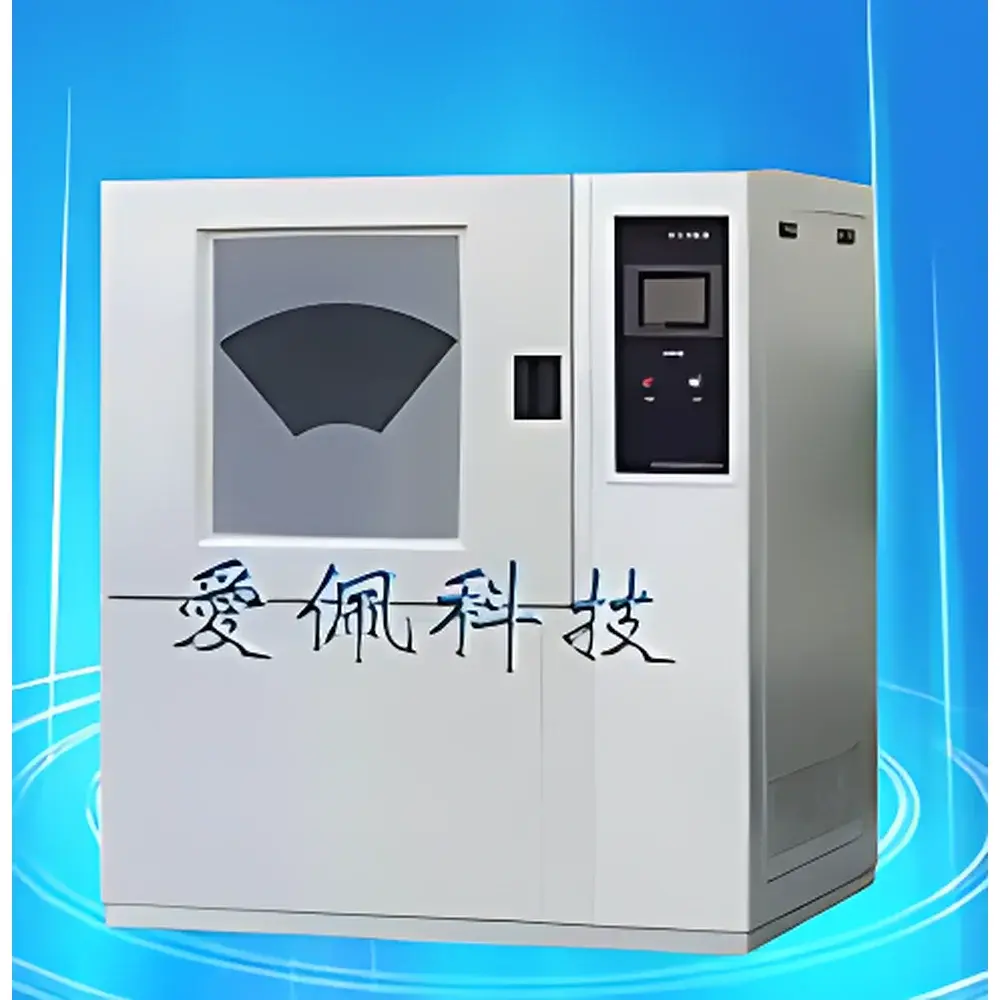
APKJ AP-SC Series IP56 Sand and Dust Test Chamber
| Brand | APKJ |
|---|---|
| Model | AP-SC |
| Type | Environmental Test Chamber for Ingress Protection (IP) Rating Validation |
| Compliance | IP56, GB/T 4208–2017 (IEC 60529), GB/T 2423.37–2012, MIL-STD-810F Method 510.5 |
| Chamber Volume Options | 500 L (800×800×800 mm), 1000 L (1000×1000×1000 mm) |
| Dust Circulation | Vertical downward non-laminar flow with vibratory dust collection funnel and recirculating centrifugal blower |
| Dust Medium | Silica sand or talcum powder (75 µm sieve aperture, 50 µm wire diameter) |
| Dust Density | 2–4 kg/m³ |
| Airflow Velocity | ≤2 m/s |
| Pneumatic Pressure Range | 0.5–1.0 MPa |
| Vacuum Pump Option | 0–30 kPa (optional) |
| Sample Height Adjustment | 0–750 mm |
| Timing Range | 0–99 h 59 min (programmable cycle & blow-dust duration) |
| Timing Accuracy | ±1 min |
| Temperature Control | Ambient to +50°C (optional heating module) |
| Viewing Window | Large-area tempered glass with anti-dust sealing |
| Structural Integrity | High-precision sheet metal fabrication, fully sealed chamber body, zero external dust leakage |
| Control System | Imported LCD touch-panel programmable controller with real-time parameter display and data logging capability |
Overview
The APKJ AP-SC Series IP56 Sand and Dust Test Chamber is an engineered environmental simulation system designed to evaluate the ingress protection performance of electrical, electronic, electromechanical, and electrochemical equipment under controlled airborne particulate exposure. It replicates the operational and storage conditions defined in IP56-rated validation protocols—where “5” denotes protection against limited dust ingress (non-harmful accumulation inside enclosures), and “6” specifies resistance to powerful water jets. The chamber operates on a vertical, gravity-assisted, non-laminar dust deposition principle: dust particles are introduced from above, settle onto test specimens under natural convection and controlled airflow, then collected via a vibratory funnel and reintroduced into the circulation loop by a high-efficiency centrifugal blower. This closed-loop architecture ensures consistent dust concentration, uniform spatial distribution, and repeatable exposure profiles across multiple test cycles—critical for compliance verification against IEC 60529, GB/T 4208–2017, GB/T 2423.37–2012, and MIL-STD-810F Method 510.5.
Key Features
- Robust chamber construction using precision-welded, high-tolerance sheet metal with full gasket-sealed joints—guaranteeing zero external dust leakage during operation.
- Vertically oriented dust delivery system with adjustable sample height (0–750 mm) and large-area, multi-layer sealed observation window for real-time visual monitoring without compromising chamber integrity.
- Imported programmable LCD touch controller supporting dual-mode timing: total test duration (0–99 h 59 min) and independent blow-dust interval control (1 s–9999 min), both with ±1 minute accuracy.
- Vibratory dust collection funnel integrated with low-noise transmission mechanism—minimizing mechanical resonance and enabling stable, long-duration cycling.
- Recirculating air system featuring reverse-flow fan design to suppress dust backflow and maintain directional downward particle transport.
- Optional vacuum pump (0–30 kPa) for enhanced dust suspension control and accelerated deposition kinetics in high-density testing scenarios.
- Heating module (ambient to +50°C) with PID-regulated thermal field management—ensuring uniform temperature distribution during combined thermal-dust stress evaluation.
Sample Compatibility & Compliance
The AP-SC chamber accommodates a broad range of device geometries—from handheld consumer electronics and automotive ECUs to industrial control cabinets and outdoor telecommunications enclosures. Its modular internal dimensions (standard options: 800×800×800 mm and 1000×1000×1000 mm) allow for full-system or component-level evaluation under standardized dust loading (2–4 kg/m³) using either calibrated silica sand or pharmaceutical-grade talcum powder (sieve aperture: 75 µm; wire diameter: 50 µm). All configurations meet statutory requirements for IP56 certification testing per GB/T 4208–2017 (equivalent to IEC 60529), as well as environmental stress screening per GB/T 2423.37–2012 (identical to IEC 60068-2-68) and military-grade durability assessment per MIL-STD-810F Method 510.5. The system supports traceable calibration documentation and is compatible with GLP-aligned test record generation when paired with APKJ’s optional data acquisition interface.
Software & Data Management
The embedded control firmware supports time-stamped event logging—including start/stop timestamps, pressure setpoints, cycle counts, and operator ID inputs—enabling audit-ready reporting for ISO/IEC 17025-accredited laboratories. While the base configuration utilizes standalone LCD-based programming, optional RS485/Modbus RTU or Ethernet TCP/IP interfaces enable integration with centralized LIMS or MES platforms. Data export is supported via USB flash drive in CSV format, preserving all runtime parameters and alarm histories. Firmware updates are delivered via secure authenticated channels and retain user-defined test profiles across revisions. The system does not implement FDA 21 CFR Part 11 electronic signature functionality natively but can be deployed within validated environments when operated under documented SOPs and manual logbook supplementation.
Applications
- Validation of enclosure integrity for outdoor lighting fixtures, solar inverters, and EV charging stations exposed to arid, dusty climates.
- Pre-compliance screening of medical devices intended for field deployment in desert or construction-site environments.
- Reliability qualification of avionics housings subjected to airborne particulate ingestion during ground operations.
- Material compatibility testing of gaskets, seals, and conformal coatings under sustained dust abrasion and thermal cycling.
- Quality assurance for consumer appliances (e.g., power tools, HVAC controllers) undergoing IP rating certification prior to CE or CCC marking.
- Research studies on dust adhesion mechanisms, filtration efficiency degradation, and electrostatic charge accumulation on insulating surfaces.
FAQ
What standards does the AP-SC chamber specifically support for IP56 testing?
It fully complies with GB/T 4208–2017 (IEC 60529), GB/T 2423.37–2012 (IEC 60068-2-68), and MIL-STD-810F Method 510.5 for dust ingress evaluation.
Can the chamber operate without a vacuum pump?
Yes—the vacuum pump is an optional accessory used only for advanced dust suspension control; standard IP56 testing functions independently using gravity-fed circulation.
Is the dust medium included with the system?
No—users must supply certified test dust (silica sand or talcum powder meeting 75 µm sieve specification) per applicable standard; APKJ provides material sourcing guidance and calibration certificate templates.
Does the chamber support automated pass/fail judgment based on test outcomes?
No—it delivers controlled environmental exposure only; functional evaluation of test specimens must be performed externally using designated performance criteria and measurement instruments.
What maintenance intervals are recommended for long-term reliability?
Filter replacement every 200 operational hours, blower bearing inspection biannually, and full gasket integrity verification annually—documented in the included Maintenance Logbook.



