
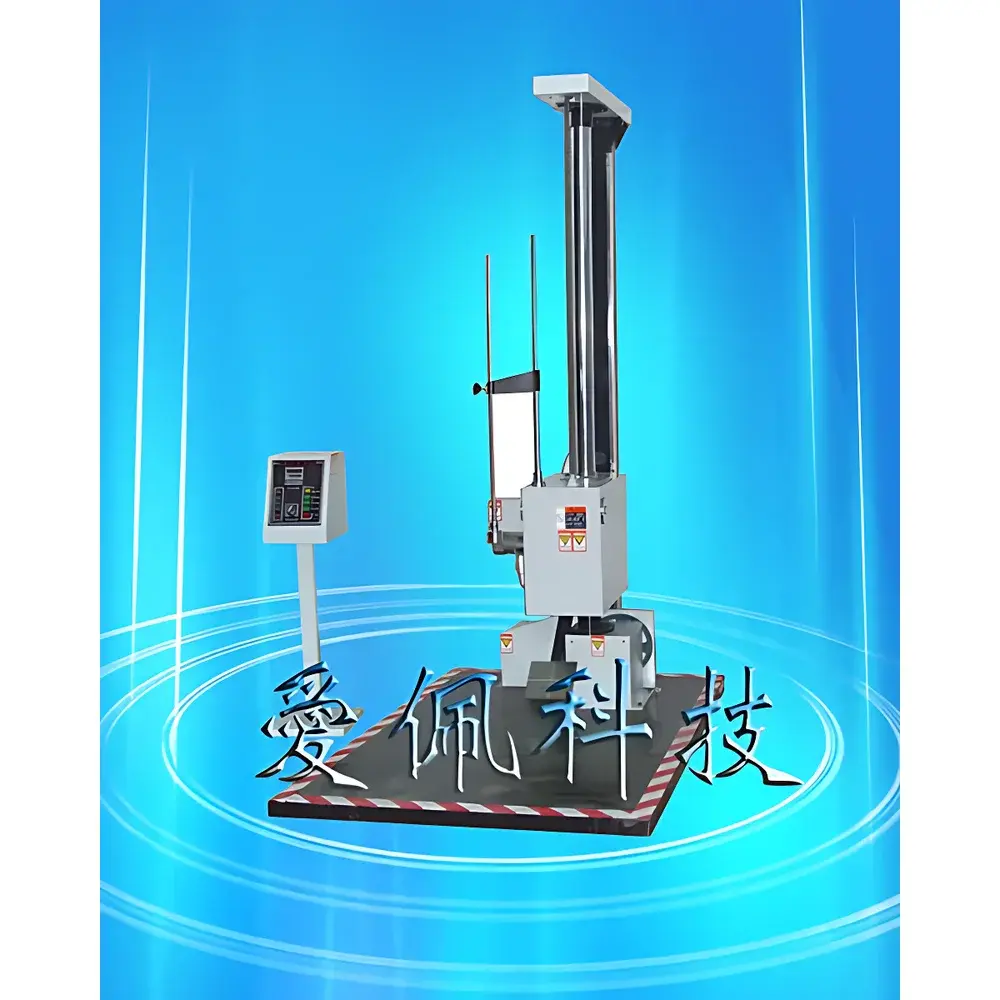
APKJ AP-DL Single-Arm Drop Tester for Packaging and Consumer Electronics
| [Brand | APKJ |
|---|---|
| Origin | Guangdong, China |
| Manufacturer Type | Manufacturer |
| Model | AP-DL |
| Max Test Height | 300–1800 mm |
| Max Drop Weight | 1 kg |
| Height Accuracy | ±2% or ±10 mm |
| Detachment Height | 300 mm |
| Counting Range | 0–999,999 (LCD) |
| Air Supply | ≥0.5 MPa |
| Power | AC 220 V, 50 Hz, 3 A |
| Dimensions (W×D×H) | 720 × 910 × 2500 mm |
| Weight | 150 kg |
| Compliance | JIS C 0044, IEC 60068-2-32] |
Overview
The APKJ AP-DL Single-Arm Drop Tester is an electromechanical test system engineered for standardized free-fall impact evaluation of packaged goods and small consumer electronics. It operates on the principle of controlled gravitational acceleration, enabling precise simulation of real-world handling hazards—including accidental drops during transportation, retail handling, or end-user operation. The tester features a single-arm, dual-column structural architecture with motorized vertical positioning, pneumatic release actuation, and hydraulic damping to ensure repeatable drop initiation, stable post-impact deceleration, and long-term mechanical integrity. Designed in accordance with international environmental stress testing standards—including IEC 60068-2-32 (Environmental testing – Part 2-32: Tests – Test Ed: Free fall) and JIS C 0044 (Drop test method for electronic equipment)—the AP-DL delivers traceable, auditable, and reproducible impact conditions across face, edge, and corner orientations.
Key Features
- Single-arm configuration with adjustable drop plane orientation (0°–120°), enabling accurate alignment of specimen impact surfaces relative to the horizontal base plate (angular deviation ≤5°).
- Motor-driven vertical lift and electric reset mechanism, integrated with a high-resolution SICK encoder for closed-loop height tracking and digital height display (optional).
- SMC pneumatic components throughout—including precision air cylinders, solenoid valves, and vacuum suction cups—ensuring consistent actuation force, cycle durability, and low-maintenance operation.
- Patented synchronized release system: SMC pneumatic grippers hold specimens during ascent and detach at a pre-set 300 mm height above the impact surface, preserving original orientation during free fall.
- Multi-material impact base options: interchangeable steel, tempered acrylic, concrete, or marble plates—supporting regional regulatory requirements and material-specific energy absorption profiles.
- Automatic cycle counting (0–999,999) with LCD interface; programmable drop height within 300–1800 mm range; height repeatability ±2% or ±10 mm (whichever is greater).
- Hydraulic buffer system integrated into the support frame to absorb kinetic energy upon arm return, minimizing mechanical shock transmission and extending service life.
Sample Compatibility & Compliance
The AP-DL accommodates specimens up to 1 kg and dimensions compatible with standard handheld electronics (e.g., smartphones, PDA devices, adapters, audio players). Its modular clamping system—featuring adjustable SMC pneumatic fingers and optional universal-joint vacuum fixtures—supports heterogeneous geometries without requiring custom tooling. The system meets the mechanical and procedural requirements of IEC 60068-2-32 (free-fall test methodology), JIS C 0044 (drop test for electronic apparatus), and aligns with broader quality management frameworks including ISO/IEC 17025 (for accredited lab use) and GLP-compliant test documentation workflows. While not inherently 21 CFR Part 11 compliant, its digital counter and height logging capability support audit-ready record retention when integrated with validated laboratory information management systems (LIMS).
Software & Data Management
The AP-DL operates as a standalone electromechanical platform with embedded microcontroller logic—no proprietary PC software required. All operational parameters (height setting, drop count, cycle status) are managed via front-panel membrane switches and displayed on an integrated LCD module. Height calibration is traceable to mechanical scale markings and verified using the SICK incremental encoder output. For laboratories requiring electronic data capture, the unit provides TTL-level pulse outputs from the counter and relay-status signals that can be interfaced with external PLCs, DAQ systems, or custom-built LabVIEW or Python-based logging tools. Optional RS-232 or Modbus RTU modules (available upon request) enable integration into centralized test management platforms supporting FDA 21 CFR Part 11 audit trails when paired with appropriate validation protocols.
Applications
- Pre-certification drop validation for CE, FCC, and KC-marked consumer electronics prior to market launch.
- Design verification testing of packaging integrity—including corrugated boxes, blister packs, and molded trays—under simulated logistics impacts.
- Manufacturing line QA/QC screening for mobile device assembly lines (e.g., Nokia, Huawei, ZTE, Samsung, TCL, BBK Electronics).
- Comparative analysis of protective materials (foam inserts, honeycomb boards, molded pulp) under standardized impact vectors.
- Reliability engineering studies correlating drop-induced mechanical stress with functional failure modes (e.g., display cracking, battery dislodgement, PCB solder joint fracture).
FAQ
What standards does the AP-DL comply with?
The AP-DL is designed and verified to meet the procedural and performance criteria of IEC 60068-2-32 and JIS C 0044. It supports implementation of other drop-related clauses in MIL-STD-810, ASTM D5276, and GB/T 4857.5 when configured with appropriate fixtures and reporting protocols.
Can the drop height be adjusted in real time during testing?
Yes—height is set digitally via the front panel before each drop cycle. Motorized lift ensures repeatable repositioning without manual recalibration between tests.
Is the impact surface interchangeable?
Yes—the base plate is modular. Standard configurations include hardened steel, 12-mm tempered acrylic, and 100-mm reinforced concrete slabs—all secured via T-slot mounting for rapid changeover.
Does the system include data export functionality?
The base model provides local LCD readouts and relay-triggered pulse outputs. Optional serial communication modules (RS-232/Modbus) enable automated data logging and LIMS integration.
What maintenance is required for long-term reliability?
Routine inspection of pneumatic lines, lubrication of THK linear guides every 500 cycles, and annual verification of encoder linearity and height scale accuracy are recommended per manufacturer guidelines.



