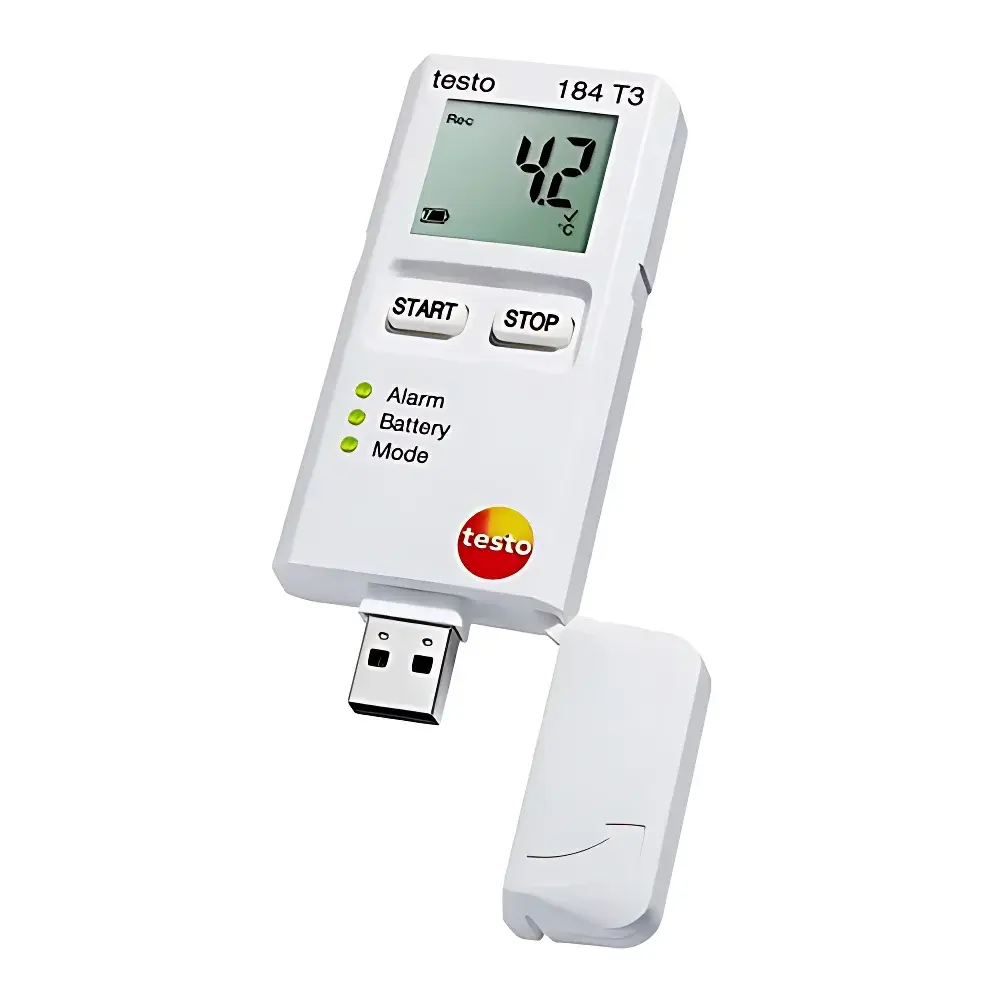
testo 184 T3 USB Temperature Data Logger
| Brand | testo |
|---|---|
| Origin | Germany |
| Model | 0572 1843 |
| Channel Count | Single-Channel |
| Measurement Range | −35 to +70 °C |
| Accuracy | ±0.5 °C |
| Resolution | 0.1 °C |
| Response Time (t₉₀) | 30 min |
| Logging Interval | 1 min to 24 h |
| Memory Capacity | 40,000 readings |
| Battery Life | 500 days (at 25 °C, 15-min interval) |
| Power Source | Replaceable 3 V lithium battery |
| Dimensions | 97 × 12 × 40 mm (L×W×H) |
| Weight | 44 g |
| Enclosure Material | ABS |
| IP Rating | IP67 |
| Display | Single-line segment LCD (no backlight) |
| Interface | USB Type-A, NFC |
| Compliance | EN 12830, CE 2014/30/EU, DIN EN 61326-1:2013, DIN EN 50581:2013, FDA 21 CFR Part 11 (when used with testo ComSoft CFR software), HACCP, GxP |
Overview
The testo 184 T3 is a certified, single-channel USB temperature data logger engineered for continuous, unattended monitoring of temperature-sensitive shipments—including pharmaceuticals, biologics, vaccines, chilled and frozen foodstuffs, and precision electronics. It operates on the principle of high-stability NTC thermistor sensing, delivering traceable, metrologically sound measurements across a wide operational range (−35 °C to +70 °C). Designed for compliance-critical logistics, the device captures time-stamped temperature values at user-defined intervals (from 1 minute to 24 hours), stores up to 40,000 readings internally, and maintains full data integrity without external power or network dependency. Its ruggedized ABS housing meets IP67 ingress protection standards, ensuring reliable performance in humid, dusty, or transiently submerged transport environments. The unit is pre-calibrated and supplied with an ISO/IEC 17025-accredited calibration certificate—digitally embedded and retrievable directly from the device.
Key Features
- Zero-software operation: Fully functional as a plug-and-play USB device—no driver installation, no third-party applications required for basic readout or PDF report generation.
- Embedded configuration & documentation: Stores its own configuration profile, calibration certificate (HACCP-compliant), user manual, and generated PDF reports internally—eliminating version control risks and offline accessibility gaps.
- Visual compliance verification: Dual-status LED indicator provides immediate pass/fail feedback upon arrival: green = within limits; red = excursion detected—enabling rapid go/no-go decisions at unloading points.
- Long-term autonomy: 500-day battery life (at 25 °C, 15-minute logging interval) using a field-replaceable 3 V lithium cell—no specialized tools or service intervention needed.
- Regulatory-ready reporting: Generates PDF/A-compliant reports directly via USB connection—ensuring long-term readability, digital signature support, and archival stability per ISO 19005-1.
- NFC-enabled mobility: Optional wireless data transfer to testo Quick Printer (via NFC) supports on-site label printing—ideal for cold chain handover documentation in warehouses or customs checkpoints.
Sample Compatibility & Compliance
The testo 184 T3 is validated for use across regulated supply chains where thermal integrity is mandated by quality management frameworks. It conforms to EN 12830 for temperature recorders used in refrigerated transport and storage, and meets electromagnetic compatibility (EMC) and safety requirements per DIN EN 61326-1:2013 and DIN EN 50581:2013. When paired with testo ComSoft CFR software, it satisfies FDA 21 CFR Part 11 requirements for electronic records and signatures—including audit trail, role-based access control, and electronic signature validation. Its design supports HACCP principles and GxP (GLP/GMP) workflows, particularly in pharmaceutical distribution (e.g., ICH guidelines for stability storage conditions) and food safety management systems. The device carries CE marking under Directive 2014/30/EU (EMC) and has undergone RTCA/DO-160G environmental testing for air cargo applications.
Software & Data Management
Data retrieval requires only a standard USB port and Adobe® Acrobat Reader—no proprietary runtime or system-level permissions. Upon connection, the device mounts as a mass-storage device, exposing a folder structure containing timestamped PDF reports, CSV exports, and embedded metadata (including device ID, calibration date, and configuration hash). All reports include digital watermarks, cryptographic checksums, and tamper-evident headers to prevent post-hoc modification. For enterprise deployment, testo ComSoft CFR software enables centralized fleet management, automated report scheduling, multi-user permission tiers, and full 21 CFR Part 11 audit trails—including operator login logs, parameter change history, and electronic signature capture. Raw data export supports integration into LIMS, ERP, or QMS platforms via standardized CSV or XML schemas.
Applications
- Pharmaceutical cold chain monitoring: Real-time validation of temperature excursions during clinical trial material shipments and commercial vaccine distribution.
- Frozen food logistics: Verification of compliance with EU Regulation (EC) No 852/2004 and FDA Food Safety Modernization Act (FSMA) requirements.
- Electronics component transit: Ensuring moisture-sensitive devices (MSL-rated ICs) remain within specified thermal profiles during global air freight.
- Biobank sample transport: Maintaining documented thermal continuity for cryopreserved specimens moving between collection sites and central repositories.
- Auditable warehouse validation: Supporting periodic temperature mapping studies and routine chamber qualification per ISO 14644 or WHO TRS 961 Annex 9.
FAQ
Does the testo 184 T3 require software to generate reports?
No—PDF reports are generated automatically upon USB connection using only Adobe® Acrobat Reader.
Can the device be reconfigured after deployment?
Yes—configuration can be updated via USB before shipment; once started, logging parameters are locked until stopped and reprogrammed.
Is the calibration certificate included with the device traceable to national standards?
Yes—the embedded ISO/IEC 17025 certificate references DAkkS-accredited calibration laboratories and includes uncertainty values per ISO/IEC 17025:2017.
What happens if the battery depletes mid-shipment?
The device retains all logged data permanently in non-volatile memory—even after battery exhaustion—and resumes operation immediately upon battery replacement.
How is data integrity ensured during USB transfer?
All exported files contain SHA-256 hashes embedded in metadata, and PDF reports include digital signatures verifiable through Adobe’s certification infrastructure.