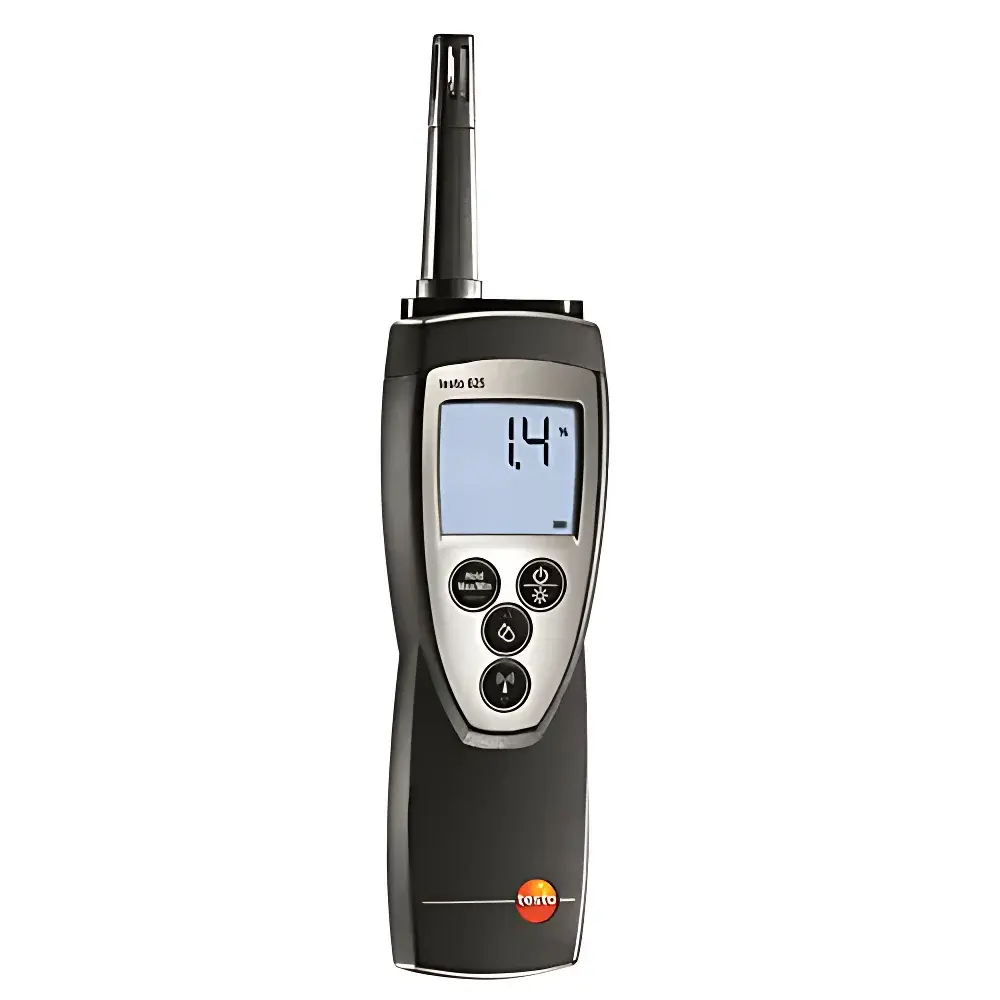
testo 625 Precision Temperature and Humidity Meter
| Brand | testo |
|---|---|
| Origin | Germany |
| Model | 0563 6251 |
| Temperature Range | -10 to +60 °C |
| Temperature Accuracy | ±0.5 °C |
| Temperature Resolution | 0.1 °C |
| Relative Humidity Range | 0 to 100 %RH |
| RH Accuracy | ±2.5 %RH (5–95 %RH) |
| RH Resolution | 0.1 %RH |
| Operating Ambient Temperature | -20 to +50 °C |
| Display | Backlit LCD |
| Power Supply | 9 V battery |
| Dimensions | 182 × 64 × 40 mm |
| Weight | 195 g |
| Enclosure Material | ABS |
| Battery Life | ~70 h |
| Storage Temperature | -40 to +70 °C |
Overview
The testo 625 Precision Temperature and Humidity Meter is a handheld, field-deployable environmental monitoring instrument engineered for reliable, repeatable measurement of ambient air temperature and relative humidity in controlled indoor environments. Utilizing a high-stability capacitive humidity sensor and an integrated NTC thermistor, the device delivers traceable metrological performance aligned with industrial hygiene and facility management requirements. Its core functionality includes real-time calculation of dew point temperature and wet-bulb temperature—critical parameters for assessing condensation risk, thermal comfort, and moisture-related degradation in sensitive infrastructure. Designed and manufactured in Germany, the testo 625 complies with EN 60751 (for Pt/Ni-based resistance thermometers) and adheres to the fundamental principles of ISO/IEC 17025 regarding measurement uncertainty estimation. It is not intended for process control or regulatory compliance reporting per se, but serves as a primary verification tool for HVAC commissioning, archival storage validation, and preventive environmental surveillance.
Key Features
- Integrated capacitive humidity sensor with long-term stability and low drift—calibrated against NIST-traceable reference standards at time of manufacture
- Dual-parameter display: simultaneous readout of air temperature (°C), relative humidity (%RH), dew point (°C), and wet-bulb temperature (°C)
- Backlit LCD screen with intuitive icon-driven interface—optimized for low-light conditions in basements, archives, and server rooms
- Hold function for freezing live readings; Min/Max tracking with timestamped recall for trend identification over extended observation periods
- Auto-power-off after 10 minutes of inactivity—extends 9 V alkaline battery life to approximately 70 hours under typical usage
- Rugged ABS housing rated for mechanical robustness in daily field use; IP54-rated against dust ingress and water splashes
- Compact ergonomic form factor (182 × 64 × 40 mm, 195 g) enables one-handed operation and easy transport between inspection points
Sample Compatibility & Compliance
The testo 625 is optimized for gaseous-phase measurements in still or low-velocity air environments (≤1 m/s). It is not suitable for direct immersion, high-temperature ducts (>60 °C), or corrosive atmospheres without protective accessories. The instrument meets CE marking requirements under the EU Electromagnetic Compatibility Directive 2014/30/EU and the Low Voltage Directive 2014/35/EU. While it does not carry formal GLP/GMP certification, its documented calibration uncertainty (±0.5 °C for temperature, ±2.5 %RH within 5–95 %RH range), factory calibration certificate, and stable sensor architecture support use in environments governed by ISO 14644 (cleanrooms), ISO 11783 (agricultural storage), and ASHRAE Standard 55 (thermal environmental conditions). For applications requiring audit-ready data integrity, optional testo Smart Probes or external logging modules may be deployed in conjunction with validated software platforms.
Software & Data Management
The testo 625 operates as a standalone, battery-powered meter with no built-in data logging or Bluetooth/Wi-Fi connectivity. All measurements are displayed in real time and retained only in volatile memory during active use. Min/Max values persist until manually reset. For documentation purposes, users may manually record readings into lab notebooks or digital systems compliant with 21 CFR Part 11 (when paired with appropriate electronic signature workflows). testo offers complementary PC software (testo Comfort Software, sold separately) that supports manual entry of multiple testo 625 datasets for comparative analysis, report generation, and export to CSV/PDF formats. No firmware updates or cloud synchronization are supported—ensuring deterministic behavior and eliminating cybersecurity exposure vectors common in connected instrumentation.
Applications
- Environmental monitoring in archival repositories, libraries, and museum storage vaults where strict RH control (<40–60 %RH) prevents paper embrittlement and pigment fading
- Preventive maintenance in commercial buildings—identifying localized condensation-prone zones (e.g., thermal bridges, poorly insulated windows) via dew point mapping
- Quality assurance in pharmaceutical warehousing and food cold chain staging areas, verifying ambient conditions prior to batch release
- Greenhouse climate optimization—tracking diurnal RH fluctuations and correlating with plant transpiration models
- Educational laboratories for teaching psychrometric principles, including Mollier diagram interpretation and adiabatic saturation calculations
- Post-construction HVAC balancing—verifying setpoint adherence and identifying airflow imbalances through spatial temperature/humidity profiling
FAQ
Does the testo 625 support external probe inputs beyond the integrated humidity/temperature sensor?
No—the device features only a fixed, non-removable capacitive RH sensor and embedded NTC thermistor. It does not accept Type K or other wired/wireless probe interfaces.
Is the calibration certificate provided with the instrument NIST-traceable?
Yes—the included factory calibration report references traceability to national metrology institutes (e.g., PTB in Germany) via accredited calibration laboratories operating under ISO/IEC 17025.
Can the testo 625 be used in outdoor environments?
It is rated for operation between –20 °C and +50 °C ambient temperature, but its IP54 rating limits prolonged exposure to rain, direct sunlight, or high wind speeds—use indoors or under sheltered conditions only.
What is the recommended recalibration interval?
testo recommends annual verification against a certified reference hygrometer and dry-well calibrator, especially when used in critical applications or following mechanical shock.
Is the battery user-replaceable?
Yes—the 9 V alkaline battery is accessible via a screw-secured compartment on the rear housing and requires no tools for replacement.