
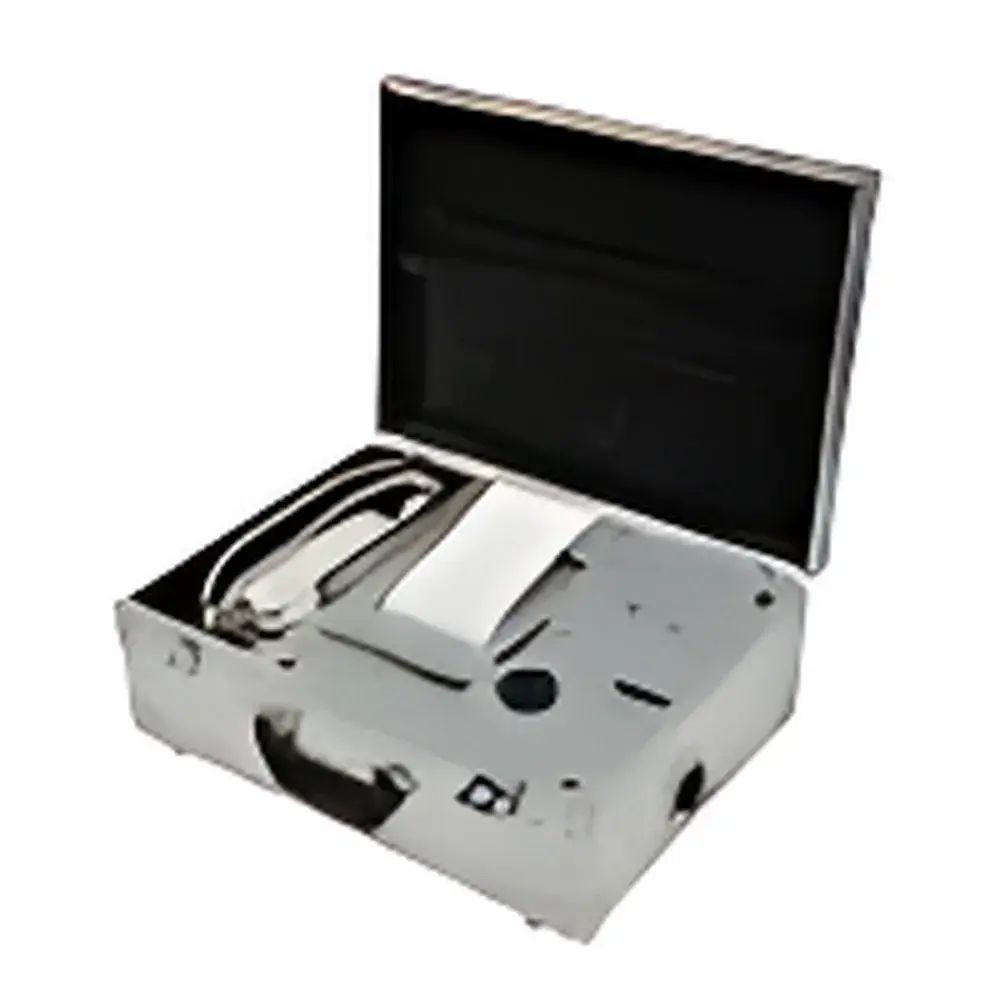
Zawada NDT WRD120B Magnetic Flux Leakage (MFL) Steel Wire Rope Tester
| Origin | Poland |
|---|---|
| Manufacturer Type | Authorized Distributor |
| Origin Category | Imported Instrument |
| Model | WRD120B |
| Pricing | Upon Request |
Overview
The Zawada NDT WRD120B is a portable, field-deployable magnetic flux leakage (MFL) wire rope inspection system engineered for high-reliability non-destructive testing (NDT) of ferromagnetic steel wire ropes. Developed by Zawada NDT—a Polish manufacturer with over three decades of domain-specific experience in rope integrity assessment—the WRD120B implements a dual-sensor MFL methodology to detect localized and distributed anomalies including broken wires, pitting corrosion, cross-sectional loss, wear, and geometric deformation. Unlike conventional eddy current or ultrasonic systems, the WRD120B leverages controlled magnetization and differential flux sensing to quantify metal loss with traceable sensitivity down to 0.05% of nominal cross-sectional area—subject to rope construction and sensor configuration. Its architecture deliberately isolates data acquisition from host-computer interference, ensuring measurement integrity in electromagnetically noisy industrial environments such as mine shafts, cableway stations, cranes, and suspension bridge maintenance zones.
Key Features
- Four-channel synchronized signal acquisition: two induction sensor channels, one Hall-effect channel, and one mathematically integrated MFL channel for enhanced defect quantification
- Modular probe compatibility supporting diameter ranges from 5 mm to 165 mm—including WRT-20/WRT-25 mini-probes, GP/GM standard probes, and specialized LRM-MH and LRM-SAG-2 configurations for flat steel belts
- Real-time rope-speed monitoring (0.05–10 m/s) with ±0.01 m/s resolution and bidirectional length counter (1–9999 m)
- Thermal array printer (112 mm × 25 m roll) with configurable print density (1–10 mm per meter or per second), plus simultaneous PCMCIA memory card logging (4 MB capacity = ~2400 m or 2400 s of full-channel data)
- On-device waveform replay, defect tagging, rope ID assignment (up to 100 unique IDs), and multi-color battery/printer status indicators
- Operating temperature range: –25 °C to +40 °C; humidity tolerance: up to 95% RH (non-condensing)
Sample Compatibility & Compliance
The WRD120B is validated for use on all ferromagnetic wire rope constructions—including parallel-lay, lang-lay, and rotation-resistant types—as defined under ISO 4309:2017 (Cranes — Wire ropes — Care and maintenance, inspection and discard). It complies with EN 12927-3:2013 (Non-destructive testing — Equipment for magnetic particle and magnetic flux leakage testing — Part 3: Characterization and verification) for sensor linearity and repeatability. While not certified to ASTM E1571 (Standard Specification for Ferromagnetic Wire Rope Magnetic Testing), its detection threshold and calibration traceability align with the performance expectations outlined in Clause 7.2 for quantitative MFL-based cross-sectional loss assessment. The system supports GLP-aligned documentation through timestamped, ID-tagged records and audit-ready export formats.
Software & Data Management
Data acquired by the WRD120B is stored in a proprietary binary format compatible with the WRD120 PRE_PLUS analysis software suite. This Windows-based application enables synchronized multi-channel waveform visualization, digital zooming, spatial defect localization (distance-from-start reference), automatic peak detection, and customizable report generation (PDF/CSV export). All reports include metadata: rope ID, test date/time, operator ID (manually entered), sensor type, speed profile, and calibration confirmation flags. The software supports 21 CFR Part 11-compliant user access control when deployed in regulated environments—though electronic signatures require integration with validated identity management infrastructure. Raw channel data can be imported into MATLAB or Python environments via ASCII conversion utilities included in the software package.
Applications
The WRD120B serves critical inspection roles across vertical transportation, material handling, and civil infrastructure sectors. Typical use cases include scheduled rope surveillance in mining hoists (per MSHA 30 CFR §56.19033), pre-service verification of elevator traction ropes (EN 81-20 Annex E), periodic inspection of aerial tramway cables (CEN/TS 15912), and forensic evaluation after overload events or environmental exposure (e.g., coastal salt corrosion). Its portability and battery operation (rechargeable Li-ion, >8 h continuous runtime) make it suitable for remote site deployment without external power. Dual-sensor depth-localization capability (available with GP-1, GP-2, or GM probes equipped with coaxial induction pairs) supports tiered assessment protocols required by insurance underwriters and third-party certification bodies.
FAQ
What detection principle does the WRD120B employ?
It uses magnetic flux leakage (MFL) technology, where a permanent magnet circuit saturates the rope, and deviations in flux return paths—caused by metal loss or discontinuities—are captured by induction and Hall-effect sensors.
Can the WRD120B detect corrosion under grease or surface contamination?
Yes—MFL penetration depth exceeds typical lubricant film thicknesses; however, heavy ferrous debris or thick non-magnetic coatings may attenuate signal amplitude and require cleaning prior to inspection per ISO 4309 guidance.
Is calibration traceable to national standards?
Zawada NDT provides factory calibration certificates referencing DIN 54113-2 traceable reference ropes; field recalibration is performed using certified artificial defect test pieces (e.g., machined grooves at 0.5%, 1.0%, and 2.5% CSA loss).
Does the system support automated pass/fail decision logic?
No—it delivers raw and processed signal data for expert interpretation; pass/fail criteria must be applied per client-specific procedures aligned with ISO 4309, EN 12927, or internal asset integrity management frameworks.
What is the maximum recording duration with a full 4 MB PCMCIA card?
Approximately 2400 seconds (40 minutes) at full 4-channel sampling rate; duration scales linearly with reduced channel activation or lower sampling frequency configurations.





