
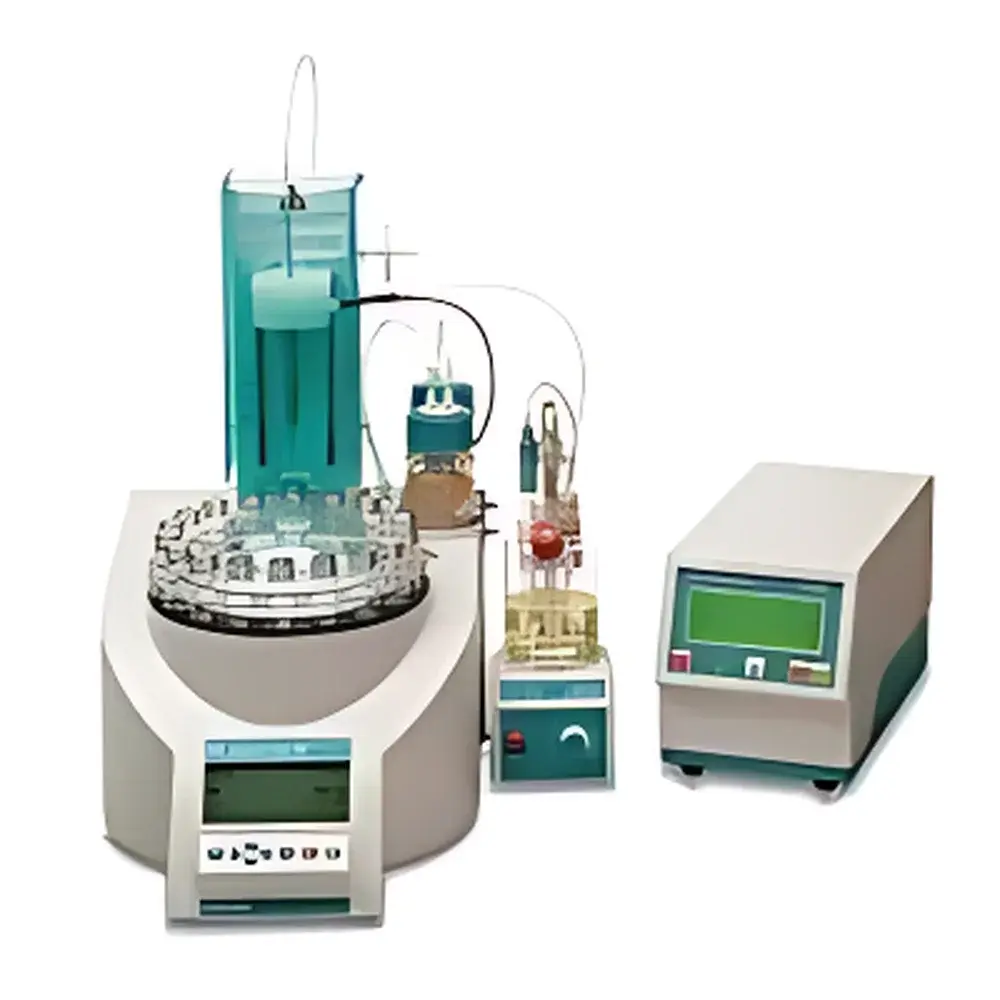
Metrohm 885 Automated Headspace Heating Karl Fischer Moisture Determination System
| Brand | Metrohm |
|---|---|
| Origin | Switzerland |
| Manufacturer Type | Original Equipment Manufacturer (OEM) |
| Origin Category | Imported |
| Model | 885 |
| Titration Mode | Fully Automated |
| Instrument Type | Volumetric Karl Fischer Titrator with Integrated Headspace Heater |
| Sample Handling | Headspace vial-based, non-contact sample introduction |
| Compliance | Designed for GLP/GMP environments, supports 21 CFR Part 11–compliant software modules (when paired with OMNIS platform) |
| Power Supply | 100–240 V AC, 50/60 Hz |
| Data Storage | Internal instrument memory + optional networked database via OMNIS Software |
| Environmental Operating Conditions | 10–40 °C, 20–80% RH (non-condensing) |
Overview
The Metrohm 885 Automated Headspace Heating Karl Fischer Moisture Determination System is an integrated analytical platform engineered for the precise, interference-free quantification of trace to macro-level water content in thermally labile, poorly soluble, or chemically reactive samples. Unlike conventional volumetric KF titrators that require direct dissolution of the sample into methanol-based electrolyte, the 885 employs a sealed headspace vial heating strategy: solid or viscous samples are weighed, sealed in inert glass vials with PTFE-coated septa, and thermally equilibrated under controlled carrier gas flow. Water liberated from the matrix volatilizes into the headspace, is swept by dry carrier gas (typically nitrogen or dried air), and delivered directly to the titration cell—bypassing solvent compatibility limitations, minimizing reagent consumption, and eliminating cross-contamination between samples. This physical separation of sample conditioning and electrochemical titration ensures high reproducibility, robustness against side reactions (e.g., aldehydes, ketones, or basic amines consuming iodine), and compliance with pharmacopeial requirements for residual moisture analysis in APIs and excipients.
Key Features
- Fully electronic, microprocessor-controlled headspace heater with programmable temperature range (30–250 °C) and ±0.5 °C stability, enabling method optimization for diverse matrices including polymers, hygroscopic salts, and lyophilized biologics.
- Low-dead-volume, heated transfer lines with integrated thermal insulation prevent condensation during vapor transport—critical for maintaining quantitative transfer efficiency and avoiding memory effects.
- Patented screw-cap vial system with reusable borosilicate glass vials and replaceable PTFE-faced silicone septa; eliminates carryover and reduces consumable cost per analysis.
- Auto-sampling capability via rotating sample carousel (up to 30 positions), synchronized with balance integration for automatic mass import (RS232 or USB HID interface compatible with METTLER TOLEDO, SARTORIUS, and other GLP-grade balances).
- Modular architecture: seamlessly interfaces with Metrohm’s OMNIS Titration Platform for method development, audit trail generation, electronic signatures, and full 21 CFR Part 11 compliance support.
- Compact footprint (W × D × H: 420 × 520 × 450 mm) suitable for regulated QC laboratories with space constraints and stringent environmental control requirements.
Sample Compatibility & Compliance
The 885 system is validated for use across pharmaceutical, chemical, polymer, and food-grade materials where traditional KF titration fails—such as cellulose derivatives, metal oxides, silicone elastomers, and active pharmaceutical ingredients containing amine or carbonyl functional groups. It conforms to ASTM E203, USP , EP 2.5.12, and ISO 760 methodologies for headspace-based moisture determination. All hardware components—including vial holders, gas manifolds, and titration cells—are constructed from chemically resistant materials (e.g., PTFE, glass, and stainless steel 316) to ensure long-term stability in aggressive KF reagent environments. The system supports IQ/OQ documentation packages and is routinely deployed in FDA- and EMA-inspected facilities for release testing and stability studies.
Software & Data Management
When operated with Metrohm OMNIS Software (v3.0+), the 885 enables fully traceable workflows: user-defined methods store heating profiles, gas flow rates (5–100 mL/min), purge durations, and titration parameters; each analysis generates immutable raw data files (.omn), PDF reports with embedded metadata (operator ID, timestamp, balance serial number), and configurable audit trails. Electronic signature functionality satisfies ALCOA+ principles. Data export supports CSV, XML, and LIMS-compatible formats (ASTM E1384, HL7). Local storage retains ≥10,000 result records with time-stamped event logs (power cycles, calibration events, error codes).
Applications
- Residual moisture analysis in freeze-dried protein formulations prior to stoppering.
- Water content verification in lithium-ion battery cathode materials (e.g., NMC, LFP) where solvent incompatibility precludes direct titration.
- QC testing of silica gel desiccants and molecular sieves used in packaging validation.
- Determination of bound water in cementitious materials and refractory ceramics.
- Stability-indicating assays for hydrolytically unstable esters and lactams under accelerated conditions.
FAQ
Can the 885 be used with coulometric KF titration cells?
Yes—the system is compatible with both volumetric and coulometric detection modules; selection depends on expected water concentration (coulometric recommended for 100 µg H₂O).
Is method transfer from manual headspace KF possible?
Absolutely—OMNIS allows import of existing heating/time/gas parameters and auto-conversion into validated digital methods with version control.
How often must the PTFE septa be replaced?
Under standard operation (≤150 °C, 30 samples/day), septa maintain integrity for ≥200 injections; replacement is indicated by increased baseline drift or failed blank tests.
Does the system support multi-step heating ramps?
Yes—up to three independent temperature segments with dwell times can be programmed to optimize moisture release kinetics for complex matrices like layered composites or coated tablets.
What maintenance is required for the heated transfer line?
Quarterly visual inspection for PTFE degradation; annual recalibration of heater PID loop using NIST-traceable thermocouple standards is recommended for GMP applications.





