
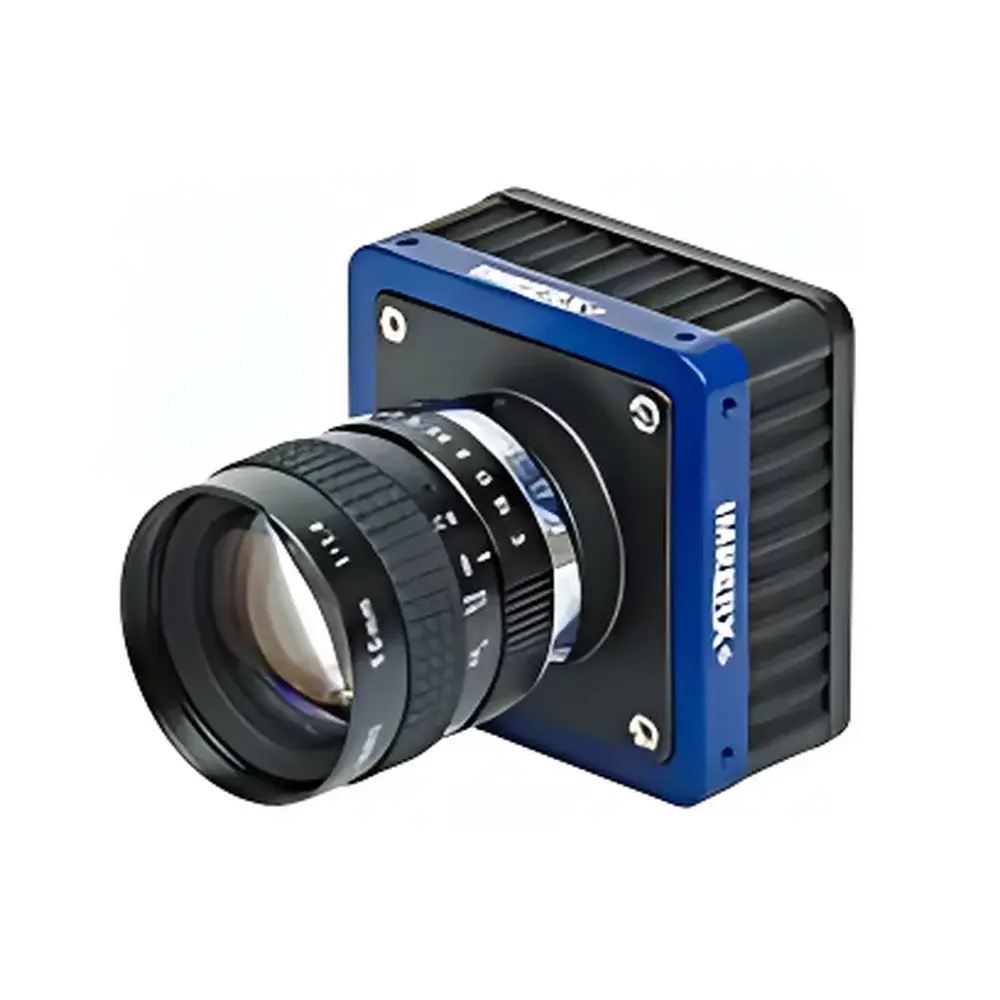
Imperx Cheetah Series High-Speed CMOS Cameras (6–25 MP)
| Brand | Imperx |
|---|---|
| Origin | USA |
| Model | Cheetah |
| Interface Options | Camera Link / USB3 Vision / GigE Vision |
| Resolution Range | 2.8 MP to 25 MP |
| Frame Rate Range | up to 129 fps (8-bit, full resolution) |
| Shutter Modes | Global & Rolling |
| Dynamic Range | Wide Dynamic Range (WDR) with 3 adjustable knee points |
| Sensor Type | Monochrome or Color CMOS |
| NIR Sensitivity | Enhanced |
| Trigger Modes | Software, Hardware, Encoder |
| ROI Support | Yes |
| Dark Current | Low |
| Smear & Dark Sun Suppression | Yes |
| Dual-Frame (A/B) Configuration | Yes |
| Compliance | RoHS, CE, FCC, FDA 21 CFR Part 11 (software-controlled audit trail optional) |
Overview
The Imperx Cheetah Series represents a purpose-engineered family of high-speed, high-resolution CMOS imaging platforms designed for demanding industrial and scientific applications where temporal fidelity, spatial accuracy, and robust environmental adaptability are non-negotiable. Leveraging advanced back-illuminated and stacked CMOS sensor architectures, the Cheetah line delivers exceptional quantum efficiency—particularly in the near-infrared (NIR) spectrum (700–1000 nm)—enabling reliable performance under low-light or spectrally selective illumination conditions common in automated optical inspection (AOI), traffic monitoring, and high-speed motion analysis. Unlike legacy CCD-based systems, Cheetah cameras utilize true global shutter operation (selectable per model), eliminating motion-induced distortion and enabling precise synchronization across multi-camera arrays. The architecture supports pixel-level control of exposure, gain, black level, and dynamic range mapping—critical for applications requiring quantitative intensity reproducibility across varying lighting gradients.
Key Features
- Wide Dynamic Range (WDR) Engine: Implements three user-definable knee points in the tone-mapping curve, allowing independent optimization of shadow detail, midtone linearity, and highlight retention—essential for scenes containing both direct sunlight and deep shadow (e.g., toll plaza imaging or outdoor rail inspection).
- Dual-Frame (A/B) Architecture: Enables simultaneous configuration of two independent image pipelines within a single camera—each with unique resolution, exposure time, gain, gamma, and WDR settings. Frames can be interleaved, matched, or blended via programmable trigger logic or external encoder input.
- Flexible Readout Modes: Supports region-of-interest (ROI) acquisition at accelerated frame rates without sensor binning; sub-sampling and pixel averaging modes provide hardware-level noise reduction while preserving geometric fidelity.
- Low-Noise Imaging Stack: Integrates correlated double sampling (CDS), on-chip analog-to-digital conversion (10/12-bit), and temperature-stabilized sensor control to maintain dark current below 0.5 e⁻/pixel/s at 25°C—ensuring stability over extended acquisition sequences.
- Multi-Interface Interoperability: Available with Camera Link Base/Medium, USB3 Vision (USB3-UVC compliant), and GigE Vision (GenICam v3.x compliant) interfaces—each supporting full GenTL transport layer compatibility and standardized feature naming for seamless integration into HALCON, OpenCV, or National Instruments environments.
- Industrial-Grade Robustness: IP67-rated housing options (optional), extended operating temperature range (−10°C to +60°C), and conformal coating available for vibration- and humidity-prone deployments such as vehicle-mounted ITS systems or factory-floor robotic guidance.
Sample Compatibility & Compliance
Cheetah cameras are engineered for compatibility with standard C-mount and F-mount optics, supporting working distances from macro (<50 mm) to telecentric (>1 m) configurations. All models comply with ISO 12233:2017 for spatial frequency response measurement and support MTF calculation via built-in test pattern generators. For regulated environments—including pharmaceutical packaging line verification or automotive ADAS validation—the optional firmware package enables GLP/GMP-compliant audit trails, electronic signatures, and FDA 21 CFR Part 11–aligned user access logging. Electromagnetic compatibility meets EN 61000-6-2 (immunity) and EN 61000-6-4 (emissions); safety certification includes UL 61010-1 and IEC 62368-1.
Software & Data Management
Imperx provides the fully documented IAPI (Imperx Application Programming Interface), a cross-platform C/C++ SDK with Python bindings, supporting Linux (Ubuntu LTS, Red Hat), Windows (10/11 x64), and real-time OS extensions (QNX, VxWorks). The included CheetahView GUI offers live histogram overlays, real-time WDR curve editing, ROI drag-and-drop configuration, and synchronized multi-camera timing diagrams. All metadata—including timestamp (IEEE 1588 PTP v2.1 capable), exposure parameters, sensor temperature, and trigger latency—is embedded in standard TIFF, BMP, or RAW16 container formats. For enterprise deployment, the optional Cheetah Enterprise Server supports centralized configuration management, firmware versioning, and secure REST API access for CI/CD pipeline integration.
Applications
- Industrial Machine Vision: High-precision PCB solder-joint inspection at conveyor speeds >2 m/s; semiconductor wafer defect classification using NIR reflectance contrast; robotic pick-and-place guidance with sub-pixel edge localization.
- Intelligent Transportation Systems (ITS): License plate recognition (LPR) under variable ambient illumination; vehicle classification and axle-counting at highway speeds; railway wheel defect detection using strobed LED illumination synchronized to train velocity.
- Scientific Imaging: Time-resolved particle image velocimetry (PIV) in wind tunnels; laser-induced fluorescence (LIF) lifetime mapping in combustion diagnostics; high-fidelity documentation of rapid-phase-change phenomena (e.g., droplet impact, solidification fronts).
- Defense & Aerospace: UAV-based EO/IR payload stabilization feedback; missile seeker head testing with synthetic scene projection; structural health monitoring via digital image correlation (DIC) under cyclic loading.
FAQ
Does the Cheetah series support hardware-triggered exposure synchronization across multiple cameras?
Yes—via TTL-compatible input with configurable delay (10 ns resolution) and jitter <250 ps. Multi-camera sync is supported natively in Camera Link and GigE Vision variants using GenCP broadcast commands.
Can WDR parameters be adjusted dynamically during acquisition without frame interruption?
Yes—WDR knee points and slopes are updated in real time via GenICam feature control; no frame drop or reinitialization required.
Is pixel-level calibration data (flat-field, dark-frame, PRNU) provided with each unit?
Yes—factory-measured correction maps are stored in non-volatile memory and applied automatically on startup; raw uncorrected data is also accessible via SDK flag.
What is the maximum cable length supported for each interface type?
Camera Link: up to 10 m (Base/Medium profile); USB3 Vision: up to 5 m (active cables extend to 15 m); GigE Vision: up to 100 m (Cat6a/Cat7, PoE+ compatible).
Are FPGA-based preprocessing capabilities available for edge computing?
Yes—selected Cheetah models offer optional FPGA co-processing modules for real-time Bayer demosaicing, convolution filtering, or blob analysis—reducing host CPU load and latency in embedded vision systems.




