
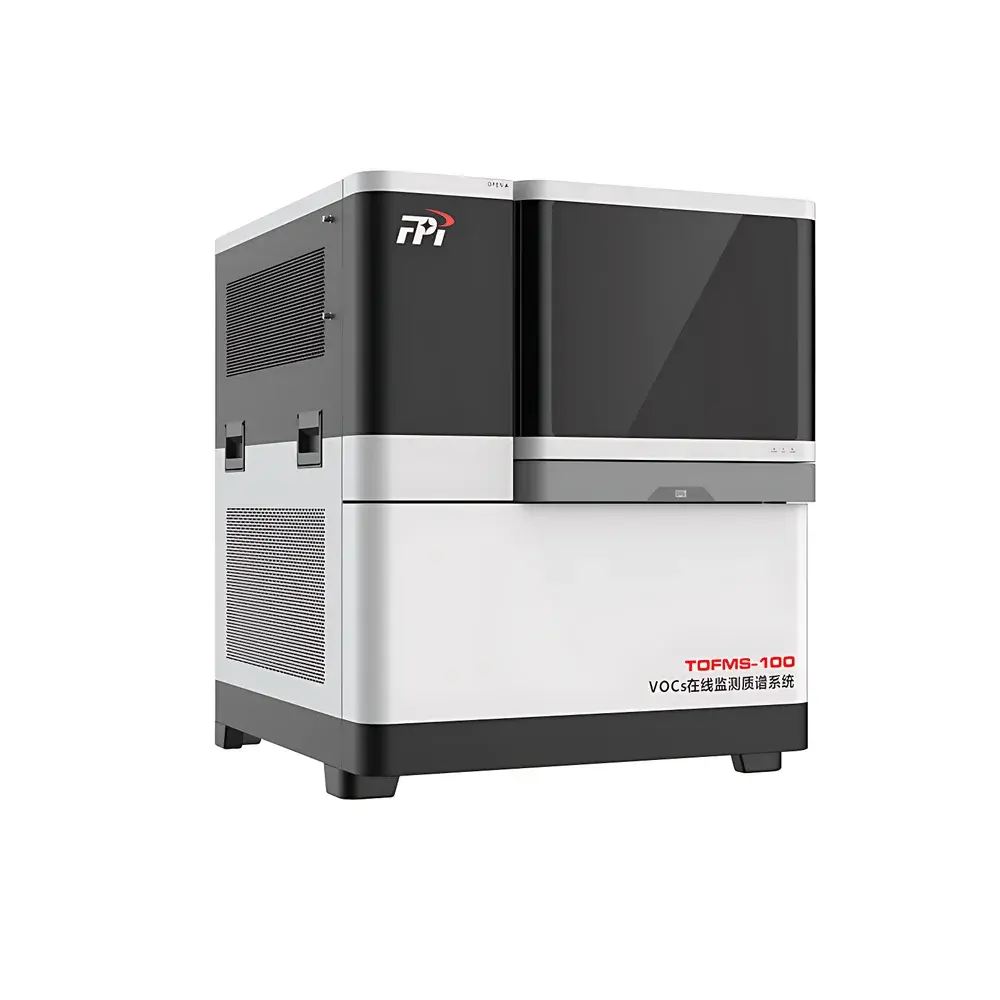
FPI TOFMS-100 Online VOC Monitoring Time-of-Flight Mass Spectrometer System
| Brand | FPI (Focus Photonics Inc.) |
|---|---|
| Origin | Zhejiang, China |
| Manufacturer Type | Original Equipment Manufacturer (OEM) |
| Country of Origin | China |
| Model | TOFMS-100 |
| Detection Principle | Single-Photon Ionization Time-of-Flight Mass Spectrometry (SPI-TOFMS) |
| Instrument Type | Continuous Online Analyzer |
| Configuration | Integrated VOC Monitoring System with GIS-enabled Mobile Deployment Capability |
| Detection Range | 0.1 ppb – 1000 ppm (v/v) |
| Mass Resolution | >800 (FWHM at m/z 92) |
| Accuracy | < ±1% Full Scale (0–500 ppb) |
| Response Time | ≤1 s (T90) |
Overview
The FPI TOFMS-100 Online VOC Monitoring Time-of-Flight Mass Spectrometer System is an engineered solution for real-time, quantitative, and qualitative analysis of volatile organic compounds (VOCs) in ambient air. It employs single-photon ionization (SPI) coupled with orthogonal-acceleration time-of-flight mass spectrometry (oa-TOFMS), a soft ionization technique that minimizes fragmentation and preserves molecular ion signals—critical for unambiguous identification of structurally diverse VOCs in complex atmospheric matrices. Unlike electron ionization (EI)-based systems, SPI delivers near-molecular-ion-dominant spectra, significantly improving spectral deconvolution fidelity for multi-component environmental samples. The system is designed for continuous, unattended operation in regulatory monitoring networks, industrial fence-line applications, and mobile deployment platforms—including integration into TOFMS-equipped survey vehicles for high-resolution spatial mapping of VOC emissions.
Key Features
- Direct capillary inlet with zero sample pre-treatment: eliminates membrane permeation losses and maintains quantitative integrity across polar, non-polar, and reactive VOC species.
- Detection limit of <0.1 ppb (S/N ≥ 3) for representative aromatics and oxygenated VOCs, achieved via high-efficiency ion transmission optics and microchannel plate (MCP) detector with optimized anode impedance matching.
- SPI ion source operating at 10.2 eV photon energy: selectively ionizes VOCs while suppressing ionization of major air constituents (N₂, O₂, CO₂, H₂O), thereby reducing chemical noise and matrix suppression effects.
- Full-spectrum acquisition at 10 Hz duty cycle: enables simultaneous detection and quantification of >300 VOCs per second, supporting dynamic plume tracking and rapid event response.
- Wide linear dynamic range spanning six orders of magnitude (ppt to ppm), validated across calibration standards traceable to NIST SRMs.
- Integrated geographic information system (GIS) interface: geotags spectral data in real time, enabling spatial interpolation, emission hotspot localization, and time-resolved pollution fingerprinting.
- Robust thermal management and pressure-stabilized vacuum architecture: ensures long-term signal stability under variable ambient conditions typical of field deployments.
Sample Compatibility & Compliance
The TOFMS-100 is validated for direct analysis of ambient air, stack effluents, and indoor air without derivatization or cryo-focusing. It complies with key technical requirements outlined in China’s “Technical Guidelines for Ambient Air VOCs Monitoring (HJ 1010–2018)” and aligns with international best practices for real-time mass spectrometric monitoring referenced in ISO 16000-28 (Indoor air — Determination of VOCs by online SPME-GC/MS) and EPA Method TO-15A (for compound class coverage, though not a direct replacement). While not certified to EU CE or US EPA Tier 1 equivalency, its analytical performance meets data quality objectives (DQOs) specified in ambient air quality management frameworks requiring sub-ppb sensitivity, ≤1 s temporal resolution, and compound-specific identification confidence >95% (per NIST MS Search 2.4 library match threshold with retention index support where applicable).
Software & Data Management
The proprietary FPI VOCView™ software provides full instrument control, real-time spectral visualization, automated peak integration, and library-assisted identification using a curated environmental VOC spectral library (≥420 compounds). All raw and processed data are stored in HDF5 format with embedded metadata (timestamp, GPS coordinates, pressure, temperature, humidity). Audit trails comply with GLP principles: user logins, method versioning, parameter change history, and electronic signatures are recorded. Data export supports CSV, NetCDF, and XML formats for interoperability with third-party environmental data management systems (EDMS) and regulatory reporting portals. Optional 21 CFR Part 11-compliant configuration available upon request, including role-based access control and electronic record archiving.
Applications
- Mobile surveying of industrial clusters: real-time mapping of benzene, toluene, xylene (BTX), aldehydes, terpenes, and halogenated solvents across chemical parks and petrochemical zones.
- Emergency response: rapid source attribution during chemical spills, fugitive emission events, or odor complaints—enabling evidence-based enforcement and community exposure assessment.
- Photochemical smog precursor monitoring: time-synchronized measurement of isoprene, monoterpenes, and aromatic hydrocarbons to support ozone formation potential modeling.
- Process emission verification: continuous monitoring at stack outlets or reactor vents to validate abatement system efficiency and support compliance with local VOC discharge permits.
- Urban background and roadside monitoring: high-frequency profiling of traffic-related VOCs (e.g., acetaldehyde, 1,3-butadiene) to inform health risk assessments and low-emission zone planning.
FAQ
What ionization method does the TOFMS-100 use, and why is it preferred for ambient VOC analysis?
It uses vacuum ultraviolet (VUV) single-photon ionization (SPI) at 10.2 eV. This energy selectively ionizes most VOCs while leaving major atmospheric gases (O₂, N₂, CO₂, H₂O) largely un-ionized—reducing background interference and enhancing detection specificity.
Can the system operate continuously without manual intervention?
Yes. Designed for unattended 24/7 operation, it includes automated calibration gas injection, internal pressure and temperature stabilization loops, and remote diagnostics accessible via secure HTTPS interface.
Is the instrument suitable for regulatory reporting?
While not EPA-certified, its performance metrics meet or exceed data quality objectives specified in national ambient air monitoring guidelines for VOC speciation. Users should verify acceptance criteria with local regulatory authorities prior to submission.
How is data georeferenced during mobile surveys?
Integrated GNSS receiver (GPS + BeiDou + Galileo) provides sub-3-meter horizontal accuracy. Positional metadata is time-synchronized to spectral acquisition at 10 Hz and embedded directly into each spectrum file.
What maintenance intervals are recommended for field deployment?
Ion source cleaning every 3 months; MCP detector replacement every 18–24 months under typical ambient air sampling conditions; vacuum pump oil change every 6 months. Preventive maintenance logs are auto-generated and exportable.







