
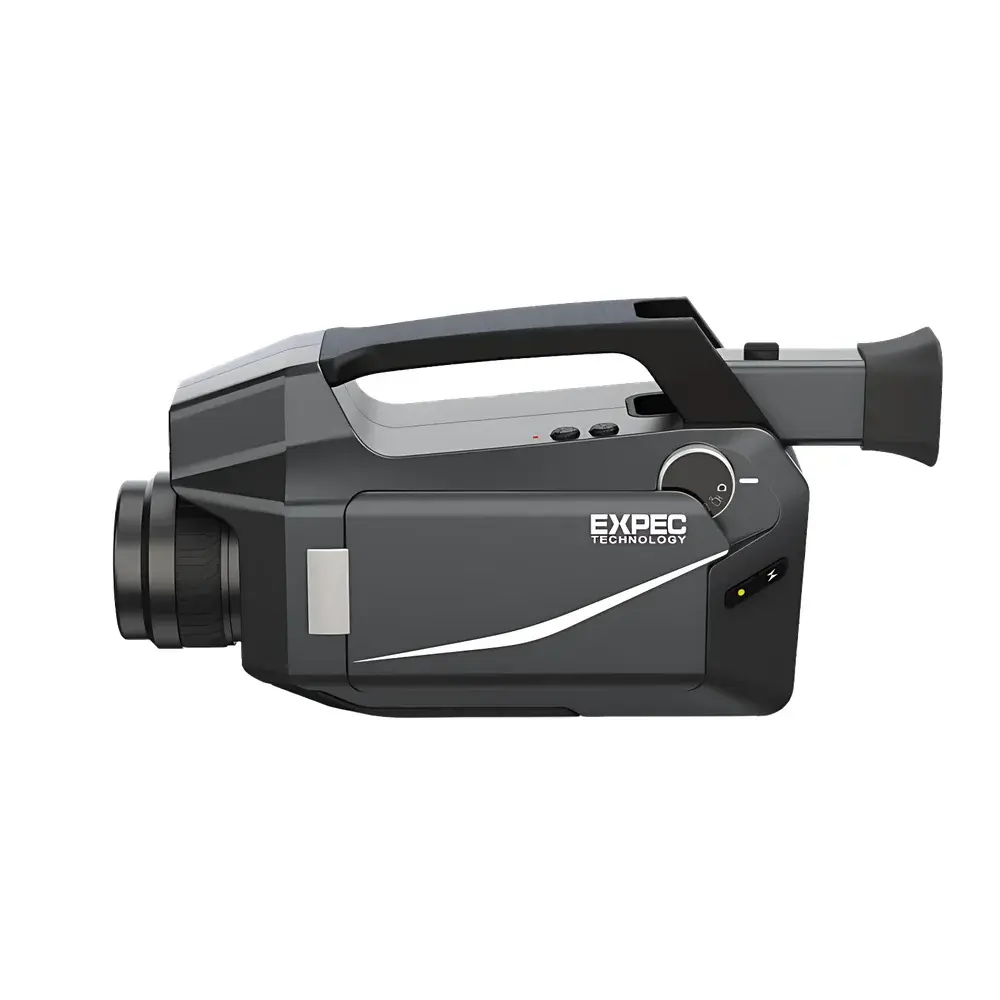
EXPEC 1880 Infrared Optical Gas Imaging (OGI) Camera
| Brand | EXPEC |
|---|---|
| Origin | Zhejiang, China |
| Manufacturer Type | Authorized Distributor |
| Country of Origin | China |
| Model | EXPEC 1880 |
| Pricing | Available Upon Request |
Overview
The EXPEC 1880 Infrared Optical Gas Imaging (OGI) Camera is a purpose-built, portable mid-wave infrared (MWIR) imaging system engineered for real-time, non-contact detection and visualization of volatile organic compound (VOC) emissions. Operating on the principle of spectral absorption contrast—leveraging the characteristic infrared absorption bands of hydrocarbon gases in the 3.2–3.4 µm range—the instrument enables optical identification of gas plumes against ambient thermal backgrounds without physical sampling. Designed for field-deployable environmental monitoring and industrial leak detection, the EXPEC 1880 delivers high-contrast thermal imagery with a thermal sensitivity (NETD) of ≤0.010 °C at 25 °C, ensuring reliable visualization of low-concentration, low-velocity VOC releases under variable ambient conditions.
Key Features
- Portable MWIR OGI platform with integrated 4.3-inch rotatable LCD display for real-time gas plume visualization and on-device source localization
- Operating temperature range: −25 °C to +50 °C; full functional integrity—including autofocus, brightness/contrast adjustment, and image storage—even at sub-zero temperatures
- Cold storage capability: stable operation and data retention verified down to −40 °C
- Lightweight design: total mass of 3.2 kg for extended handheld or tripod-mounted survey use
- Wireless interoperability: Wi-Fi-enabled integration with portable FID/PID analyzers (e.g., flame ionization and photoionization detectors), enabling synchronized display of quantitative concentration data alongside thermal imagery
- Remote operation support: compatible with intrinsically safe handheld controllers for hazardous-area deployment (e.g., Zone 1/21 environments)
- Field documentation suite: built-in still-image capture, voice annotation, HD video recording, and GPS geotagging for audit-ready evidence collection
Sample Compatibility & Compliance
The EXPEC 1880 is optimized for qualitative optical detection—not quantitative concentration measurement—of gaseous hydrocarbons and oxygenated VOCs exhibiting strong MWIR absorption signatures. Validated detectable compounds include methane, ethane, propane, butanes, pentanes, hexanes, heptanes, octane, ethylene, propylene, benzene, toluene, xylene, styrene, ethylbenzene, cyclohexane, methanol, ethanol, isopropanol, acetone, methyl ethyl ketone, acetaldehyde, formaldehyde, ethylene oxide, propylene oxide, and numerous chlorinated and fluorinated VOCs. The system supports compliance workflows aligned with EPA Method OOOOa (OGI for LDAR), ASTM D7925-21 (Standard Guide for Optical Gas Imaging), and ISO 17025-accredited field verification protocols. While not certified for intrinsic safety per IEC 60079-0/11, it is routinely deployed in conjunction with ATEX/IECEx-rated accessories and remote control interfaces for classified locations.
Software & Data Management
Imagery and metadata are stored internally in standard DICOM-compatible thermal image format (.seq or .jpg with embedded radiometric data). Onboard firmware supports time-stamped image export via USB or Wi-Fi to secure enterprise servers or cloud-based environmental management platforms. Optional desktop analysis software provides frame-by-frame plume trajectory analysis, comparative baseline imaging, and report generation templates compliant with regulatory submission requirements (e.g., EPA LDAR reporting formats). Audit trail functionality includes user login logs, timestamped configuration changes, and GPS-referenced image metadata—supporting GLP-aligned documentation practices and internal QA/QC traceability.
Applications
The EXPEC 1880 is widely deployed across upstream, midstream, and downstream energy infrastructure for routine LDAR (Leak Detection and Repair) surveys, fugitive emission screening, and regulatory compliance verification. Key application domains include refinery process units, petrochemical plant boundaries, natural gas transmission and distribution stations, LNG terminals, offshore platforms, wellhead sites, storage tank farms, loading racks, and fueling facilities. Environmental agencies and third-party inspection bodies utilize the system for enforcement-level field audits, post-incident plume mapping, and long-term emissions trend monitoring. Its portability and rapid response make it especially suited for mobile survey teams conducting large-area scanning under variable meteorological conditions.
FAQ
Does the EXPEC 1880 provide quantitative gas concentration values?
No—it is an optical gas imaging tool designed for qualitative plume visualization and spatial localization. Quantitative analysis requires integration with calibrated FID or PID sensors.
Is the camera certified for use in hazardous areas?
The core unit is not intrinsically safe certified; however, remote operation via Wi-Fi-connected ATEX/IECEx-compliant handsets enables safe deployment in Zone 1/21 environments.
Can thermal images be exported with radiometric data?
Yes—images retain full pixel-level temperature data and can be exported in radiometric JPEG or proprietary SEQ format for post-processing in third-party thermal analysis tools.
What is the minimum detectable leak rate under typical field conditions?
Detection sensitivity is highly dependent on gas type, wind speed, background emissivity, and distance; under controlled EPA OOOOa test conditions, the system reliably visualizes methane leaks ≥0.1 g/hr at 5–10 m standoff distance.
Does the device support firmware updates and calibration verification?
Yes—field-upgradable firmware and NIST-traceable blackbody calibration routines are accessible via USB or secure Wi-Fi, supporting ongoing metrological assurance per ISO/IEC 17025 laboratory quality systems.



