
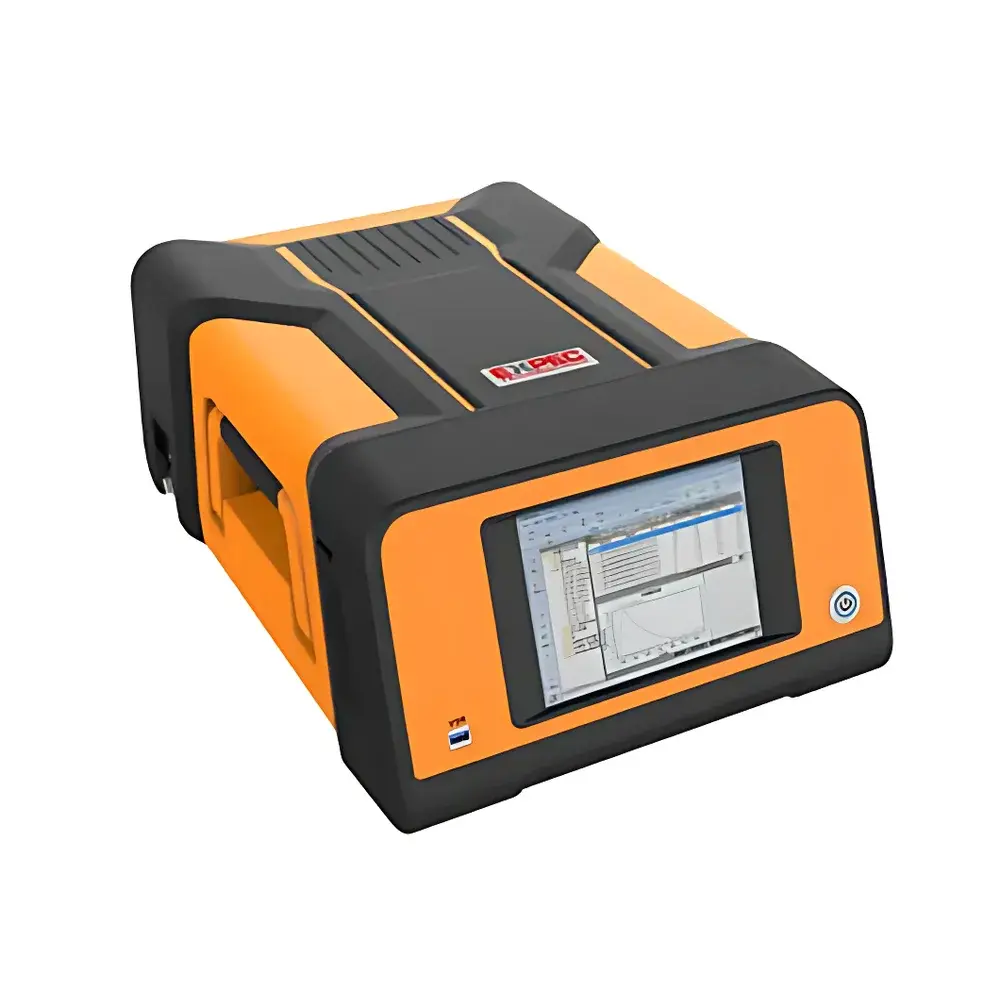
EXPEC 1680 Portable Fourier Transform Infrared (FTIR) Gas Analyzer
| Brand | EXPEC / Spectrometer Technology |
|---|---|
| Origin | Zhejiang, China |
| Manufacturer Type | Authorized Distributor |
| Product Category | Domestic |
| Model | EXPEC 1680 |
| Instrument Type | Portable |
| Instrument Principle | Fourier Transform Infrared (FTIR) Spectroscopy |
| Regulatory Compliance | HJ 920-2017, HJ 919-2017 |
| Target Analytes | >50 Inorganic & Organic Gases |
| Integrated Features | Heated Sample Path, Onboard Sampling System, GPS Geotagging, Touchscreen UI, Wi-Fi Connectivity, Auto Temperature Control, Remote Operation Capability |
Overview
The EXPEC 1680 Portable Fourier Transform Infrared (FTIR) Gas Analyzer is an engineered field-deployable spectroscopic instrument designed for real-time, in-situ identification and quantification of gaseous compounds across industrial emission monitoring, environmental emergency response, and process control applications. Operating on the principle of interferometric infrared absorption spectroscopy, the system utilizes a Michelson interferometer to generate high-fidelity interferograms, which are Fourier-transformed into absorbance spectra spanning the mid-infrared region. This enables simultaneous detection of multiple analytes based on their unique vibrational–rotational absorption fingerprints. The analyzer is specifically configured to meet the technical requirements of Chinese environmental standards HJ 920-2017 (“Emergency Monitoring of Inorganic Harmful Gases in Ambient Air Using Portable FTIR”) and HJ 919-2017 (“Determination of Volatile Organic Compounds in Ambient Air Using Portable FTIR”), ensuring regulatory alignment for field use in emissions compliance verification and incident response.
Key Features
- Integrated heated sampling path (up to 180 °C) with full-line thermal management to prevent condensation, adsorption, or fractional loss of reactive or polar species such as NH₃, HF, HCl, and formaldehyde
- Onboard gas sampling module with programmable flow control, pressure regulation, and automatic temperature stabilization—eliminating reliance on external pumps or conditioning units
- Dual-mode operation: standalone field analysis via embedded 7-inch capacitive touchscreen interface or remote supervision via Wi-Fi-enabled PC connection with secure TLS-encrypted data streaming
- Embedded GPS receiver for automatic georeferencing of every spectral acquisition; metadata including timestamp, location coordinates, ambient T/RH, and instrument status are embedded in raw data files
- Modular mechanical architecture optimized for shock resistance (IEC 60068-2-64 compliant), IP54-rated enclosure, and battery-operated runtime exceeding 4 hours under continuous measurement conditions
- Pre-loaded quantitative calibration libraries for over 50 target gases—including SO₂, NO, NO₂, N₂O, CO, CO₂, O₂ (via zirconia sensor fusion), H₂O, NH₃, HF, HCl, CH₄, C₂H₆, C₃H₈, C₂H₄, C₃H₆, C₂H₂, benzene, toluene, ethylbenzene, styrene, formaldehyde, and formic acid
Sample Compatibility & Compliance
The EXPEC 1680 is validated for direct analysis of undiluted stack gases, ambient air, and confined-space atmospheres without pre-concentration or chemical derivatization. Its optical path design accommodates variable matrix compositions—including high-moisture (>90% RH), high-dust, and corrosive environments—through robust purge gas integration and anti-fouling optical coatings. The instrument conforms to GLP-aligned data integrity practices: all spectral acquisitions include audit-trail metadata, user authentication logs, and immutable file hashing. While not certified to ISO/IEC 17025 for accredited testing, its measurement traceability follows NIM (National Institute of Metrology, China) reference standards, and calibration protocols align with ASTM D6348-10 (standard test method for determination of gaseous compounds by FTIR). Data output formats comply with EPA Method 320 and EU EN 15267-3 structural reporting conventions.
Software & Data Management
The analyzer runs proprietary EXPEC IR-Suite v3.x firmware, supporting both qualitative library matching (using correlation coefficient and least-squares fitting) and quantitative analysis via multivariate partial least squares (PLS) regression models. All calibrations are stored as encrypted .calx files with version control and expiration tagging. Raw interferograms (.ifg) and processed spectra (.spc) are saved in JCAMP-DX v6 format, compatible with third-party chemometric platforms including GRAMS/AI, OPUS, and Python-based SciPy/NumPy workflows. Data export supports CSV, PDF report generation (with customizable templates), and direct upload to cloud-hosted LIMS via HTTPS REST API. Audit trail records include operator ID, calibration verification timestamps, spectral quality metrics (e.g., SNR per band, zero-level stability), and GPS-derived positional uncertainty.
Applications
- Continuous emission monitoring (CEM) at waste incineration facilities—quantifying HCl, HF, SO₂, NOₓ, and dioxin precursors in flue gas
- Ultra-low emission verification in coal-fired power plants, sintering plants, and cement kilns per China’s “Ultra-Low Emission Transformation” policy (GB 13223-2011 amendments)
- Ammonia slip assessment across SCR and SNCR denitrification systems—measuring NH₃ concentration gradients before and after catalyst beds
- Field-based emergency response to chemical releases—rapid screening of VOCs and toxic inorganics during hazmat incidents, leveraging built-in alarm thresholds and compound-specific alert logic
- Mobile monitoring campaigns using vehicle-mounted configurations—enabling spatial mapping of fugitive emissions from petrochemical clusters or landfill sites
- Research-grade atmospheric chemistry studies—capturing time-resolved speciation of reactive intermediates in oxidation flow reactors or smog chambers
FAQ
Does the EXPEC 1680 support quantitative analysis for regulatory reporting?
Yes—it delivers traceable quantification for >50 gases using factory-installed PLS models validated against NIST-traceable gas standards; reports include uncertainty estimates per ISO/IEC Guide 98-3.
Is spectral data export compatible with third-party chemometric software?
All raw and processed data adhere to JCAMP-DX v6 and ASCII CSV standards, enabling seamless import into MATLAB, Python (scikit-learn), Unscrambler, and other open or commercial modeling environments.
How is instrument performance verified in the field?
Built-in automated validation routines execute daily zero/span checks using integrated reference cells; users may also perform field calibration transfer using portable permeation tubes or certified gas cylinders.
Can the system operate in extreme ambient conditions?
The unit operates continuously within –10 °C to +50 °C ambient temperature and up to 95% RH (non-condensing); internal thermal management maintains optical path stability across this range.
What cybersecurity measures are implemented for remote data transmission?
Wi-Fi communication uses WPA3-Enterprise authentication, TLS 1.2+ encryption, and role-based access control (RBAC); no default credentials or unsecured HTTP endpoints are exposed.





