
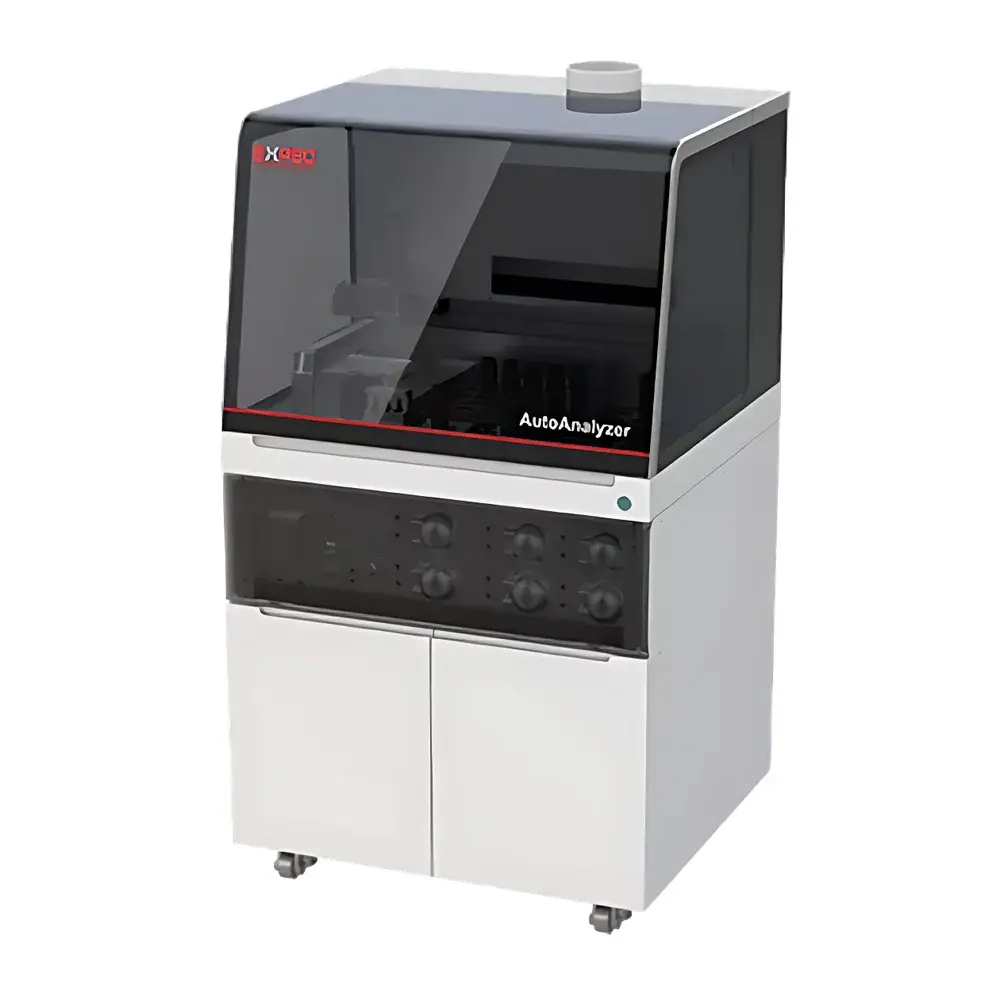
EXPEC 780 Fully Automated Graphite Block Digestion System
| Brand | EXPEC (Hangzhou Puyu Technology Co., Ltd.) |
|---|---|
| Origin | Zhejiang, China |
| Model | EXPEC 780 |
| Heating Block Material | High-Purity Graphite |
| Automation Level | Full Unattended Operation |
| Acid Resistance | PTFE/PFA-Wetted Components Compatible with HNO₃, HCl, HF, and HClO₄ |
| Temperature Control | PID-Controlled Distributed Heating |
| Temperature Range | Ambient to 230 °C |
| Sample Capacity | Up to 48 Positions (Configurable) |
| Acid Addition | Six Independent Peristaltic Pumps + Precision Syringe Pump for Spiking |
| Lid Handling | Motorized Lid Sealing/Unsealing with Condensation-Optimized Design |
| Volume Accuracy | <1% RSD at 50 mL (Ultrasonic Level Sensing) |
| Volume Range | 5–50 mL |
| Mixing Method | Pneumatic Bubble Agitation |
| Sample Transfer | Integrated Robotic Arm to Autosampler Tray |
| Exhaust System | Dedicated Acid-Fume Extraction with Corrosion-Resistant Ducting |
| Compliance | Designed for GLP/GMP Environments |
Overview
The EXPEC 780 Fully Automated Graphite Block Digestion System is an engineered solution for high-throughput, reproducible wet digestion in regulated analytical laboratories. It operates on the principle of controlled conductive heating via a high-purity graphite block, delivering uniform thermal energy across all sample positions while minimizing inter-vial temperature deviation. Unlike conventional hot plates or open-vessel heaters, the EXPEC 780 integrates closed-vessel digestion with programmable reagent delivery, lid actuation, post-digestion volume adjustment, and sample transfer—enabling end-to-end automation from acid addition to ready-for-analysis solution preparation. Its architecture addresses critical operational constraints in modern QA/QC and environmental testing labs: operator dependency, manual error propagation, exposure to corrosive fumes, and batch-to-batch variability in digestion efficiency. The system is designed for seamless integration into ICP-MS, ICP-OES, AAS, and IC workflows where trace-element recovery, contamination control, and method traceability are non-negotiable.
Key Features
- Fully automated reagent handling: Six chemically inert peristaltic pumps deliver acids (HNO₃, HCl, HF, HClO₄) with independent timing and volume control; syringe pump enables precise standard spiking with auto-calibration capability.
- Intelligent lid management: Motor-driven sealing mechanism ensures consistent pressure containment during digestion; optimized lid geometry promotes reflux condensation, enhancing reaction kinetics and reducing acid consumption.
- High-fidelity volume control: Ultrasonic level sensing achieves ≤1% volumetric accuracy at 50 mL across the 5–50 mL range; pneumatic bubbling ensures homogeneous mixing without vortexing or splashing.
- Corrosion-resilient fluid path: All wetted surfaces constructed from PTFE and PFA; graphite block coated with proprietary anti-etch layer; fully enclosed PFA tubing minimizes leaching and carryover.
- Distributed PID temperature regulation: Independent thermal sensors per zone enable real-time compensation for ambient drift and load asymmetry, ensuring ≤±0.8 °C inter-position uniformity at 180 °C.
- Dedicated fume extraction: Integrated exhaust ducting with acid-resistant fan and optional scrubber interface meets OSHA permissible exposure limits (PELs) for hydrogen fluoride and nitrogen oxides.
Sample Compatibility & Compliance
The EXPEC 780 accommodates standard 50 mL quartz, PTFE, or PFA digestion tubes and supports multi-step digestion protocols for complex matrices including soil, sediment, biological tissue (blood, liver), food homogenates, metal alloys, nuclear fuel pellets, and airborne particulate filters. Method development aligns with EPA Methods 3050B, 3051A, 3052; ISO 11466; ASTM D5762; and USP . Hardware design conforms to IEC 61010-1 safety standards for laboratory equipment. When paired with EXPEC’s validated LIMS-integrated software suite, the system supports full 21 CFR Part 11 compliance—including electronic signatures, audit trails, user access tiers, and immutable data logging—making it suitable for GLP audits and pharmaceutical QC environments.
Software & Data Management
Control is executed via a Windows-based application featuring intuitive drag-and-drop protocol builder, real-time thermal profiling, pump status monitoring, and event-triggered alerts (e.g., low acid level, lid misalignment, temperature overshoot). All method parameters—including ramp rates, hold times, reagent sequences, and volume targets—are stored as encrypted XML files with version timestamps. Raw sensor data (temperature, liquid level, pump revolutions) are logged at 1 Hz resolution and exportable in CSV or .CDF format for third-party statistical analysis. Optional API integration enables bidirectional communication with Thermo Fisher Qtegra, Agilent MassHunter, or PerkinElmer WinLab platforms.
Applications
- Environmental laboratories performing heavy metal analysis in wastewater, sludge, and contaminated soils per regulatory mandates.
- Food safety testing labs quantifying As, Cd, Pb, and Hg in infant formula, spices, and seafood using ICP-MS.
- Clinical toxicology units preparing whole blood or urine samples for multi-element panels under CLIA guidelines.
- Metallurgical R&D facilities digesting Ni-based superalloys and rare-earth magnets prior to trace impurity screening.
- Nuclear sector applications involving uranium oxide pellet dissolution and fission product recovery studies.
FAQ
Does the EXPEC 780 support hydrofluoric acid (HF) digestion protocols?
Yes—the entire fluid path, including tubing, connectors, and pump heads, is fabricated from PFA and PTFE, enabling safe, long-term use with concentrated HF up to 49% w/w.
Can digestion methods be validated per ISO/IEC 17025 requirements?
Absolutely. The system’s deterministic timing, calibrated volume delivery, and thermal uniformity data support full method validation documentation, including precision, recovery, LOD/LOQ, and robustness assessments.
Is remote monitoring supported?
The system includes Ethernet connectivity and supports SNMP-based status polling; optional VNC-enabled remote desktop access allows off-site troubleshooting without compromising network security policies.
What maintenance intervals are recommended for peristaltic pump tubing?
Under typical daily operation (8 h/day, 5 days/week), PFA-reinforced tubing should be replaced every 6 months; usage logs and pump RPM deviation alerts are tracked automatically in the software.
How is cross-contamination prevented between batches?
The system performs automatic air-purge cycles between samples, and the robotic arm uses disposable PTFE tips; all internal surfaces exposed to reagents are accessible for scheduled citric acid or dilute nitric acid cleaning protocols.



