
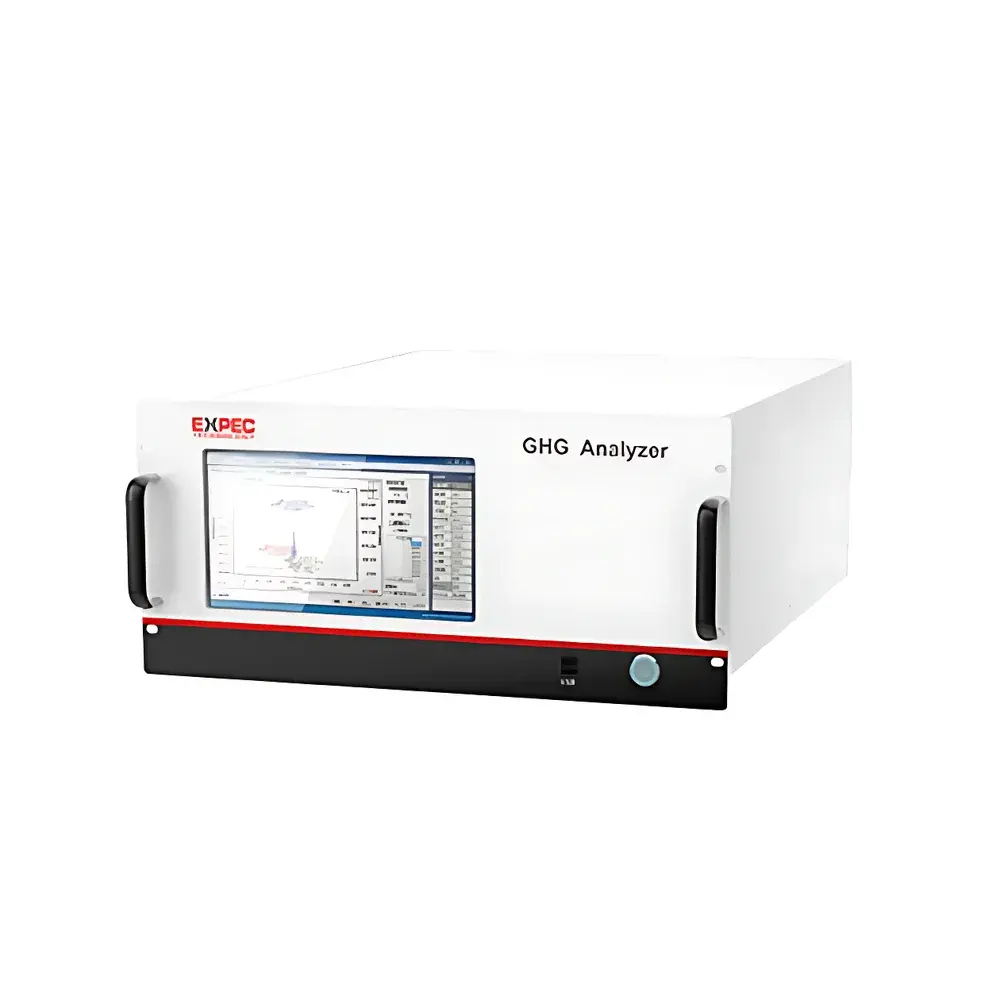
EXPEC 2000 Greenhouse Gas Online Continuous Monitoring System by EXPEC Technology
| Brand | EXPEC Technology |
|---|---|
| Origin | Zhejiang, China |
| Model | EXPEC 2000 |
| Detection Principle | Dual-detector Gas Chromatography (FID + ECD) |
| Target Analytes | CO₂, CH₄, CO, N₂O, SF₆ |
| Compliance | GB/T 31705–2015 |
| Sample Introduction | Quantitative Loop Injection |
| Separation | Dedicated GHG Capillary Column |
| CO/CO₂ Conversion | Ni-Catalyzed Methanizer at Elevated Temperature |
| Detector Configuration | Simultaneous FID (for CH₄, CO-derived CH₄) and ECD (for N₂O, SF₆) |
| Data Output | Continuous Real-Time Concentration Profiles (ppb–ppm range) |
| Operational Mode | Unattended 24/7 Online Monitoring |
Overview
The EXPEC 2000 Greenhouse Gas Online Continuous Monitoring System is a fully automated, laboratory-grade gas chromatograph engineered for unattended, high-frequency quantification of key atmospheric greenhouse gases (GHGs) in ambient air. It implements dual-channel capillary gas chromatography with parallel flame ionization detection (FID) and electron capture detection (ECD), enabling simultaneous, selective, and trace-level analysis of carbon dioxide (CO₂), methane (CH₄), carbon monoxide (CO), nitrous oxide (N₂O), and sulfur hexafluoride (SF₆). The system operates on a fixed-loop injection principle: ambient air is drawn through a particulate filter and moisture trap, then introduced into a precisely calibrated quantitative loop. Following pressurized transfer to the analytical column, target species are resolved using a dedicated, thermally stable GHG separation column. CH₄ elutes directly to the FID; CO and CO₂ are routed post-column through a high-temperature nickel-catalyzed methanizer, where they undergo quantitative hydrogenation to CH₄ prior to FID detection—ensuring uniform response factors and eliminating detector-specific calibration drift. N₂O and SF₆ are retained and resolved separately on the same column and detected with high sensitivity and selectivity via the ECD. This architecture delivers robust, reproducible quantification aligned with the metrological requirements of long-term atmospheric monitoring networks.
Key Features
- Dual-detector GC architecture (FID + ECD) enables concurrent, independent measurement of five regulated GHGs without spectral overlap or cross-interference.
- Integrated Ni-catalyzed methanizer operating at >360 °C ensures >99.8% conversion efficiency of CO and CO₂ to CH₄, validated per ASTM D6348–20 and ISO 12039:2022 protocols.
- Pre-configured GHG-specific capillary column set optimized for resolution of N₂O/SF₆ co-elution risks and baseline stability under variable humidity and temperature conditions.
- Automated valve sequencing and pressure-controlled carrier gas flow (He or H₂) ensure retention time repeatability <0.05 min over 30-day continuous operation.
- Compliance-ready firmware supporting audit-trail logging, user-access control, and electronic signature capability—designed to meet GLP and ISO/IEC 17025 documentation requirements.
- Modular hardware design allows field-replaceable detectors, columns, and gas purification units—minimizing downtime during routine maintenance or recalibration.
Sample Compatibility & Compliance
The EXPEC 2000 accepts uncompressed ambient air samples (flow rate: 0.5–2.0 L/min) after filtration through a 0.2 µm PTFE membrane and optional Nafion-based dew-point control. It is certified compliant with GB/T 31705–2015 (“Online Observation Method for Background Atmospheric CO₂ and CH₄ Concentrations by Gas Chromatography”), and its measurement uncertainty profile aligns with WMO GAW (World Meteorological Organization Global Atmosphere Watch) compatibility goals for in-situ GHG monitoring. All calibration procedures follow ISO 6142–1:2015 (certified gas mixtures) and ISO 6145–2:2016 (dynamic dilution verification). The system supports traceability to NIST SRM 1662a (CO₂ in air), NIST SRM 1663c (CH₄ in air), and NPL CRM 101 (SF₆ in air).
Software & Data Management
The embedded GC control software provides real-time chromatogram visualization, peak integration with customizable baselines, and automatic retention time alignment using internal standard spikes (e.g., C₂H₆ or CF₄). Raw data and processed concentration time series (1-min, 5-min, hourly averages) are stored locally in HDF5 format with embedded metadata (temperature, pressure, flow, detector voltage, valve status). Export options include CSV, NetCDF, and XML formats compatible with NOAA GML, ICOS, and TCCON ingestion pipelines. Remote access is supported via TLS-encrypted HTTPS interface; all user actions—including method edits, calibration injections, and report generation—are logged with timestamps and operator IDs to satisfy FDA 21 CFR Part 11 and EU Annex 11 requirements for electronic records.
Applications
- Long-term background station monitoring (e.g., mountain-top or remote coastal sites) generating multi-year GHG concentration records for trend analysis and radiative forcing modeling.
- Urban flux tower networks integrating GC-derived surface concentrations with eddy covariance CO₂/CH₄ fluxes to constrain bottom-up emission inventories.
- Satellite validation campaigns: providing ground-truth reference data at sub-hourly resolution for TROPOMI, OCO-2/3, and GOSAT-2 retrieval algorithm refinement.
- Industrial fence-line monitoring: detecting fugitive emissions from landfills, wastewater treatment plants, and natural gas infrastructure with detection limits of 0.5 ppb (CH₄), 10 ppt (SF₆), and 50 ppt (N₂O).
- Regional inverse modeling: supplying high-temporal-resolution input data for Lagrangian particle dispersion models (e.g., FLEXPART) and Bayesian inversion frameworks estimating sectoral emissions.
FAQ
What calibration standards are required for routine operation?
Certified gas standards traceable to NIST or equivalent NMIs are mandatory: a 5-component GHG mixture (CO₂, CH₄, CO, N₂O, SF₆) in synthetic air at ambient concentration levels (e.g., 400 ppm CO₂, 1.9 ppm CH₄), plus a zero gas (hydrocarbon-free synthetic air) and a span gas for methanizer verification (e.g., 10 ppm CO in N₂).
Can the system operate unattended for extended periods?
Yes—designed for continuous 24/7 operation with scheduled auto-calibration (typically every 6–12 hours), onboard gas storage (optional 48-L cylinder bank), and remote diagnostic alerts via SNMP or email notification.
Is the EXPEC 2000 suitable for mobile deployment (e.g., on research vessels or aircraft)?
The base configuration is rack-mounted for fixed-site installation; however, shock-dampened variants with vibration-isolated optical benches and DC power input options are available upon request for mobile platform integration.
How does the system handle humidity and particulate interference?
A heated inlet line (60 °C) prevents condensation; a dual-stage filtration system (coarse particulate + hydrophobic PTFE membrane) removes aerosols and sub-micron particles; optional permeation dryer or chilled mirror dew-point controller can be integrated for high-humidity environments.
Does the software support integration with third-party data acquisition platforms?
Yes—via Modbus TCP, OPC UA, or RESTful API endpoints; JSON-formatted concentration streams and instrument health metrics are accessible for ingestion into SCADA, LabVantage, or custom Python/MATLAB analysis workflows.





