
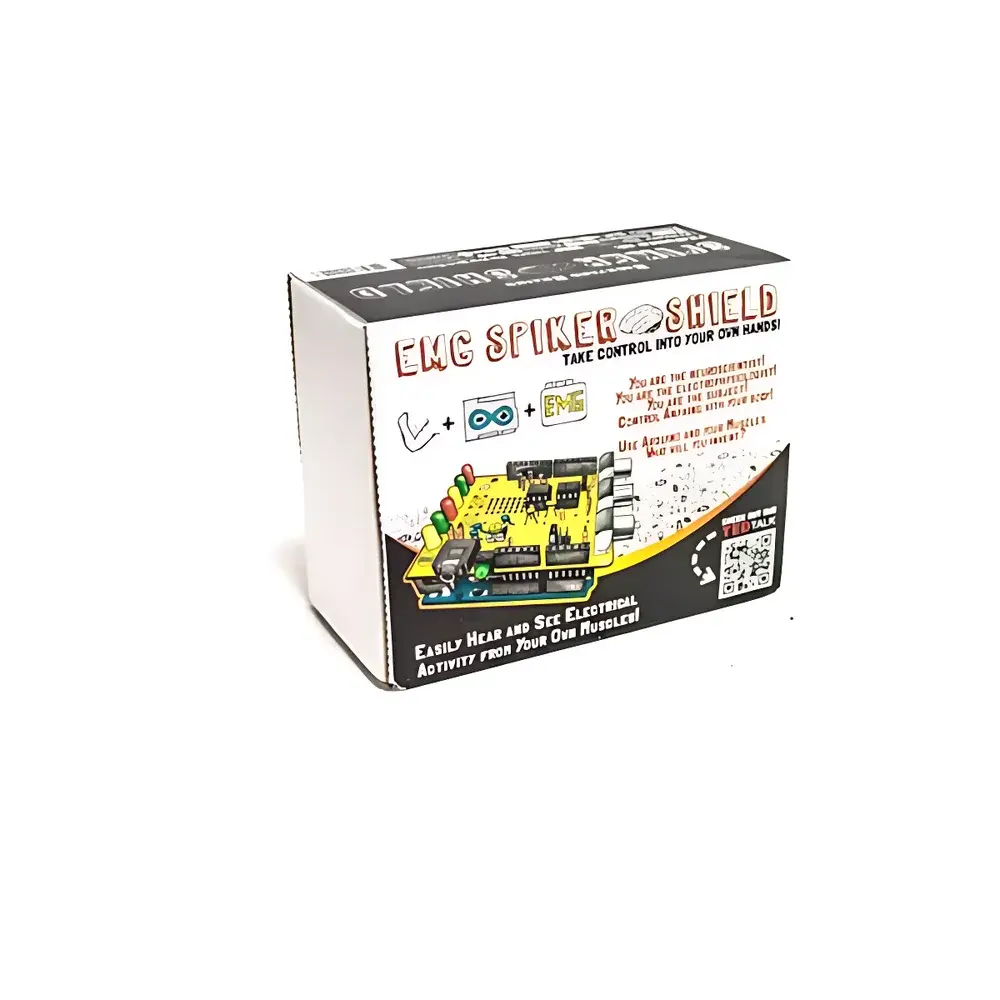
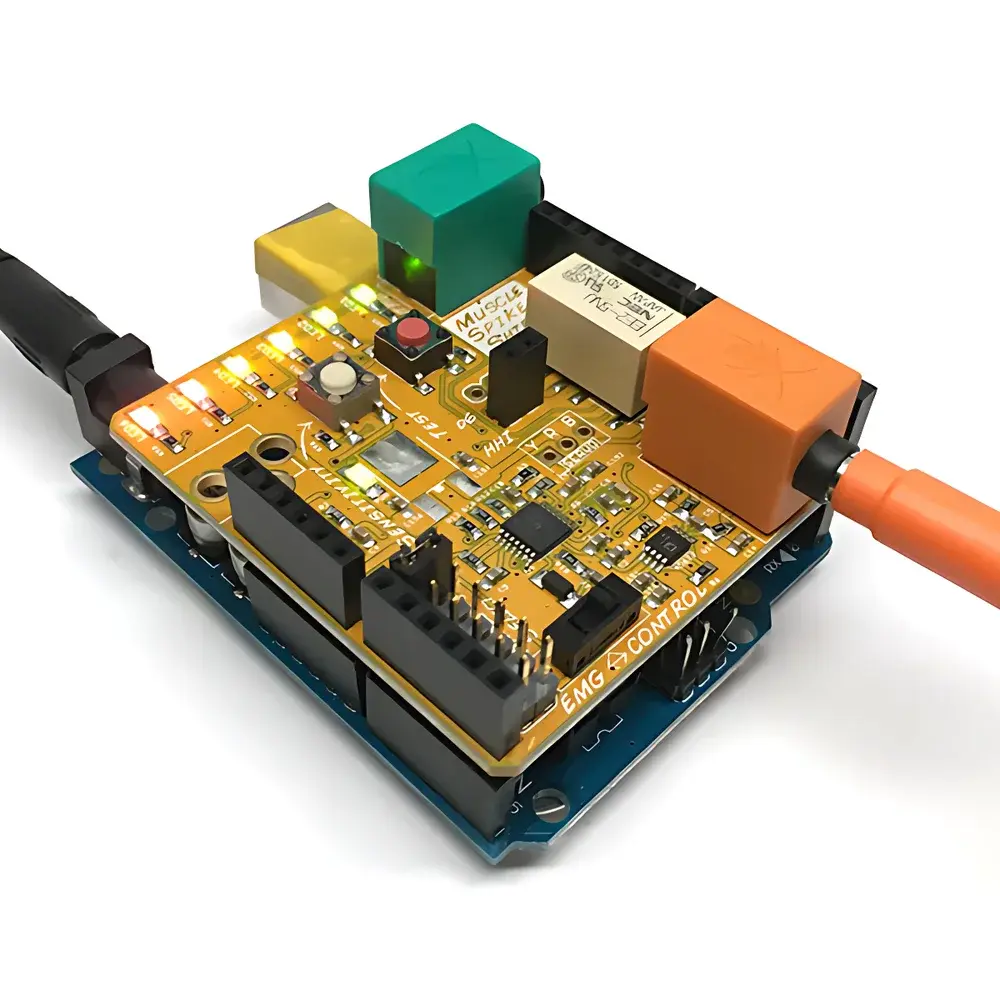
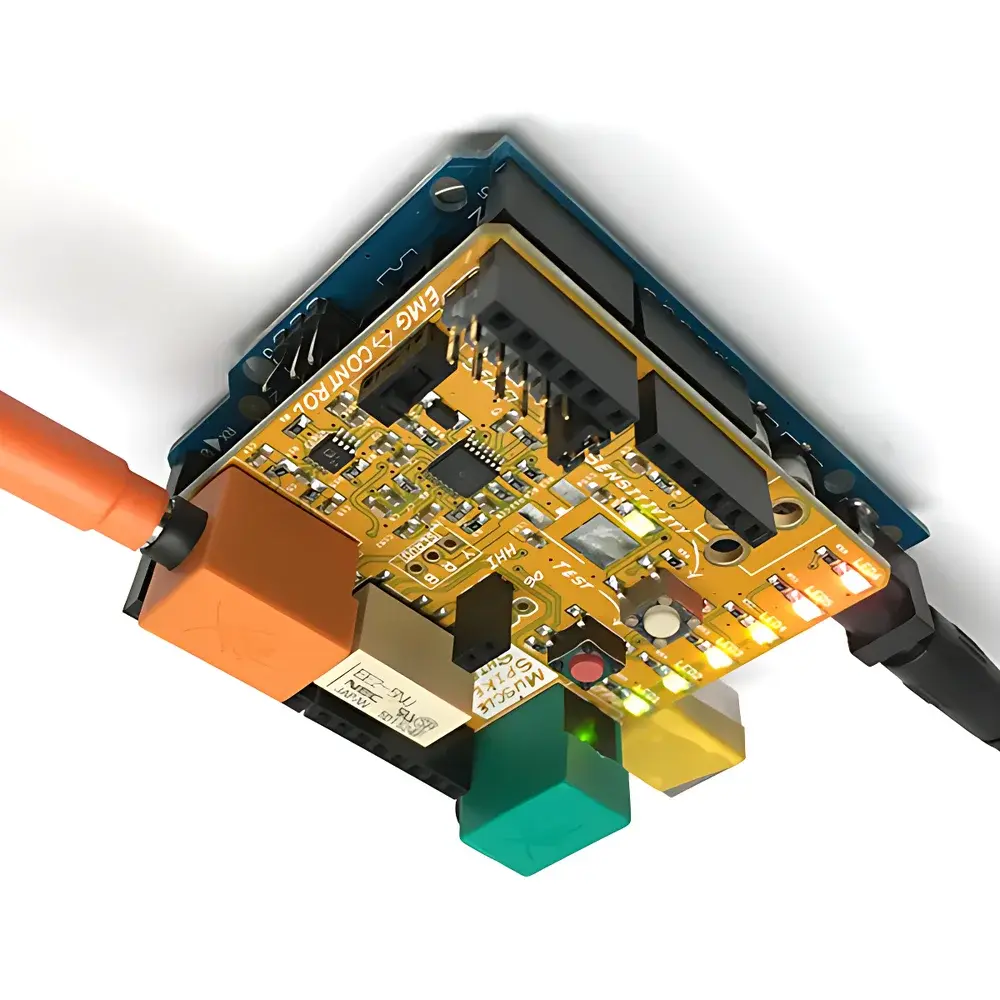
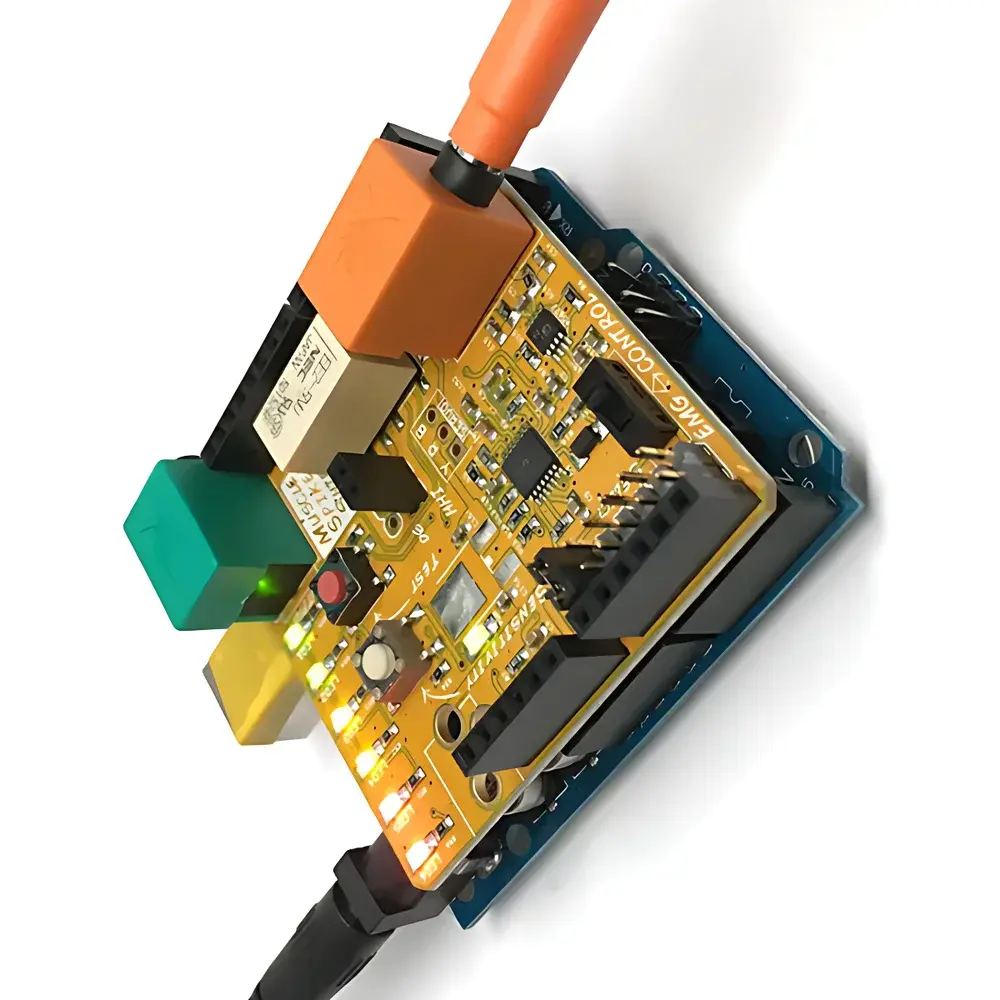
Muscle SpikerShield Bundle by Backyard Brains
| Brand | Backyard Brains |
|---|---|
| Origin | USA |
| Model | Muscle SpikerShield Bundle |
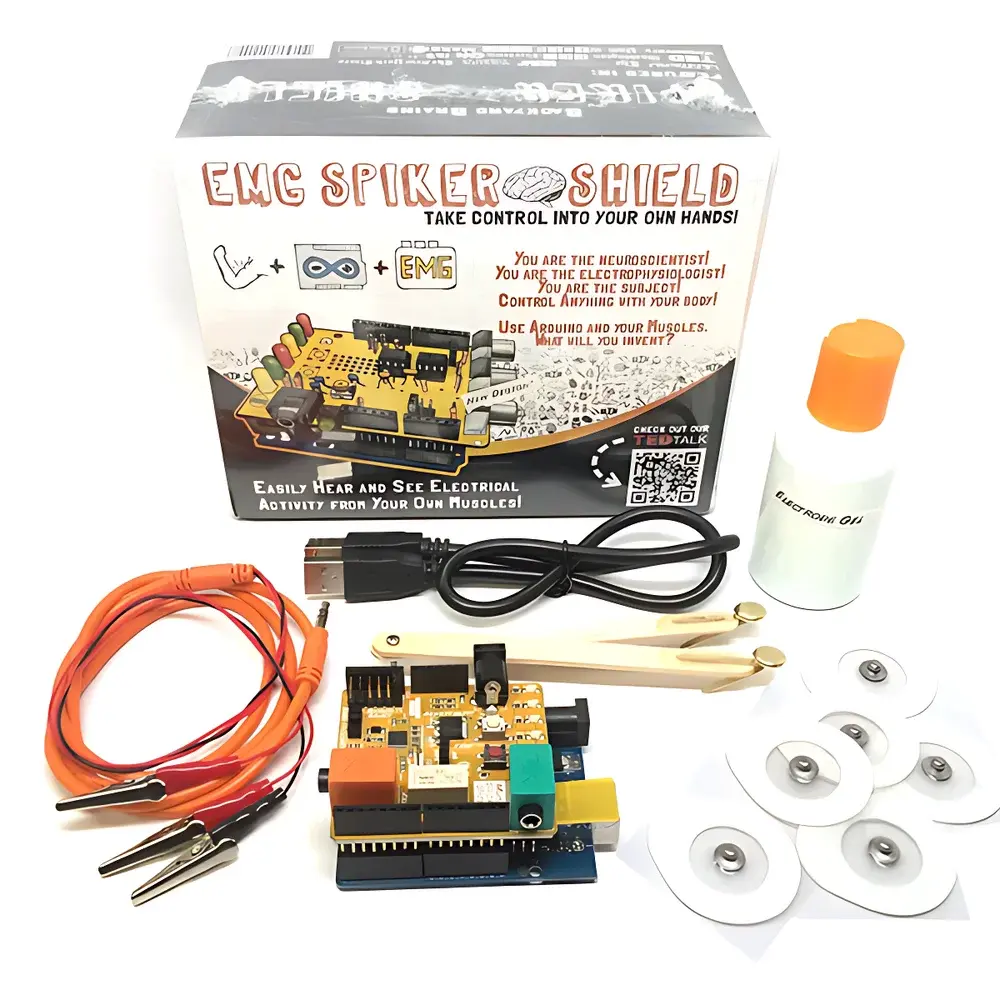
| Includes | Pre-assembled SpikerShield board, Arduino Uno (preloaded with EMG demo firmware), USB cable, 6× adhesive EMG electrodes, 1× adjustable wooden electrode stand, 1× bottle of conductive electrode gel, 1× orange recording electrode wire with alligator clips (2× red, 1× black), 1× brass rod-style electrodes for small-muscle recording |
| Compliance | CE, FCC, RoHS compliant |
| Software | Open-source Arduino IDE-compatible firmware, Python-based data visualization examples available via Backyard Brains GitHub repository |
| Target Platform | Arduino Uno R3 compatible |
| Input Signal Type | Bipolar surface electromyography (sEMG) |
| Sampling Resolution | 10-bit ADC (default), upgradable to 12-bit via firmware modification |
| Operating Voltage | 5 V DC (USB-powered) |
| Bandwidth | 10–450 Hz (analog signal path), configurable digital filtering in firmware |
Overview
The Muscle SpikerShield Bundle by Backyard Brains is an open-hardware educational electrophysiology platform designed for real-time acquisition and interpretation of surface electromyographic (sEMG) signals. Engineered for precision and accessibility, it implements a low-noise, high-gain analog front-end optimized for bipolar sEMG detection—leveraging differential amplification, 60 Hz notch filtering, and programmable gain staging to isolate biologically relevant muscle action potentials from ambient electromagnetic interference. The system operates on the principle of non-invasive bioelectric signal transduction: when skeletal muscle fibers depolarize during voluntary contraction, extracellular voltage gradients propagate through tissue and skin, where they are captured by surface electrodes and converted into digitizable analog waveforms. This bundle integrates seamlessly with the Arduino Uno microcontroller, enabling immediate deployment of classroom-ready experiments, human-computer interface prototyping, and foundational neuroengineering investigations—without requiring soldering, calibration tools, or proprietary software licenses.
Key Features
- Pre-assembled, fully tested SpikerShield board with integrated instrumentation amplifier, bandpass filtering (10–450 Hz), and hardware-level 60 Hz notch filter
- Arduino Uno R3 microcontroller preloaded with validated firmware for real-time LED control via EMG amplitude thresholding—serving as both functional demo and codebase reference
- Dual-electrode modality support: six self-adhesive Ag/AgCl patch electrodes for large-muscle sEMG (e.g., biceps brachii, quadriceps femoris), plus brass rod electrodes mounted on an adjustable wooden stand for high-spatial-resolution recording from orbicularis oculi or intrinsic hand muscles
- Open-source architecture: full schematics, BOM, PCB layout files, and Arduino firmware published under CC-BY-SA; Python data-logging and visualization scripts available on GitHub
- USB-powered operation (5 V DC) with plug-and-play compatibility across Windows, macOS, and Linux systems—no external power supply or driver installation required
- FCC/CE/RoHS certified for laboratory and educational use; meets IEC 60601-1 essential performance criteria for non-invasive bioelectric measurement devices used in teaching environments
Sample Compatibility & Compliance
The Muscle SpikerShield Bundle supports surface EMG recordings from human skeletal muscle tissue under controlled, non-clinical conditions. It is intended exclusively for educational, demonstration, and prototyping applications—not for diagnostic, therapeutic, or regulatory-submission purposes. Electrode configurations comply with ASTM F2678-22 guidelines for surface EMG sensor placement and skin-electrode interface impedance management. The included conductive gel maintains stable skin contact impedance below 10 kΩ at 50 Hz, consistent with ISO 26542:2017 recommendations for low-noise sEMG acquisition. All electronic components meet EN 55032:2015 emission limits and EN 61000-4-3 immunity requirements for laboratory-grade instrumentation.
Software & Data Management
Firmware is deployed via the Arduino IDE using standard serial communication protocols (UART @ 115200 baud). Raw EMG time-series data can be streamed in real time to host computers using Serial Monitor or custom Python scripts (PySerial + Matplotlib). The open-source firmware includes configurable parameters for gain scaling, moving-average window length, and LED activation thresholds—enabling adaptation to diverse experimental designs. Audit trails for firmware modifications are maintained in public GitHub repositories, supporting GLP-aligned documentation practices for undergraduate research labs. While not FDA 21 CFR Part 11 compliant (as it is not a regulated medical device), the platform’s version-controlled codebase facilitates reproducibility and peer verification in academic settings.
Applications
- Undergraduate neuroscience and biomedical engineering laboratories: hands-on instruction in bioelectric signal acquisition, noise rejection techniques, and neuromuscular physiology
- Human-computer interface (HCI) prototyping: mapping sEMG amplitude or spectral features to control external actuators, MIDI devices, or assistive technologies
- Art-science collaborations: real-time sonification or visual translation of muscle activity for interactive installations
- Rehabilitation engineering education: comparative analysis of motor unit recruitment patterns across muscle groups and contraction intensities
- Kinesiology and sports science demonstrations: correlating sEMG onset latency with movement initiation timing in reaction-time paradigms
FAQ
Is this device suitable for clinical diagnostics or patient monitoring?
No. The Muscle SpikerShield Bundle is classified as an educational and research-grade instrument per IEC 62304 Annex C and is not certified for clinical use, medical device classification, or regulatory submission.
Can I modify the firmware to implement custom signal processing algorithms?
Yes. Full source code, hardware design files, and technical documentation are openly licensed and hosted on GitHub. Modifications require basic familiarity with C++ and Arduino programming conventions.
What is the recommended inter-electrode distance for optimal sEMG signal quality?
For large-muscle recordings using patch electrodes, maintain a 20–30 mm center-to-center spacing aligned parallel to muscle fiber orientation, per SENIAM project recommendations.
Does the system support wireless data transmission?
Not natively. However, users may integrate third-party Bluetooth or LoRa modules via Arduino’s UART or I²C interfaces—subject to firmware reconfiguration and RF compliance validation.
Are replacement electrodes and gel available separately?
Yes. Backyard Brains offers consumables—including Ag/AgCl patches, brass rod electrodes, and conductive gel—through authorized distributors with traceable lot numbers and shelf-life documentation.



