
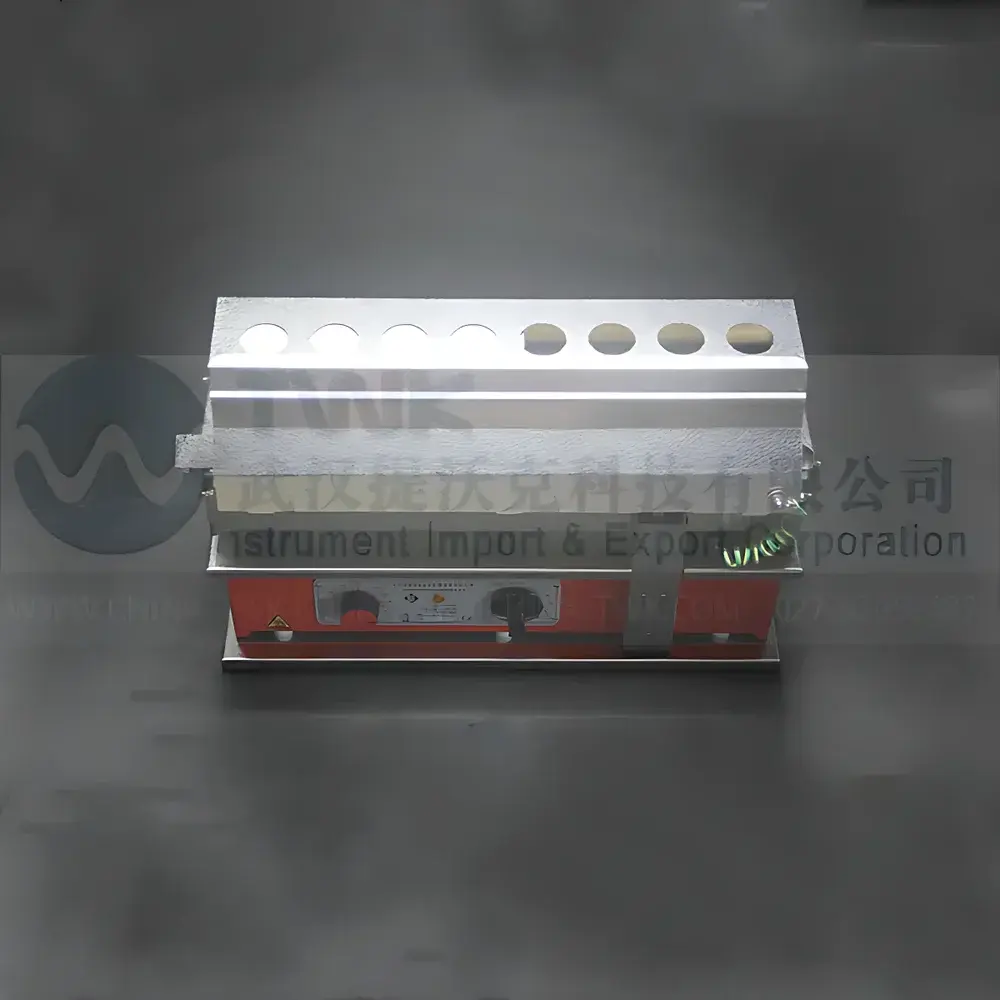
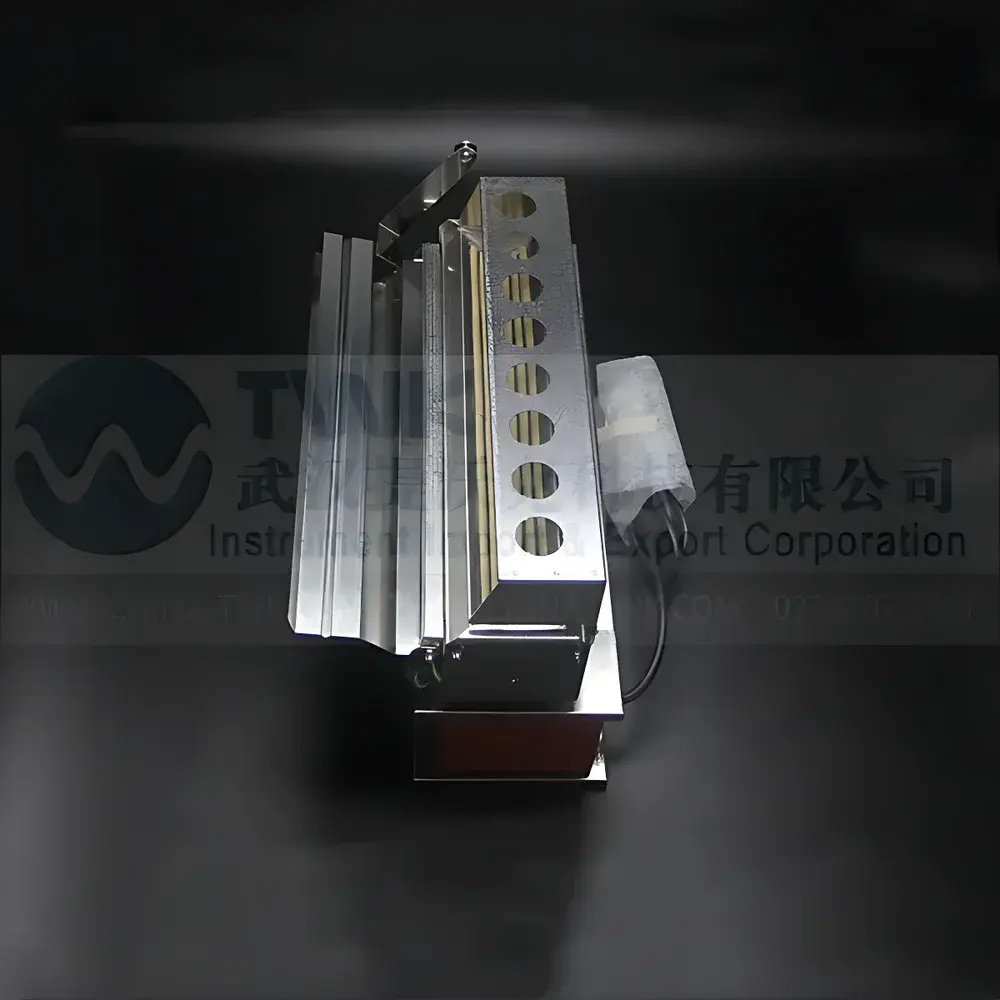
Harry Gestigkeit SVD95/P Digital Rapid Ashing Furnace
| Brand | Harry Gestigkeit |
|---|---|
| Origin | Germany |
| Model | SVD95/P |
| Power | 2500 W |
| Voltage | 220 V |
| External Dimensions | 450 × 310 × 180 mm |
| Maximum Temperature | 950 °C |
| Heating Time (RT → 950 °C) | < 5 min |
| Crucible Capacity | 8 × Ø34 mm or up to 4 × Ø50 mm |
| Ashing Bed Length | 400 mm |
| Timer Range | 0–120 min with audible alarm |
| Safety Interlock | Lid-activated power cutoff |
| Construction Material | Grade G stainless steel |
| Compliance | CE-marked, designed for ISO 562 / ASTM D3174 / AOAC 942.05 ash content determination |
Overview
The Harry Gestigkeit SVD95/P Digital Rapid Ashing Furnace is a compact, high-performance laboratory furnace engineered for rapid, reproducible ash content determination in accordance with standardized gravimetric methods. It operates on the principle of controlled oxidative thermal decomposition—subjecting organic samples to precisely regulated high-temperature combustion in ambient air, thereby quantifying inorganic residue (ash) as a percentage of the original dry mass. Designed for routine quality control and regulatory testing in food, feed, pharmaceutical, environmental, and materials laboratories, the SVD95/P delivers full operational temperature (up to 950 °C) from ambient in under five minutes—significantly reducing cycle time versus conventional muffle furnaces. Its open-top, inclined ashing bed architecture enables direct visual monitoring of combustion progression, supporting method development, endpoint verification, and operator training without compromising thermal uniformity or safety.
Key Features
- Rapid Thermal Response: Optimized heating element layout and low thermal mass chamber enable ramp rates exceeding 150 °C/min, achieving 950 °C within ≤4.5 minutes from room temperature.
- Visual Ashing Bed: 400 mm-long inclined crucible support allows unobstructed observation of sample ignition, charring, and ash formation—critical for detecting incomplete combustion or volatile loss artifacts.
- Dual-Crucible Compatibility: Accommodates either eight Ø34 mm porcelain or platinum crucibles (standard configuration) or up to four larger Ø50 mm crucibles for bulk or heterogeneous samples.
- Precision Digital Timer: 0–120 min programmable countdown timer with audible buzzer alert; maintains power-on state post-alarm to prevent premature cooling during critical hold phases.
- Integrated Safety Architecture: Mechanical lid interlock instantly de-energizes heating elements upon cover opening; constructed from corrosion-resistant Grade G stainless steel per DIN 1.4841 (equivalent to AISI 330), ensuring long-term stability at peak temperature.
- Space-Efficient Footprint: Compact external dimensions (450 × 310 × 180 mm) suit benchtop deployment in high-density lab environments without requiring dedicated ventilation hoods—ambient air exchange suffices for standard ashing protocols.
Sample Compatibility & Compliance
The SVD95/P supports ash content analysis across diverse matrices including animal feed, cereals, dairy powders, activated carbon, catalysts, and polymer additives. Its open-air combustion environment complies with the fundamental requirements of ISO 562 (Solid mineral fuels), ASTM D3174 (Coal and coke), and AOAC Official Method 942.05 (Total ash in foods). While not a forced-air or oxygen-enriched system, its geometry promotes natural convective oxygen replenishment across the crucible array—enhancing burnout efficiency for low-volatility organics. The furnace meets CE marking requirements for electromagnetic compatibility (EMC Directive 2014/30/EU) and low voltage safety (LVD Directive 2014/35/EU). For GLP/GMP-regulated environments, it supports documented operation via external data loggers; however, it does not include built-in 21 CFR Part 11 audit trail functionality.
Software & Data Management
The SVD95/P is a stand-alone analog-digital hybrid instrument with no embedded microprocessor or network interface. Temperature setpoint and timer are managed via front-panel push-button controls with LED digit display (0.1 °C resolution, ±2 °C accuracy at 950 °C). No proprietary software is required or provided. Users maintain traceability through manual logbooks or integration with LIMS via external thermocouple data acquisition systems (e.g., USB-connected Type-S or K thermocouples with calibrated reference junctions). All timing and temperature events are operator-recorded; the audible timer alarm serves as a procedural checkpoint for sample removal or hold-phase initiation.
Applications
- Regulatory ash content verification per USP <731>, Ph. Eur. 2.4.12, and JP 2.40.
- Quality assurance of mineral supplements, fertilizers, and soil amendments.
- Residue quantification in catalyst recovery processes (e.g., Pt/C, Ni/Al2O3).
- Preparation of inorganic standards for ICP-OES/MS analysis following complete organic matrix removal.
- Educational demonstrations of thermal decomposition kinetics and stoichiometric ash yield prediction.
FAQ
Does the SVD95/P support programmable multi-step temperature profiles?
No—this is a single-setpoint furnace with fixed maximum temperature (950 °C) and manual timer control. It is optimized for isothermal ashing, not thermal ramping protocols.
Can it be used for loss-on-ignition (LOI) measurements?
Yes, provided the protocol specifies ambient-air combustion at 950 °C for defined durations; users must validate LOI repeatability against certified reference materials for their specific matrix.
Is a dedicated exhaust duct required?
Not for standard ashing; natural convection and lab ambient air exchange are sufficient. However, fume extraction is recommended when processing halogenated, sulfur-rich, or heavily sooted samples.
What crucible materials are compatible?
Porcelain, alumina, and platinum crucibles are validated; avoid quartz above 800 °C due to devitrification risk and stainless steel due to oxidation interference.
How is calibration verified?
Users perform periodic verification using NIST-traceable secondary standard thermocouples placed inside representative crucibles at the center of the ashing bed, recorded during stabilized 950 °C operation.



