
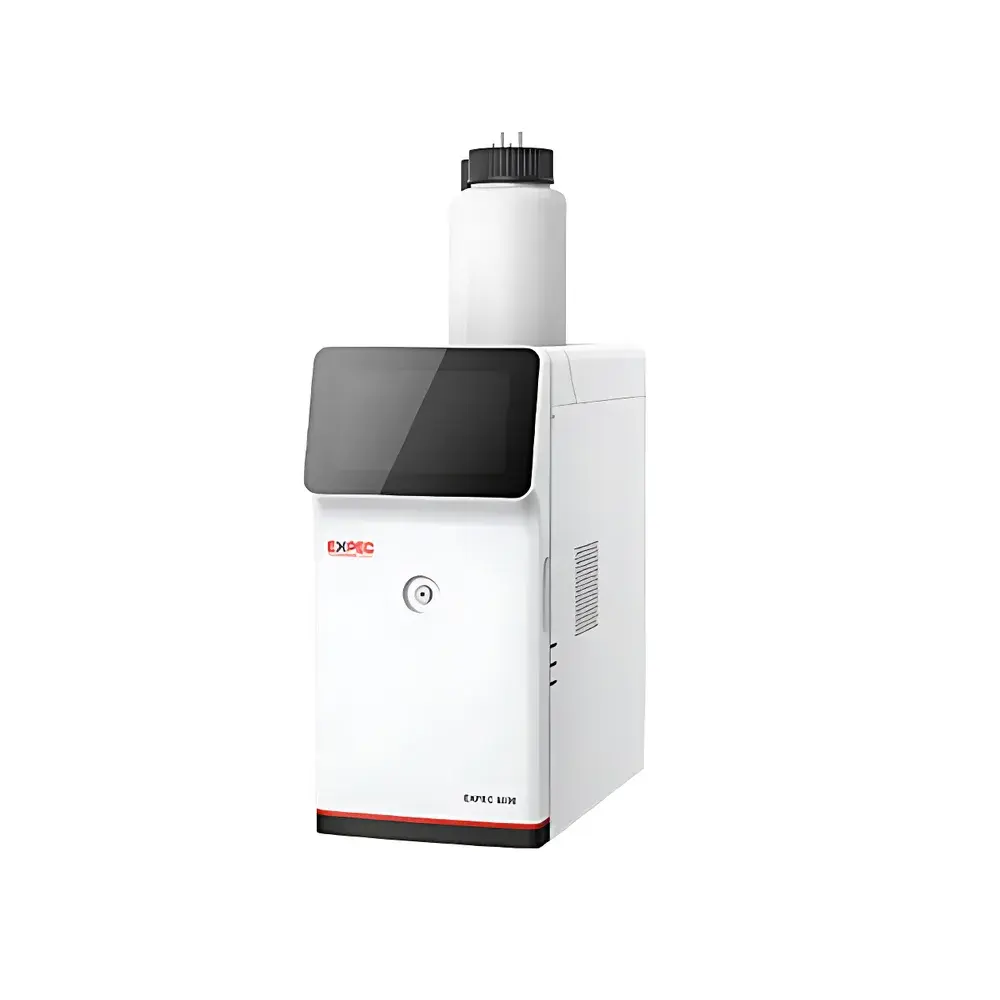
EXPEC 6800 Ion Chromatograph
| Brand | EXPEC (Puyu Technology) |
|---|---|
| Origin | Zhejiang, China |
| Model | EXPEC 6800 |
| Detection Principle | Suppressed Conductivity Detection with Electrolytic Regeneration |
| Column Compatibility | Capillary- and Micro-bore Format (≤0.4 mm ID) |
| Eluent Generation | On-line Electrolytic Eluent Generator (“Water-Only” Mode) |
| Temperature Control | Dual-stage Full-Flowpath Thermal Management (−10 °C to 45 °C ambient operating range) |
| Suppressor Type | Continuous Electrolytic Regenerative Membrane Suppressor |
| Data Acquisition | Integrated Industrial PC with Touchscreen + External Chromatography Workstation (Windows-based, FDA 21 CFR Part 11 compliant modules available) |
| Compliance | ASTM D4327, ISO 14911, USP <645>, EPA Methods 300.0, 317.0, 321.8 |
Overview
The EXPEC 6800 Ion Chromatograph is a high-performance, laboratory-grade analytical system engineered for precise anion and cation separation and quantification in complex matrices. Built upon suppressed conductivity detection and continuous electrolytic regeneration technology, the instrument employs a capillary- and micro-bore chromatographic architecture—optimized for low flow rates (0.1–0.5 mL/min) and minimal eluent consumption. Its core design integrates a full-flowpath dual-stage thermal management system, enabling stable column and detector operation across extreme ambient conditions (−10 °C to 45 °C), including mobile or field-deployable environments such as vehicle-mounted labs or remote monitoring stations. Unlike conventional ion chromatographs relying on manually prepared eluents and chemical regeneration, the EXPEC 6800 features an on-line electrolytic eluent generator that produces high-purity KOH, methanesulfonic acid (MSA), or other eluents from deionized water alone—eliminating manual preparation errors and significantly improving inter-day reproducibility.
Key Features
- Dual-stage full-flowpath temperature control: Independent regulation of column oven, detector cell, and entire fluidic path—including active cooling down to 4 °C—enabling robust analysis of thermally labile species (e.g., perchlorate, iodide, organic acids) without degradation.
- Ultra-low eluent consumption: 2 L of deionized water supports up to 16 days of continuous operation (8 h/day), reducing operational overhead and minimizing baseline drift during long gradient runs.
- Continuous electrolytic membrane suppressor: No external acid/base reagents required; compact footprint ensures optimal compatibility with narrow-bore columns and low-volume detection cells.
- Integrated industrial touchscreen interface: Embedded Windows-based controller enables complete method development, injection control, real-time peak integration, calibration curve generation, and report export—without external PC dependency.
- Modular IC-MS coupling architecture: Designed for seamless interfacing with quadrupole, triple-quadrupole, and high-resolution mass spectrometers via standardized ESI or APCI interfaces; supports speciation analysis per EPA Method 1632 and ISO/IEC 17025-compliant workflows.
- Impurity ion trap: Installed upstream of the separator column to scavenge trace metal ions and carbonate/bicarbonate contaminants—critical for maintaining baseline stability during multi-step gradient elution.
Sample Compatibility & Compliance
The EXPEC 6800 accommodates aqueous samples across wide concentration ranges—from sub-pptr environmental waters to high-salinity industrial effluents—following appropriate dilution or matrix elimination (e.g., solid-phase extraction, inline dialysis). It meets regulatory requirements for routine testing under ASTM D4327 (anions in water), ISO 14911 (determination of inorganic anions), USP <645> (conductivity of purified water), and EPA Methods 300.0 (anions), 317.0 (perchlorate), and 321.8 (bromate). When configured with audit-trail-enabled software modules, the system supports GLP/GMP data integrity standards, including electronic signatures, user access levels, and 21 CFR Part 11-compliant metadata logging.
Software & Data Management
Data acquisition and processing are managed through a dual-platform architecture: the onboard touchscreen interface provides immediate access to sequence control, real-time chromatogram visualization, and basic reporting; while the optional external Chromatography Data System (CDS) offers advanced tools for peak deconvolution, multi-component calibration, automated QC flagging, and LIMS integration via ASTM E1384 or HL7 protocols. All raw data files adhere to ANDI/NetCDF format, ensuring long-term archival compatibility and third-party spectral library interoperability.
Applications
The EXPEC 6800 delivers validated performance in regulated and research-driven settings, including drinking water compliance monitoring (NO₃⁻, F⁻, Cl⁻, SO₄²⁻, BrO₃⁻), semiconductor rinse water purity assessment (ppq-level fluoride and chloride), food extract analysis (phosphate, nitrite, sulfite), agricultural soil leachate profiling (NH₄⁺, NO₂⁻, PO₄³⁻), and speciation studies (As(III)/As(V), Cr(III)/Cr(VI), Se(IV)/Se(VI)) when coupled to ICP-MS or ESI-QTOF platforms.
FAQ
Does the EXPEC 6800 support gradient elution?
Yes—it supports both isocratic and multi-step linear or nonlinear gradient elution using the integrated electrolytic eluent generator.
Is the suppressor compatible with capillary-format columns?
Yes—the low-volume continuous regenerative membrane suppressor is specifically engineered for sub-0.4 mm ID columns and maintains >95% suppression efficiency at flow rates as low as 0.1 mL/min.
Can the system operate unattended for extended periods?
Yes—equipped with autosampler-ready I/O ports, power-fail recovery logic, and scheduled shutdown/startup functions, it supports overnight and weekend sequences with full event logging.
What regulatory documentation is provided for validation?
Factory-installed IQ/OQ documentation, hardware/firmware version logs, and electronic calibration certificates are supplied; PQ protocols can be customized per client SOP or ISO/IEC 17025 requirements.
Is remote diagnostics supported?
Yes—via secure TLS-encrypted VNC tunneling to the embedded industrial PC, authorized service engineers can perform firmware updates, flow-path diagnostics, and detector cell verification without on-site visits.
Related Products






