
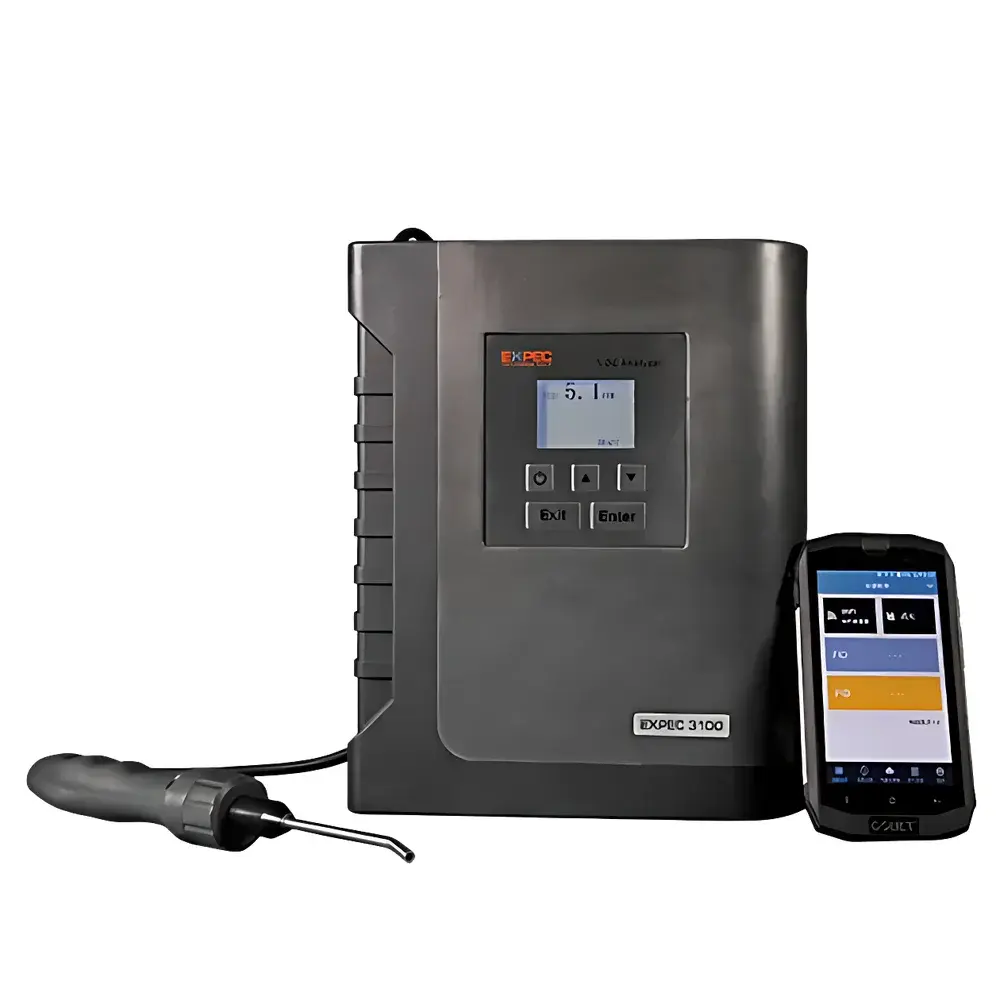
EXPEC 3100 Portable VOC Analyzer (Battery-Powered GC-FID/PID System)
| Brand | EXPEC (Hangzhou Superspectra Technology Co., Ltd.) |
|---|---|
| Origin | Zhejiang, China |
| Model | EXPEC 3100 |
| Instrument Type | Portable Gas Chromatograph with Flame Ionization and Photoionization Detectors |
| Compliance | GB 37822–2019, HJ 733–2014, HJ 1019–2019 |
| Weight | 3.7 kg |
| Response Time | < 3.5 s (FID/PID) |
| Detector Options | FID (standard), PID (optional) |
| Explosion Protection | Intrinsically Safe (handheld controller), Flameproof (FID module), Certified for Class I, Division 1 hazardous locations |
Overview
The EXPEC 3100 Portable VOC Analyzer is a field-deployable gas chromatography system engineered for rapid, on-site quantification of volatile organic compounds (VOCs) in ambient air, industrial process streams, soil headspace, and fugitive emission sources. Unlike benchtop GC systems, the EXPEC 3100 integrates a miniaturized capillary column oven, precision carrier gas control (hydrogen or air), and dual-detector capability—featuring a flame ionization detector (FID) as standard and an optional photoionization detector (PID)—within a rugged, lightweight chassis. Its operational principle relies on separation via temperature-programmed capillary GC followed by selective detection: FID provides universal, linear response to hydrocarbons and most organics (detection limit ≤ 0.1 ppm C₁–C₁₂), while PID delivers enhanced sensitivity to aromatic and unsaturated compounds (e.g., benzene, styrene, formaldehyde) with ionization energies below 10.6 eV. Designed for compliance-driven environmental monitoring, the instrument meets Chinese national standards including GB 37822–2019 (Control Standard for Unorganized VOC Emissions), HJ 733–2014 (Technical Guideline for Leak Detection and Repair), and HJ 1019–2019 (Sampling Techniques for VOCs in Soil and Groundwater).
Key Features
- Explosion-protected architecture: Intrinsically safe handheld controller (Ex ib IIB T4 Gb), flameproof FID module (Ex d IIB T4 Gb), certified for Class I, Division 1 hazardous areas per GB 3836 series.
- Ultra-portable form factor: Total system mass of 3.7 kg; optimized thermal management and composite housing enable continuous operation for >4 hours on integrated rechargeable Li-ion battery.
- Dual-detection flexibility: Simultaneous or sequential FID/PID operation supported; PID option extends detection to low-molecular-weight polar VOCs and inorganic odorants (e.g., H₂S, NH₃) with sub-second response.
- Hydrogen fuel management: Integrated hydride-based hydrogen generation module enables safe, tool-free H₂ charging (<30 s) and venting (<60 s); optional metal hydride cylinder available for extended deployment.
- Wireless workflow integration: Industrial-grade Wi-Fi (IEEE 802.11n) links controller and analyzer at up to 30 m line-of-sight; QR-code–based site mapping supports preloaded sampling point metadata and automated report templating.
Sample Compatibility & Compliance
The EXPEC 3100 accepts direct air sampling via built-in pump (flow range: 50–500 mL/min) or connection to Tedlar® bags, sorbent tubes (e.g., Tenax TA), or heated stainless-steel canisters. It is validated for analysis of C₂–C₁₂ aliphatic/aromatic hydrocarbons, oxygenates (e.g., acetone, MEK), chlorinated solvents (e.g., TCE, PCE), and sulfur-containing compounds (e.g., mercaptans). Method alignment includes EPA Method 21 (leak detection), ASTM D6348–18 (gas chromatographic analysis of VOCs in ambient air), and ISO 16000–6 (indoor air VOC measurement). All firmware and data handling protocols support audit-ready GLP/GMP documentation requirements, including electronic signatures, user access logs, and immutable method parameter storage.
Software & Data Management
The embedded controller runs a deterministic real-time OS with dedicated GC acquisition firmware. Chromatograms are processed using peak integration algorithms compliant with ASTM E260–18 (Standard Practice for Calibration of Gas Chromatographs). Data export formats include CSV, PDF analytical reports, and XML-compatible structured output for LIMS integration. Cloud synchronization (via HTTPS/TLS 1.2) enables remote fleet management, over-the-air firmware updates, and centralized calibration tracking. All raw chromatographic data retain full traceability—including column temperature ramp profiles, detector gain settings, and gas flow rates—with time-stamped digital signatures meeting FDA 21 CFR Part 11 requirements for electronic records.
Applications
- LDAR (Leak Detection and Repair) programs across petrochemical, refining, and chemical manufacturing facilities.
- Unorganized emission monitoring from open tanks, wastewater treatment units, and loading/unloading operations per GB 37822–2019.
- Rapid soil vapor intrusion assessment during Phase II environmental site investigations (HJ 1019–2019).
- Real-time screening of gasoline vapors at service stations and bulk terminals during vapor recovery system verification.
- Odor source identification in municipal wastewater plants and food processing facilities using PID-enhanced selectivity.
- Emergency response for VOC release incidents, supporting first-responder decision-making with quantitative concentration mapping.
FAQ
What carrier gases are compatible with the EXPEC 3100?
The system is optimized for hydrogen (H₂) as both carrier and FID fuel; compressed air may be used for PID operation only. Onboard hydrogen generation eliminates external gas cylinders.
Is method validation support provided for regulatory reporting?
Yes—application notes, calibration protocols, and QC checklists aligned with HJ 733–2014 and ASTM D6348–18 are included with delivery.
Can the instrument operate in sub-zero ambient temperatures?
The operating range is –10 °C to +50 °C; column oven and detector zones maintain thermal stability via adaptive PID control down to –5 °C.
How is data integrity ensured during wireless transmission?
All wireless packets are encrypted (AES-128), timestamped, and checksum-verified; failed transfers trigger automatic retransmission without data loss.
Does the system support custom calibration curves?
Yes—up to 20 user-defined multi-point calibration curves can be stored onboard, each with unique retention time windows and integration parameters.




