
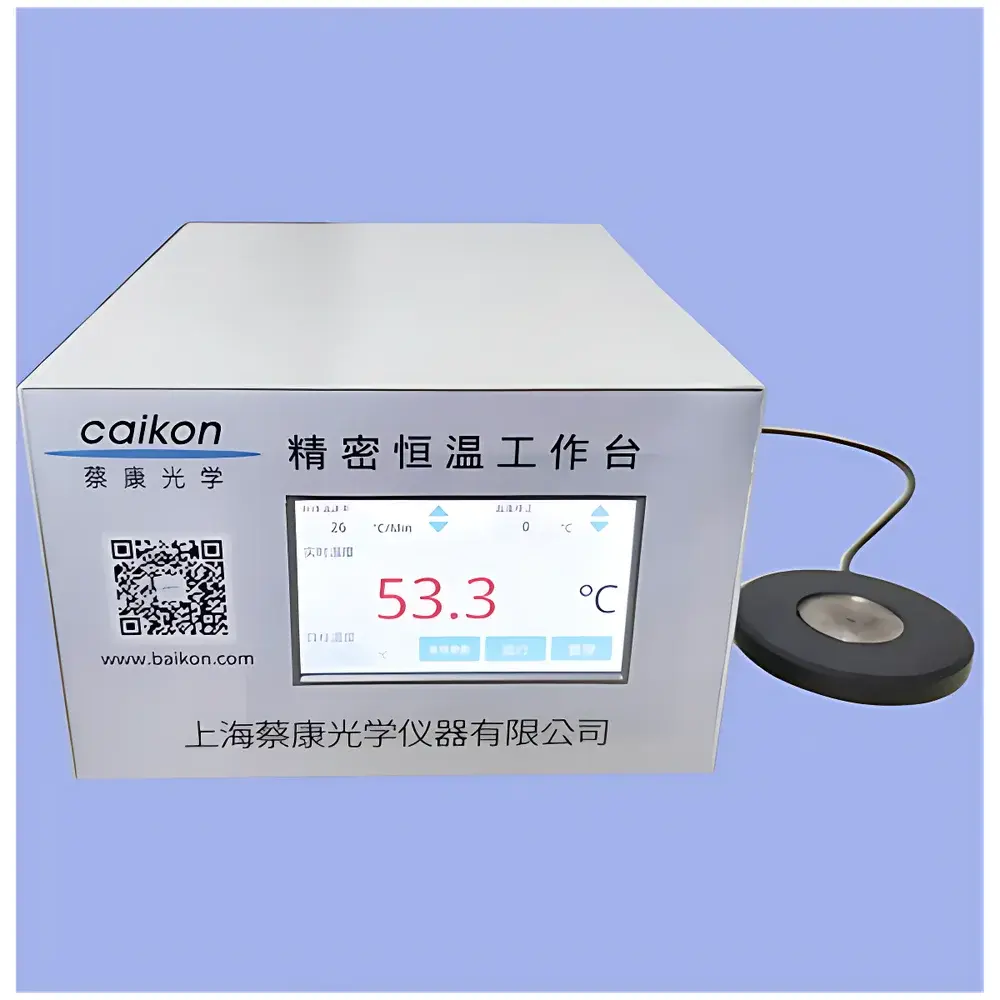
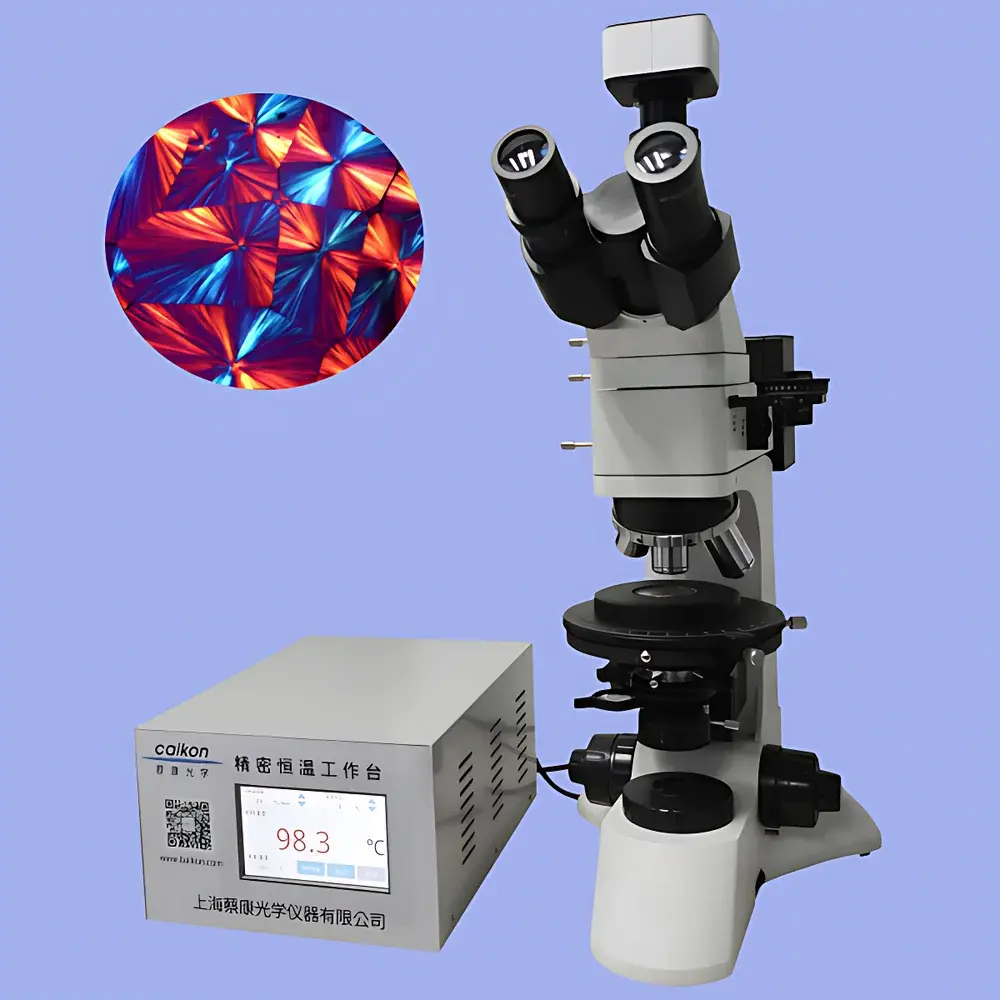
Caikon CK400CM Precision Heating Stage for Polarizing Microscopy – 400°C Touchscreen-Controlled Thermal Stage
| Brand | Caikon |
|---|---|
| Origin | Shanghai, China |
| Manufacturer Type | Direct Manufacturer |
| Region Classification | Domestic (China) |
| Model | CK400CM |
| Power Input | AC 220 V ±10%, 45–60 Hz |
| Heating Supply | DC 24 V / 3 A |
| Max. Power Consumption | 260 W |
| Temperature Range | Ambient to 400 °C (tested at 25 °C ambient, natural convection cooling) |
| Stage Surface Temp. Limit | ≤70 °C at housing (when hot zone = 400 °C) |
| Max. Sample Load | 200 g |
| Heating Zone Diameter | φ41 mm |
| Stage Disc Diameter | φ99 mm × 11 mm thick |
| Optical Aperture | φ3.8 mm |
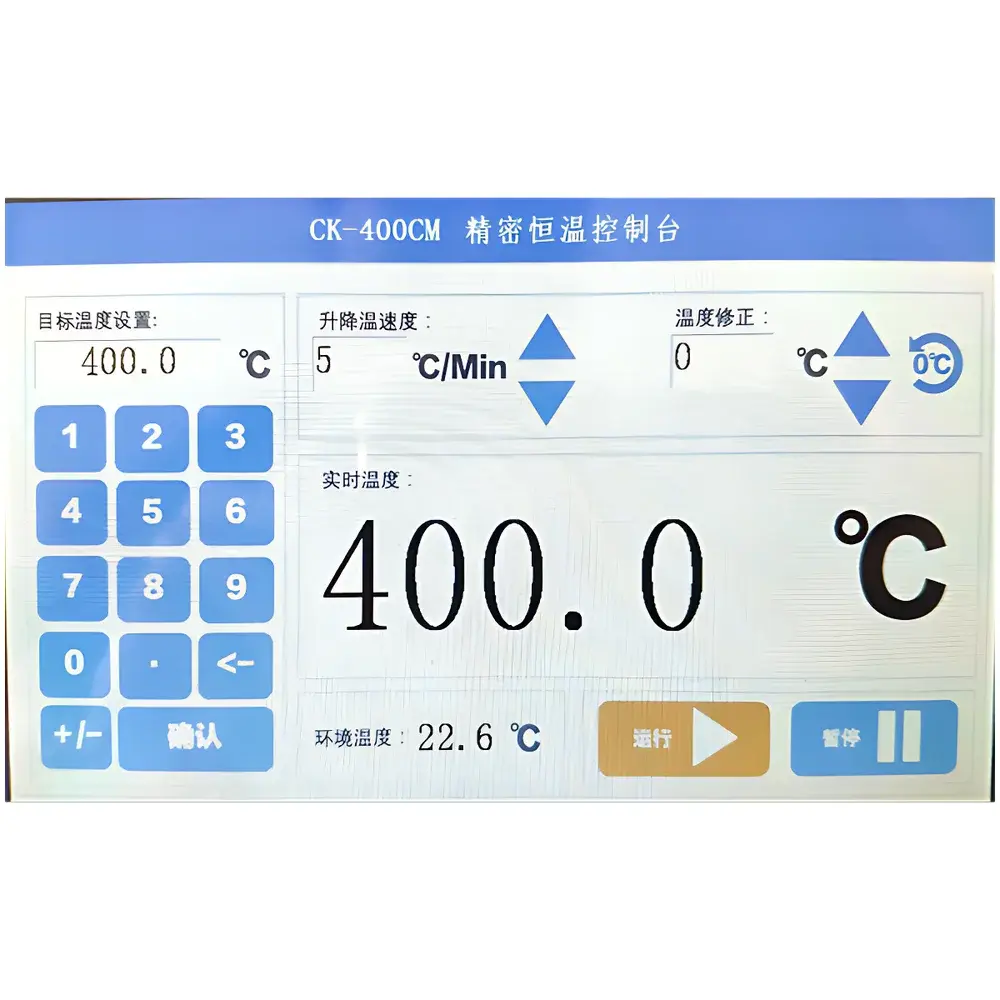
| Display | Industrial capacitive full-color touchscreen, 800 × 480 resolution |
| Control Core | 32-bit ARM processor with proprietary fuzzy PID adaptive algorithm |
| Heating Element | Ceramic PTC heater with uniform thermal distribution |
| Temp. Accuracy | ≤±0.5% of full scale |
| Temp. Stability (Drift) | ±0.5 °C |
| Response Time (Setpoint Hold) | ≤0.01 s |
| Ramp Rates | 5, 10, 20, 40, or 80 °C/min (user-selectable) |
| Ramp Time | ≤100 s (RT → 100 °C), ≤190 s (RT → 200 °C), ~17 min (RT → 400 °C, dependent on ambient & ramp rate) |
| Dimensions (Control Unit) | 280 × 220 × 150 mm |
Overview
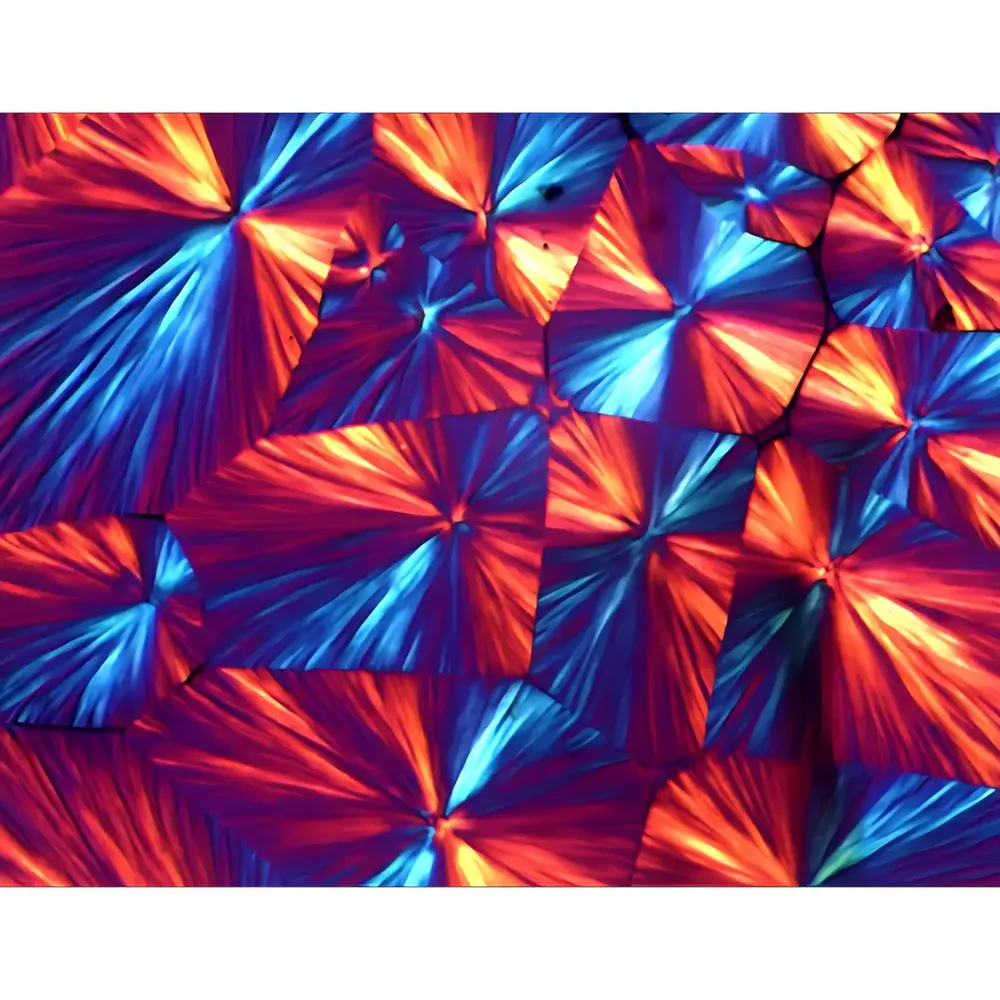
The Caikon CK400CM Precision Heating Stage is an engineered thermal platform designed for integration with polarizing microscopes and optical microscopy systems in materials science laboratories. It operates on the principle of controlled resistive heating via a ceramic PTC (Positive Temperature Coefficient) element, enabling precise, stable, and spatially uniform temperature regulation across a defined observation zone (φ41 mm). Its core function is to facilitate real-time in-situ microscopic analysis of thermally induced phase transitions—including melting, crystallization, polymorphic transformation, solid–solid transitions, and liquid crystal behavior—under calibrated thermal conditions up to 400 °C. The stage is optimized for quantitative polarized light microscopy (PLM), where birefringence changes, extinction angle shifts, and spherulite growth kinetics are correlated directly with temperature history. Its modular architecture separates the control electronics from the heated stage, minimizing thermal coupling to the microscope body and ensuring mechanical stability during long-duration thermal ramps.
Key Features
- Industrial-grade capacitive full-color touchscreen (800 × 480 px) with intuitive GUI for simultaneous display of ambient temperature, setpoint, real-time stage temperature, ramp rate, dwell time, and sensor correction offset.
- Fuzzy PID adaptive control algorithm implemented on a 32-bit ARM microcontroller ensures rapid thermal response (<0.01 s hold time), minimal overshoot, and automatic parameter tuning based on load and ambient conditions.
- Ceramic PTC heating element provides exceptional thermal uniformity (±0.3 °C across active zone), eliminates hot/cold spots, and delivers superior longevity, corrosion resistance, and electromagnetic immunity compared to wire-wound or etched-foil heaters.
- Multi-segment programmable ramp-and-hold profiles support complex thermal protocols—e.g., stepwise annealing, cyclic heating/cooling, or isothermal dwell—with on-the-fly parameter adjustment (pause/resume with updated setpoints).
- Linear sensor calibration function allows user-defined compensation for thermal lag induced by sample mass, coverslip thickness, mounting medium, or ambient drafts—critical for metrological traceability in ASTM E537 and ISO 11357-3 compliant workflows.
- Standard RS-232/RS-485 serial interface with documented ASCII protocol enables bidirectional communication with third-party acquisition software, LIMS, or automated microscopy platforms (e.g., prior to image capture triggers or stage synchronization).
Sample Compatibility & Compliance
The CK400CM accommodates standard microscope slides (76 × 26 mm) and circular cover glasses (up to φ22 mm) within its φ41 mm heated zone. Its φ3.8 mm central optical aperture maintains unobstructed light path for both transmitted and reflected illumination modes, including conoscopic and Bertrand lens configurations. The stage’s mechanical design complies with DIN 6871 and JIS B 7741 dimensional standards for universal microscope stage integration. For regulated environments, the system supports audit-ready operation: temperature logs (timestamped, with setpoint and actual values) can be exported for GLP/GMP documentation; firmware includes configurable data retention policies and optional password-protected parameter locking—aligning with FDA 21 CFR Part 11 principles when paired with validated host software. It meets CE safety requirements (EN 61010-1) and electromagnetic compatibility standards (EN 61326-1).
Software & Data Management
The CK400CM operates as a standalone instrument with embedded firmware but also functions as a peripheral in automated imaging workflows. Its open ASCII-based communication protocol allows integration with LabVIEW, Python (PySerial), MATLAB, or custom C# applications for synchronized thermal profiling and image acquisition. Temperature data streams at 10 Hz resolution and include checksum-verified packets containing: current temperature (°C), setpoint (°C), status flag (heating/holding/cooling), ramp rate (°C/min), and elapsed time. Optional Caikon ThermalSync™ software (v3.2+) adds CSV export, derivative analysis (dT/dt), alarm thresholds, and overlay plotting against live camera feeds. All logged data retain ISO/IEC 17025-compliant metadata: operator ID, instrument SN, calibration date, and environmental notes.
Applications
- Quantitative melting point determination per USP <741> and Ph. Eur. 2.2.14, particularly for pharmaceutical polymorph screening and purity assessment via mixed-melting behavior.
- In-situ observation of polymer crystallization kinetics (e.g., polyethylene, PET, PLLA) under controlled cooling rates—supporting ISO 11357-3 and ASTM D3418 validation.
- Phase transition analysis of liquid crystals, ferroelectrics, and shape-memory alloys using birefringence mapping and extinction angle tracking.
- Thermal degradation studies of nanocomposites and biomaterials, where onset decomposition temperatures are correlated with morphological changes visible under crossed polars.
- Calibration and verification of differential scanning calorimetry (DSC) results through direct visual correlation of endothermic events with microstructural evolution.
FAQ
Is the CK400CM compatible with upright and inverted polarizing microscopes?
Yes—it mounts directly onto standard mechanical stages via M4 threaded holes (center-to-center spacing: 75 mm), supporting both upright and inverted configurations without optical path obstruction.
What is the recommended maintenance interval for the ceramic heater?
No scheduled maintenance is required; the PTC element has no moving parts or consumables and is rated for >50,000 thermal cycles (25–400 °C) under continuous operation.
Can the temperature sensor be recalibrated in-house?
Yes—the firmware includes a two-point calibration mode using NIST-traceable reference thermometers (e.g., Fluke 1523 with Pt100 probe) at 100 °C and 300 °C.
Does the stage support vacuum or inert gas environments?
The base unit is not sealed; however, users may integrate it into custom environmental chambers (e.g., glovebox-compatible enclosures) provided external cooling and electrical feedthroughs are properly managed.
How is thermal drift minimized during long-duration isothermal holds?
The adaptive PID controller continuously monitors error integral and derivative terms, dynamically adjusting power output to maintain ±0.5 °C stability over 24-hour periods—even with variable ambient fluctuations of ±3 °C.






