
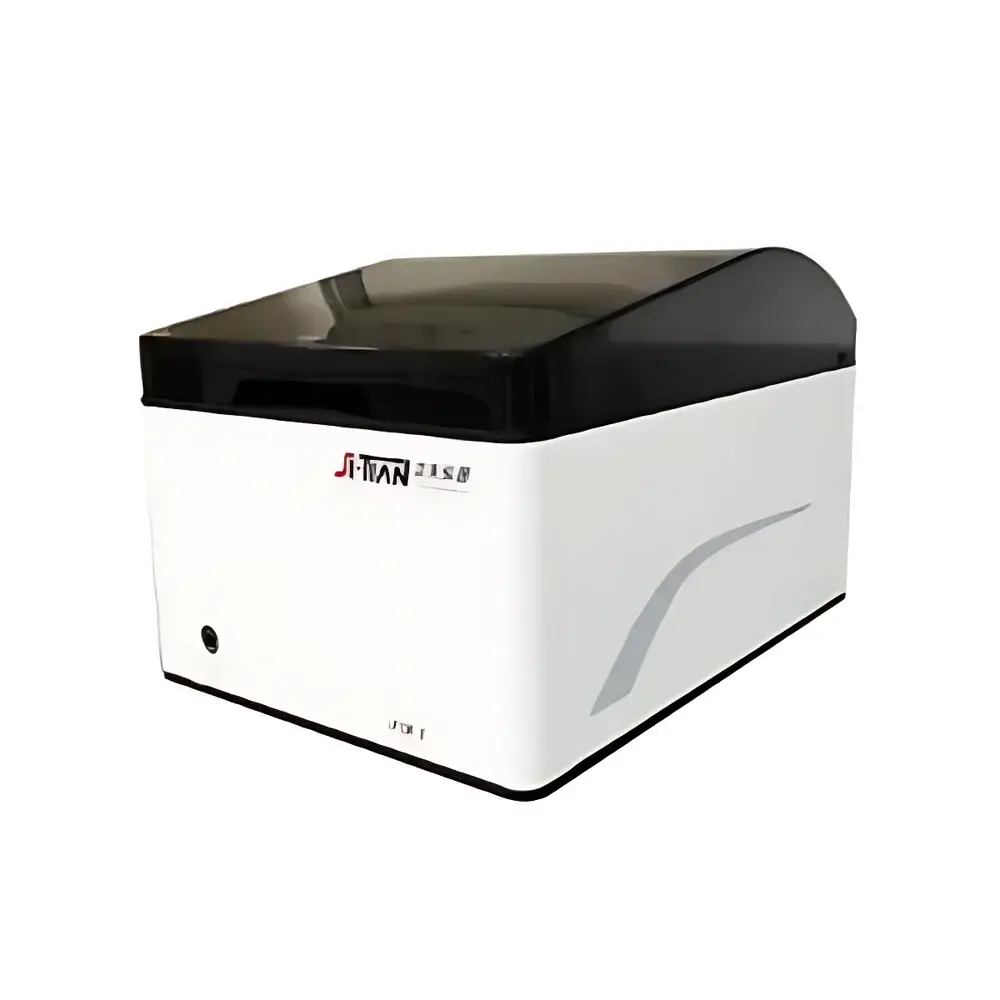
Titan Instruments iFIA E Flow Injection Analyzer
| Brand | Titan Instruments |
|---|---|
| Origin | Beijing, China |
| Model | iFIA E |
| Type | Integrated Flow Injection Analyzer (FIA) System |
| Configuration | Fully Automated, Channel-Independent Modular Design |
| Standard Package | Auto-sampler, Main Unit, Control PC, Thermal Printer |
| Optional Modules | MAC3 Multi-Analyte Configuration Module (17 parameters) |
| Compliance Context | Designed for ASTM D129, ISO 6775, ISO 1192, EPA 300.0, EPA 354.1, USP <643>, and GLP/GMP-aligned data integrity workflows |
Overview
The Titan Instruments iFIA E is a fully integrated, modular flow injection analyzer engineered for high-throughput, trace-level quantitative analysis of inorganic and organic analytes in aqueous matrices. Based on classical flow injection analysis (FIA) principles—characterized by precise zone segmentation, reproducible dispersion dynamics, and controlled reaction timing—the iFIA E eliminates manual sample handling and reagent preparation while maintaining strict adherence to standardized wet-chemistry protocols. Each analytical channel operates as a self-contained unit comprising an autosampler, peristaltic pump manifold, chemically inert microfluidic flow path (PTFE/PFA tubing), and optical or electrochemical detection module. This architecture ensures method independence across channels, enabling simultaneous multi-parameter determination without cross-contamination or calibration drift. The system is optimized for routine compliance testing in regulated environments, supporting method validation under ISO/IEC 17025 and alignment with FDA 21 CFR Part 11 requirements through audit-trail-enabled software.
Key Features
- Pressure-adjustable peristaltic pump system with dual-roller compression design, delivering stable flow rates (0.1–5.0 mL/min) over extended operation cycles (>24 h continuous run) with ≤1.2% RSD inter-run precision.
- Onboard temperature control module with digital LCD interface and real-time feedback loop; maintains reaction coil and detector cell at user-defined setpoints (30–100 °C) with ±0.3 °C stability.
- Integrated pretreatment suite including PTFE-membrane phase separation, UV photolysis (254 nm), steam distillation, acid digestion, and semiconductor-based condensation—minimizing ambient thermal interference and baseline noise.
- MAC3 expandable module supports up to 17 validated parameters via interchangeable chemistry cartridges, including NH₃-N, NO₃⁻, NO₂⁻, PO₄³⁻, SiO₂, B, Ca²⁺, Cr(VI), S²⁻ (offline), Al³⁺, Fe²⁺/³⁺, total Kjeldahl nitrogen (TKN, offline), total Kjeldahl phosphorus (TKP, offline), CN⁻ (offline), F⁻ (offline), and urea.
- Modular autosampler options enable programmable online dilution (1:2 to 1:1000), reagent replenishment, and parallel multi-channel aspiration—critical for heterogeneous sample batches from wastewater, seawater, or soil extracts.
Sample Compatibility & Compliance
The iFIA E accommodates liquid samples with suspended solids ≤20 µm (pre-filtered), pH 2–12, and salinity up to 35 g/L (seawater-compatible). It meets performance criteria specified in EPA Method 300.0 (anions), EPA 354.1 (phosphorus), ISO 6775 (cyanide), ISO 1192 (phenols), and ASTM D129 (sulfur compounds). All fluidic pathways comply with USP water conductivity monitoring standards. System validation includes linearity (R² ≥0.999 over 3 orders of magnitude), LODs consistent with regulatory thresholds (e.g., 0.005 mg/L NH₃-N, 0.002 mg/L CN⁻), and inter-laboratory reproducibility per ISO 5725-2. Data acquisition supports GLP-compliant electronic signatures and full audit trails.
Software & Data Management
Control and data processing are executed via TitanFlow v4.2 software—a Windows-based platform compliant with FDA 21 CFR Part 11 for electronic records and signatures. Functions include method editor with drag-and-drop flow path simulation, real-time chromatogram overlay, automatic peak integration using second-derivative algorithms, QC flagging (e.g., drift >5% signal deviation, blank exceedance), and LIMS export (ASTM E1384, HL7). Raw data files (.tdf) retain full timestamped metadata: pump speed, temperature logs, valve actuation history, and detector voltage traces—enabling forensic reconstruction of any analytical run.
Applications
Primary deployment domains include municipal drinking water QA/QC (ammonia, nitrate, total phosphorus), environmental monitoring (surface water, groundwater, effluent), and agrochemical residue screening (soil leachates, plant digests). Validated applications span volatile phenols (4-aminoantipyrine method), total cyanide (pyridine-barbituric acid), anionic surfactants (MBAS), sulfide (methylene blue), permanganate index (CODMn), and speciated nitrogen/phosphorus fractions. The system also supports food safety testing (formaldehyde in aquatic products) and industrial hygiene (chromium VI in cooling tower water).
FAQ
What regulatory methods does the iFIA E natively support?
It implements pre-configured methods aligned with EPA 300.0, ISO 6775, ASTM D129, and USP , with full documentation packages available for method transfer and validation.
Can multiple detection principles be used within one system?
Yes—optical (visible/UV absorbance, fluorescence) and electrochemical (amperometric) detectors are swappable per channel; detector selection is method-dependent and hardware-configurable.
Is remote monitoring or unattended operation possible?
The system supports 24/7 autonomous runs with auto-recovery after power interruption, email alerts for maintenance events, and secure VPN-enabled remote diagnostics via TitanCloud Connect.
How is calibration traceability maintained?
Certified reference materials (CRMs) from NIST or LGC are integrated into calibration sequences; all calibrants are logged with lot numbers, expiration dates, and preparation timestamps in the audit trail.
What maintenance intervals are recommended for the peristaltic pump tubing?
Tubing replacement is scheduled every 1,200 operational hours or upon observed flow deviation >3%; Titan supplies calibrated replacement kits with batch-certified dimensional tolerances.
Related Products



