
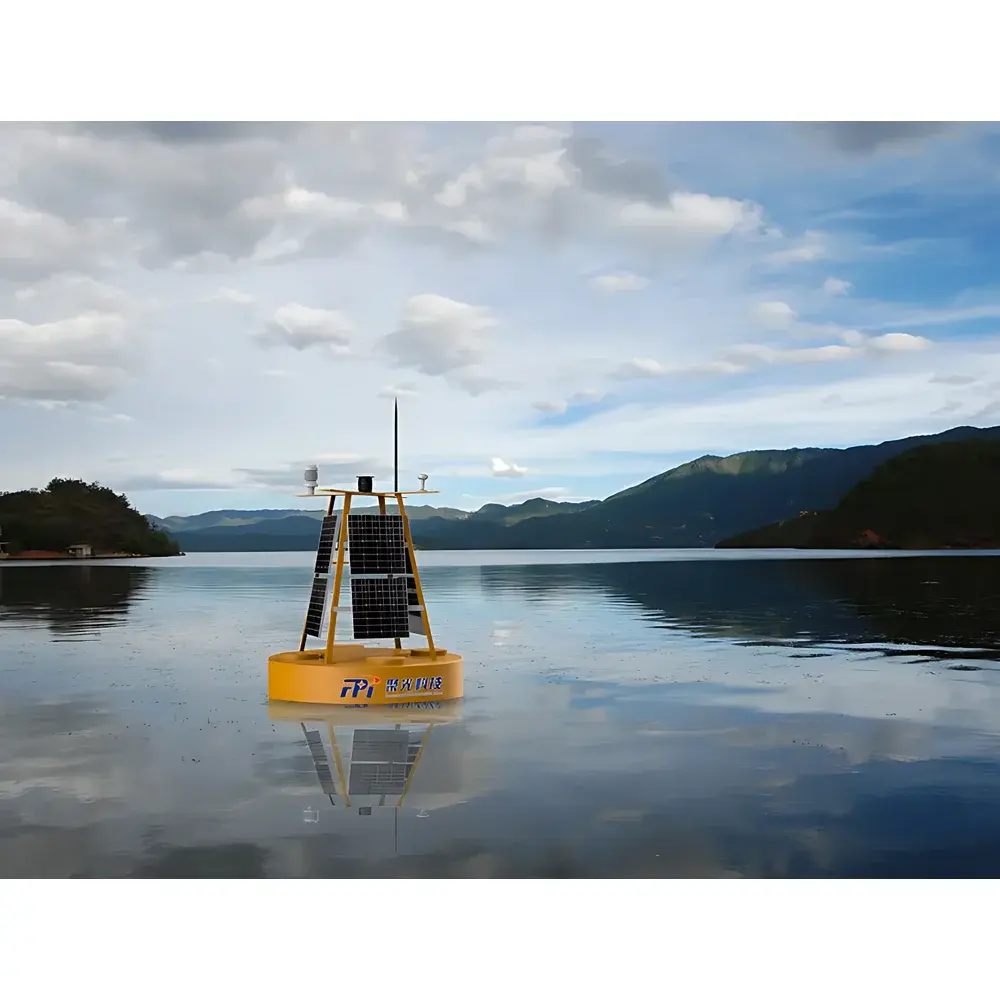
FPI Buoy-3000 Buoy-Mounted Autonomous Water Quality Monitoring System
| Brand | FPI |
|---|---|
| Origin | Zhejiang, China |
| Manufacturer Type | Original Equipment Manufacturer (OEM) |
| Product Category | Domestic |
| Model | Buoy-3000 |
| Instrument Type | Online Water Quality Analyzer |
| Measured Parameters | Ammonia-N, Total Phosphorus (TP), Total Nitrogen (TN), UV-COD, pH, Dissolved Oxygen (DO), Turbidity, Temperature, Chlorophyll-a, Phycocyanin (for Cyanobacteria), Oil-in-Water |
Overview
The FPI Buoy-3000 Buoy-Mounted Autonomous Water Quality Monitoring System is an integrated, solar-powered in-situ monitoring platform engineered for long-term, unattended operation in lakes, reservoirs, estuaries, and other open-water environments. Unlike conventional land-based water quality stations—which require complex permitting, civil construction, lengthy intake piping, and are subject to sample degradation during transport—the Buoy-3000 eliminates hydraulic transport entirely by deploying analytical modules directly at the measurement point. This design ensures high-fidelity representation of key water quality parameters, particularly those prone to change during transit (e.g., dissolved oxygen, ammonia-nitrogen, and turbidity). The system employs a hybrid sensor architecture: probe-based colorimetric analyzers for nutrient species (TP, TN, NH₃-N), electrochemical sensors for pH/DO, optical absorption (UV-254 nm) for COD estimation, and fluorescence-based detection for chlorophyll-a and phycocyanin (as a proxy for cyanobacterial biomass). All subsystems are synchronized via a programmable industrial data acquisition controller compliant with IEC 61131-3 standards.
Key Features
- Solar-renewable power architecture with dual-layer energy management: monocrystalline PV panels coupled with deep-cycle lead-acid or lithium-iron-phosphate backup batteries, enabling >14 days of continuous operation under overcast conditions.
- Integrated probe-style chemical analyzers for ammonia-nitrogen, total phosphorus, and total nitrogen—eliminating reagent consumption variability and calibration drift associated with flow-cell systems.
- Four standardized DIN-rail instrument mounting slots with configurable analog (4–20 mA, 0–5 V) and digital (RS-485 Modbus RTU, SDI-12) I/O interfaces, supporting third-party sensors from major OEMs without firmware modification.
- Polyurea-coated buoy hull providing ASTM D412 tensile strength >18 MPa and ISO 12944-6 C5-M corrosion resistance rating, validated for deployment in brackish and eutrophic freshwater with suspended solids up to 100 mg/L.
- Remote configuration and diagnostics via LTE Cat-M1/NB-IoT or dual-band Wi-Fi, with TLS 1.2 encrypted web interface and role-based access control (RBAC) aligned with NIST SP 800-53 Rev. 4 IA-2 requirements.
Sample Compatibility & Compliance
The Buoy-3000 operates exclusively in natural aquatic matrices without pre-filtration or dilution. It is validated for use in freshwater bodies with conductivity <2,000 µS/cm, pH 5.0–9.5, and suspended solids ≤200 mg/L. All embedded analytical modules comply with relevant national and international reference methods: ammonia-N per HJ 535-2009 (equivalent to ISO 7150-1), total phosphorus per HJ 536-2009 (aligned with ISO 6878), and UV-COD per HJ/T 100-2003 (correlated to ISO 15705). Data integrity conforms to GLP principles, including automated audit trails for calibration events, sensor zero/span checks, and firmware updates—all timestamped and digitally signed. System-level validation supports EPA Method 160.1 (for DO), ASTM D3370 (for grab sampling correlation), and ISO 5667-3 for spatial representativeness assessment.
Software & Data Management
Data acquisition is managed by an embedded Linux-based controller running FPI’s AquaLink™ v4.2 firmware, featuring deterministic real-time scheduling (POSIX-compliant), local edge storage (32 GB industrial-grade microSD), and dual-mode transmission: scheduled HTTP POST to cloud-hosted RESTful APIs or MQTT over TLS to private MQTT brokers. Raw sensor outputs are stored with metadata (GPS location, UTC timestamp, battery voltage, internal temperature) in CSV/NetCDF format. The optional AquaView™ web portal provides time-series visualization, statistical trend analysis (Mann-Kendall test, seasonal decomposition), and configurable alerting (email/SMS) based on user-defined thresholds or rate-of-change algorithms. All data exports include traceable lineage to NIST-traceable calibration certificates and support 21 CFR Part 11 electronic signature and audit trail requirements when deployed in regulated utility or municipal contexts.
Applications
The Buoy-3000 serves as a core component in source water protection programs for drinking water utilities, especially where rapid deployment and minimal site footprint are critical—such as upstream of intake structures in large reservoirs. It supports operational decision-making for algal bloom forecasting (via synchronous chlorophyll-a and phycocyanin tracking), nutrient loading attribution (TP/TN/NH₃-N diurnal profiling), and early warning of hypoxic events (DO + temperature + conductivity correlation). In regulatory contexts, it fulfills monitoring obligations under China’s “Blue Sky and Clear Water Protection Campaign” and provides comparable data quality to fixed stations required by EU WFD Article 8 reporting. Additional applications include research-grade limnological studies, sediment resuspension impact assessments, and post-dredging water quality verification.
FAQ
What is the maximum deployment depth for the Buoy-3000?
The system is rated for surface deployment only; submersible sensor cables extend up to 5 m below surface level, with pressure-rated connectors meeting IP68 specifications.
Can the Buoy-3000 be integrated into existing SCADA infrastructure?
Yes—Modbus TCP/RTU and OPC UA (v1.04) profiles are supported via optional gateway module; configuration files adhere to IEC 62443-3-3 Annex A security guidelines.
How often does the system require maintenance?
Sensor cleaning and calibration verification are recommended every 30–45 days in eutrophic waters; anti-fouling wipers and copper-alloy biofilm suppression rings reduce manual intervention frequency by ≥60%.
Is remote firmware update capability available?
Yes—differential OTA updates with SHA-256 signature verification and rollback recovery are enabled by default; update logs are retained for ≥180 days.
Does the system meet cybersecurity certification requirements for municipal water networks?
The embedded controller has undergone penetration testing per ISO/IEC 15408 EAL2+ and supports TLS 1.3, IEEE 802.1X port authentication, and secure boot chain verification.







