
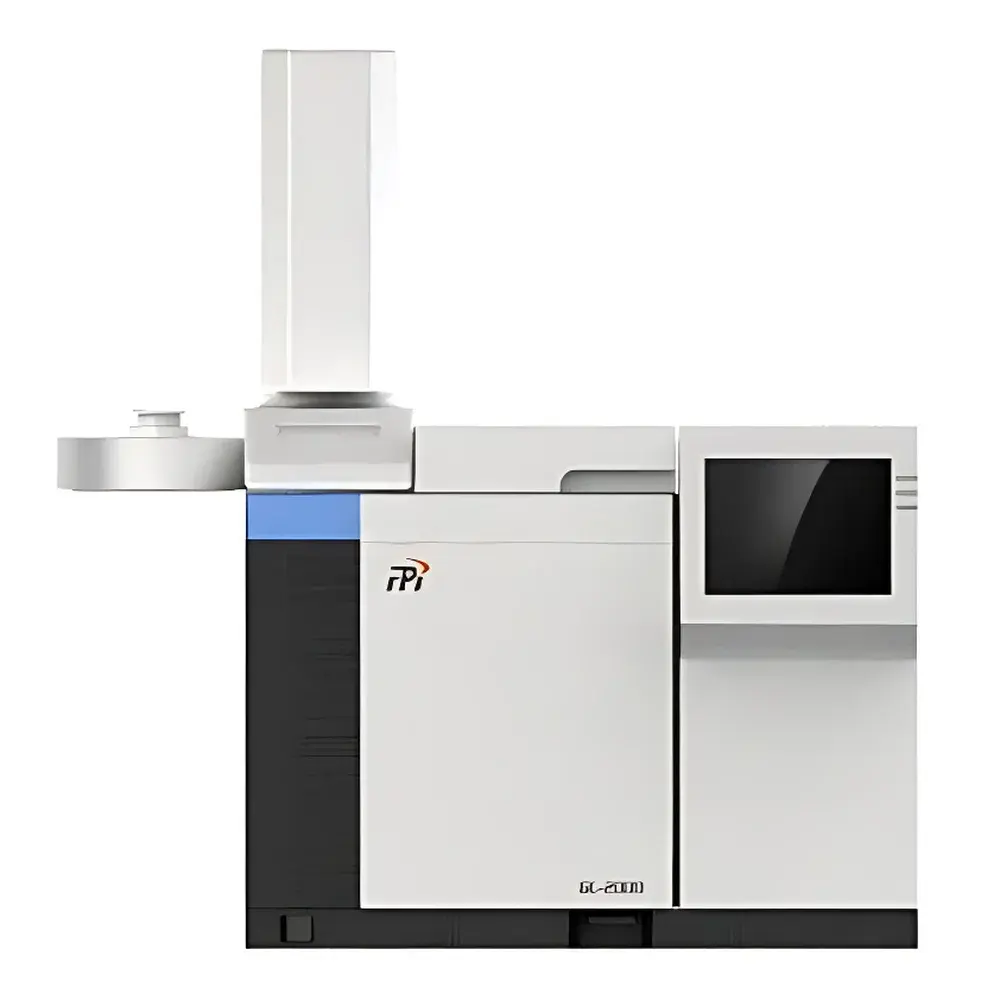
FPI GC-2000 Universal Gas Chromatograph
| Brand | FPI |
|---|---|
| Origin | Zhejiang, China |
| Manufacturer Type | Original Equipment Manufacturer (OEM) |
| Instrument Category | Domestic Lab-Scale Gas Chromatograph |
| Model | GC-2000 Universal |
| Application Scope | General-Purpose Analytical Chemistry |
| Control Interface | Full-Touch Color LCD Display |
| Pneumatic Control | Electronic Pressure and Flow Control (EPC) |
| Software Architecture | Modular Workstation with Method-Driven Workflow |
| Microfluidic Capability | Valveless Flow Switching for Column Back-Flush, Detector Selection, and GC-MS Parallel Operation |
| Compliance Context | Designed for GLP/GMP-aligned laboratories |
Overview
The FPI GC-2000 Universal Gas Chromatograph is a laboratory-grade analytical instrument engineered for robust, reproducible separation and quantification of volatile and semi-volatile organic compounds. Based on a mature chromatographic platform refined through iterative development in alignment with international design principles, the GC-2000 implements capillary gas chromatography using carrier gas-driven partitioning across a thermally stable stationary phase. Its architecture supports both routine quality control workflows and method development activities in regulated and research environments. The system operates under programmable temperature gradients and integrates real-time pneumatic monitoring to ensure retention time stability and peak resolution consistency—critical parameters for compliance with ASTM D3606, ISO 10301, and USP chromatographic validation guidelines.
Key Features
- Full-touch color LCD interface enabling intuitive method setup, real-time parameter visualization, and alarm-triggered event logging without external peripherals.
- Electronic Pressure and Flow Control (EPC) system delivering ±0.01 psi pressure resolution and ±0.1 mL/min flow accuracy across multiple inlet configurations—including split/splitless, cool-on-column, and programmed temperature vaporizing (PTV) modes.
- Modular software workstation built on a scalable client-server architecture, supporting customizable report templates, peak integration algorithms (e.g., valley-to-valley, tangent skim), and batch processing with metadata tagging.
- Valveless microfluidic routing technology enabling dynamic column back-flushing to eliminate late-eluting interferences, seamless detector switching between FID, TCD, ECD, and NPD, and concurrent operation with mass spectrometric detection systems via standardized GC-MS interface protocols.
- Rugged mechanical design with reinforced oven chamber insulation, low thermal mass heating elements, and vibration-damped optical mounts—optimized for long-term operational stability in shared-core laboratory facilities.
Sample Compatibility & Compliance
The GC-2000 accommodates liquid, gaseous, and headspace-derived samples introduced via syringe, autosampler, or purge-and-trap modules. It is routinely deployed in laboratories requiring adherence to environmental testing standards (EPA Methods 502.2, 8021B), food safety protocols (AOAC 996.15, ISO 17025-accredited residue analysis), and pharmaceutical impurity profiling (ICH Q2(R2)). All hardware and firmware components are traceable to internal calibration logs, and optional software packages provide electronic signatures, user role-based access control, and immutable audit trails compliant with FDA 21 CFR Part 11 Subpart B requirements. System suitability testing (SST) reports—including resolution, tailing factor, and %RSD of replicate injections—are auto-generated and exportable in CSV/PDF formats.
Software & Data Management
The GC-2000’s native chromatography data system (CDS) follows a modular deployment model: acquisition, processing, reporting, and archive modules operate independently yet share a unified relational database schema. Raw data files conform to ANDI/NetCDF format for cross-platform interoperability. Advanced features include automated baseline correction using asymmetric least-squares smoothing, retention time locking (RTL) with internal standard referencing, and spectral library matching for co-elution deconvolution when coupled with compatible mass spectrometers. Data integrity safeguards include write-once-read-many (WORM) storage options, SHA-256 hash verification of archived runs, and configurable retention policies aligned with ISO/IEC 27001 information security frameworks.
Applications
- Environmental monitoring: VOCs and SVOCs profiling in ambient air, soil extracts, and wastewater per EPA SW-846 methods.
- Food and beverage safety: Pesticide multiresidue screening, flavor compound fingerprinting, and ethanol quantification in fermented products.
- Pharmaceutical QC: Residual solvent analysis (ICH Q3C), excipient purity verification, and stability-indicating assay development.
- Petrochemical analysis: Hydrocarbon group-type characterization (PIONA), gasoline oxygenate determination (ASTM D4815), and refinery stream compositional mapping.
- Forensic toxicology: Detection of accelerants, drugs of abuse metabolites, and ignitable liquid residues in fire debris samples.
FAQ
Is the GC-2000 compatible with third-party mass spectrometers?
Yes—the system provides standard analog/digital I/O ports and RS-232/USB interfaces for synchronization with benchtop and triple-quadrupole MS detectors from major vendors.
Does the EPC module support helium conservation modes?
Yes—integrated carrier gas saver logic reduces flow during oven cooldown and idle periods, extending cylinder life by up to 40% without compromising method robustness.
Can the software be validated for GxP environments?
Validated installation qualification (IQ), operational qualification (OQ), and performance qualification (PQ) documentation packages are available upon request for regulated users.
What maintenance intervals are recommended for the microfluidic manifold?
No scheduled replacement is required; the valveless design eliminates wear-prone mechanical actuators—only routine septum and liner changes every 100–200 injections are advised.
Is remote monitoring supported?
The workstation includes secure HTTPS-based web interface access, enabling real-time run status viewing, method push/pull, and alert notifications via SMTP/SNMP protocols.






