
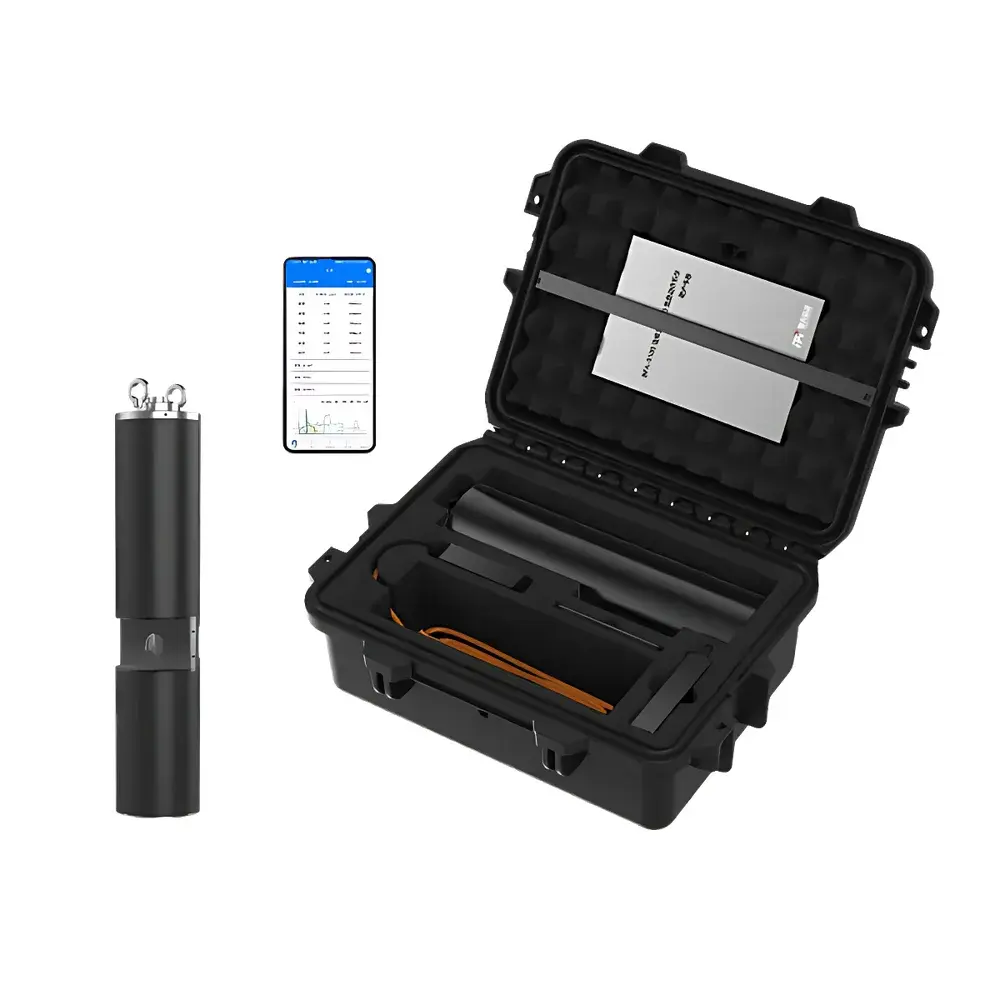
EXPEC BFA-3100 Portable In Vivo Fluorescence-Based Algal Classification Analyzer
| Brand | EXPEC (Puyu Technology) |
|---|---|
| Origin | Zhejiang, China |
| Model | BFA-3100 |
| Measurement Principle | In vivo chlorophyll & phycobiliprotein fluorescence spectroscopy |
| Detection Channels | 5 spectral bands (440 nm, 470 nm, 525 nm, 570 nm, 610 nm) |
| Algal Taxa Resolution | Cyanobacteria, Chlorophyta, Bacillariophyta, Dinophyta, Cryptophyta |
| Depth Rating | Up to 200 m (pressure-rated housing) |
| Environmental Compensation | Built-in temperature, turbidity, and background fluorescence correction |
| Data Output | Real-time spectral profiles, cell density estimates (cells/mL), Chl-a equivalent (µg/L), vertical profile logging |
| Software Compatibility | Native apps for Android, iOS, and Windows (v3.2+) |
| Enclosure | IP68-rated portable carry-case with integrated battery, pump, and probe assembly |
| Power | Rechargeable Li-ion (≥12 h field operation) |
| Communication | Bluetooth 5.0 + USB-C |
Overview
The EXPEC BFA-3100 is a field-deployable, in vivo fluorescence-based algal classification analyzer engineered for real-time, reagent-free phytoplankton community assessment in natural and engineered water systems. Unlike traditional microscopy or pigment extraction methods, the BFA-3100 leverages native photosynthetic pigment fluorescence—primarily chlorophyll a, phycocyanin, phycoerythrin, and fucoxanthin—as intrinsic optical biomarkers. By exciting pigments at multiple discrete wavelengths (440 nm, 470 nm, 525 nm, 570 nm, and 610 nm) and capturing emission spectra across optimized detection bands, the instrument resolves taxon-specific fluorescence signatures using multivariate spectral deconvolution. This approach enables quantitative discrimination among five dominant freshwater and marine algal groups—Cyanobacteria, Chlorophyta, Bacillariophyta, Dinophyta, and Cryptophyta—without sample preservation, filtration, or chemical processing. The system is calibrated against reference cultures and validated per ISO 10260:2021 (Water quality — Guidance on phytoplankton analysis by fluorometric methods) and ASTM D8080-22 (Standard Practice for In Situ Fluorescence Detection of Algal Pigments). Its compact, pressure-rated architecture supports deployment from small vessels, buoys, or handheld platforms, delivering depth-resolved profiles up to 200 m.
Key Features
- Multi-wavelength excitation and emission detection architecture ensures robust spectral separation of overlapping pigment signals, improving taxonomic resolution under variable water chemistry conditions.
- Real-time environmental compensation: integrated thermistor, turbidity sensor (nephelometric, 0–1000 NTU range), and adaptive background fluorescence subtraction algorithm mitigate interference from dissolved organic matter (DOM) and suspended solids.
- Depth-profiling capability with synchronized pressure transducer (0–20 MPa) and motorized winch interface; supports automated vertical profiling with configurable sampling intervals (0.1–5 m step resolution).
- High-reliability optomechanical design featuring solid-state LEDs, thermally stabilized photodiodes, and hermetically sealed optical path—reducing drift and maintenance frequency relative to lamp-based systems.
- Onboard data logging (≥16 GB internal storage) with timestamped spectral matrices, raw intensity values, and derived parameters (Chl-a eq., taxon-specific density, fluorescence quantum yield).
- Low-power architecture enabling >12 hours continuous operation on single charge; hot-swappable battery option available for extended missions.
Sample Compatibility & Compliance
The BFA-3100 is validated for use in freshwater lakes, reservoirs, drinking water intakes, estuarine zones, and urban rivers with turbidity ≤1000 NTU and salinity ≤35 PSU. It complies with GLP-aligned data integrity requirements: all measurements include embedded audit trail metadata (operator ID, GPS coordinates, UTC timestamp, calibration status, sensor health flags). Raw spectral files are stored in HDF5 format with embedded CF-1.7 metadata conventions, ensuring interoperability with EPA STORET, WQX, and EU WISE databases. Firmware supports optional 21 CFR Part 11-compliant electronic signature modules for regulated utilities and monitoring programs.
Software & Data Management
EXPEC AlgaView™ software suite provides cross-platform visualization and post-processing. The desktop application (Windows/macOS) supports spectral unmixing validation via constrained non-negative matrix factorization (cNMF), batch profile alignment, and export to CSV, NetCDF, or ERDAS IMG for GIS integration. Mobile clients (Android/iOS) enable live telemetry viewing, remote configuration, and offline annotation. All versions enforce role-based access control (RBAC), encrypted local storage, and automatic cloud sync to secure AWS S3 buckets with AES-256 encryption. Data exports include ISO/IEC 17025 traceable uncertainty estimates per taxon group.
Applications
- Early-warning cyanobacterial bloom detection in drinking water source protection zones.
- Vertical distribution mapping of phototrophic communities in stratified reservoirs to inform hypolimnetic aeration strategies.
- Regulatory compliance monitoring under EU Water Framework Directive (WFD) Article 8 and US Clean Water Act Section 304(a) criteria.
- Research-grade phytoplankton phenology studies across seasonal gradients, including light-limited benthic-pelagic coupling assessments.
- Calibration and validation support for satellite ocean color products (e.g., Sentinel-3 OLCI, Landsat-9 OLI-2) through match-up in situ datasets.
FAQ
Does the BFA-3100 require daily calibration with reference standards?
No—factory calibration is traceable to NIST SRM 1932 (fluorescence quantum yield standards) and remains stable for ≥6 months under typical field conditions. Field verification uses built-in LED intensity monitoring and dark-current diagnostics; full recalibration is recommended annually or after shock exposure.
Can the instrument distinguish between toxic and non-toxic strains within the same genus (e.g., Microcystis aeruginosa vs. M. wesenbergii)?
No—taxonomic resolution is at the class level (Cyanobacteria), not strain or genotype. Toxin detection requires complementary methods such as ELISA or LC-MS/MS.
Is the pressure housing compatible with ROV integration?
Yes—the 200 m-rated titanium alloy probe head and M12 wet-mateable connector support direct mounting on industry-standard observation-class ROVs (e.g., VideoRay Pro 4, Saab Seaeye Falcon DR). Mechanical and electrical interface documentation is provided under NDA.
How is data security handled during wireless transmission?
Bluetooth 5.0 LE connections use AES-128 link-layer encryption; all cloud uploads employ TLS 1.3 with mutual certificate authentication. Local device storage uses Linux dm-crypt full-disk encryption.
What maintenance is required between deployments?
Rinsing with deionized water, inspection of O-rings (per ISO 3601-1), and quarterly verification of pressure seal integrity using hydrostatic test protocol (EN 61000-6-4). No optical cleaning or alignment is required in normal operation.
Related Products







