
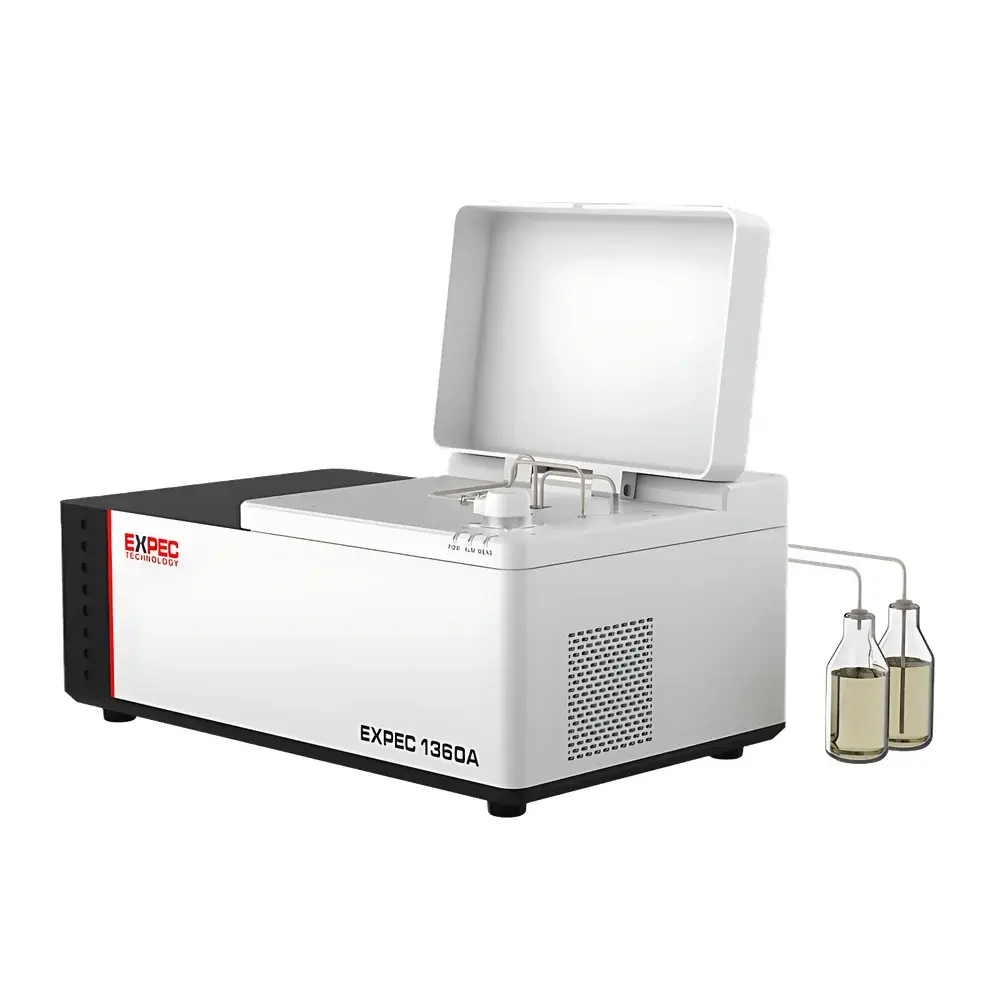
EXPEC 1360A Automated Near-Infrared Spectrometer
| Brand | EXPEC |
|---|---|
| Origin | Zhejiang, China |
| Manufacturer Type | Authorized Distributor |
| Instrument Type | Laboratory-Based NIR Spectrometer |
| Model | EXPEC 1360A |
| Application Scope | Fuel Quality Analysis (Gasoline, Diesel, Biofuels), Onboard & At-Line Deployment |
| Optional Accessories | U-Tube Oscillating Density Meter (±0.0005 g/cm³), Rechargeable Battery Pack (8 h runtime) |
| Compliance Framework | Designed for ASTM D2887, D5292, D7467, ISO 20846, and GB/T 28768-2012 alignment |
Overview
The EXPEC 1360A Automated Near-Infrared Spectrometer is an industrial-grade, laboratory-optimized analytical platform engineered for rapid, non-destructive quantification and classification of petroleum-based fuels. Leveraging second-derivative Fourier-transform near-infrared (FT-NIR) spectroscopy in the 1100–2500 nm spectral range, the instrument captures high-fidelity absorption signatures correlated with C–H, O–H, and C=O vibrational overtones. Its optical architecture integrates a thermoelectrically cooled InGaAs detector, fixed grating monochromator, and fiber-optic sampling interface—enabling robust signal-to-noise ratio (>10,000:1 at 1600 nm) under variable environmental conditions. Unlike benchtop research spectrometers, the EXPEC 1360A embeds process-ready automation: programmable autosampler integration supports unattended batch analysis of up to 48 samples per run, while real-time spectral acquisition (≤3 s per spectrum) facilitates continuous at-line monitoring in refinery QC labs or mobile fuel inspection units.
Key Features
- Automated sample handling with integrated syringe pump and flow cell module—compatible with liquid hydrocarbons, biodiesel blends, and ethanol-gasoline mixtures
- Calibration-ready spectral library pre-loaded with PLS and PCA models for gasoline RON/MON, diesel cetane number, distillation endpoints (T10/T50/T90), sulfur content, oxygenates (MTBE, ETBE), and water contamination
- Structural reinforcement per MIL-STD-810G for shock and vibration resistance—validated for operation in vehicle-mounted configurations without optical misalignment
- Embedded 10.1-inch capacitive touchscreen with full Chinese/English bilingual GUI; all operations—including method selection, calibration validation, outlier detection, and report export—executed locally without external PC dependency
- Modular hardware expansion: optional U-tube oscillating densitometer (ASTM D4052-compliant) enables simultaneous density measurement at 0.0005 g/cm³ repeatability, enhancing multivariate model robustness
- Onboard rechargeable Li-ion battery system rated for 8 hours of continuous operation—certified to IEC 62133 for safe deployment in hazardous locations (Class I, Division 2)
Sample Compatibility & Compliance
The EXPEC 1360A accepts liquid fuel samples in standard 10–25 mL vials or direct flow-through mode via 1/8″ stainless-steel tubing. It maintains measurement integrity across viscosity ranges from 0.2 to 8.0 cSt and vapor pressure up to 100 kPa (RVP). All factory-installed chemometric models are developed and verified per ASTM E1655 guidelines for NIR method validation, including linearity, accuracy, precision, limit of detection (LOD), and robustness testing. Instrument firmware and data handling routines support audit-trail functionality aligned with GLP and GMP principles; raw spectra, processed results, and user activity logs are time-stamped and digitally signed to satisfy FDA 21 CFR Part 11 requirements when deployed in regulated quality control environments.
Software & Data Management
The embedded EXPEC NIR Studio software provides end-to-end workflow management—from spectral acquisition and preprocessing (Savitzky-Golay smoothing, multiplicative scatter correction, standard normal variate) to model application and statistical reporting. Users may import third-party PLS models (e.g., Unscrambler® XML format) or develop custom calibrations using built-in cross-validation tools. Data export supports CSV, PDF, and ASTM E2915-compliant .jdx formats. Network connectivity includes Ethernet and Wi-Fi 5 (802.11ac), enabling secure TLS 1.2–encrypted communication with central LIMS servers or EXPEC’s cloud-based NIR Model Repository. Remote diagnostics, firmware updates, and spectral library synchronization occur automatically during scheduled maintenance windows—minimizing downtime in multi-site refinery networks.
Applications
- Refinery final-blend verification: Real-time RON prediction for gasoline streams prior to tank farm transfer
- Terminal custody transfer: Simultaneous determination of density, benzene content, and ethanol concentration in pipeline-delivered fuels
- Mobile field inspection: Battery-powered deployment for roadside fuel quality screening at distribution depots
- Research & development: High-throughput screening of novel biofuel formulations and additive packages
- Regulatory compliance monitoring: Routine testing against national standards (e.g., GB 17930, EN 228, ASTM D4814) with traceable uncertainty budgets
FAQ
Does the EXPEC 1360A require external calibration standards for routine operation?
No—factory-loaded models include primary reference validation sets traceable to NIST SRMs; however, periodic verification using in-house check standards (e.g., certified octane reference fuels) is recommended every 72 operational hours.
Can the instrument be integrated into an existing DCS or SCADA system?
Yes—via Modbus TCP or OPC UA protocols; analog 4–20 mA outputs are available for critical parameters (e.g., predicted RON, density) upon hardware configuration.
Is spectral data storage compliant with long-term archival requirements?
All raw interferograms and processed spectra are stored in HDF5 format with embedded metadata (wavelength axis, detector temperature, integration time), supporting 25+ year archival integrity per ISO 16363.
What maintenance intervals are specified for optical components?
The grating and detector assembly require no user-serviceable alignment; annual verification by EXPEC-certified technicians includes wavelength accuracy check (±0.2 nm) and photometric linearity assessment per ISO 17025.
Related Products




