
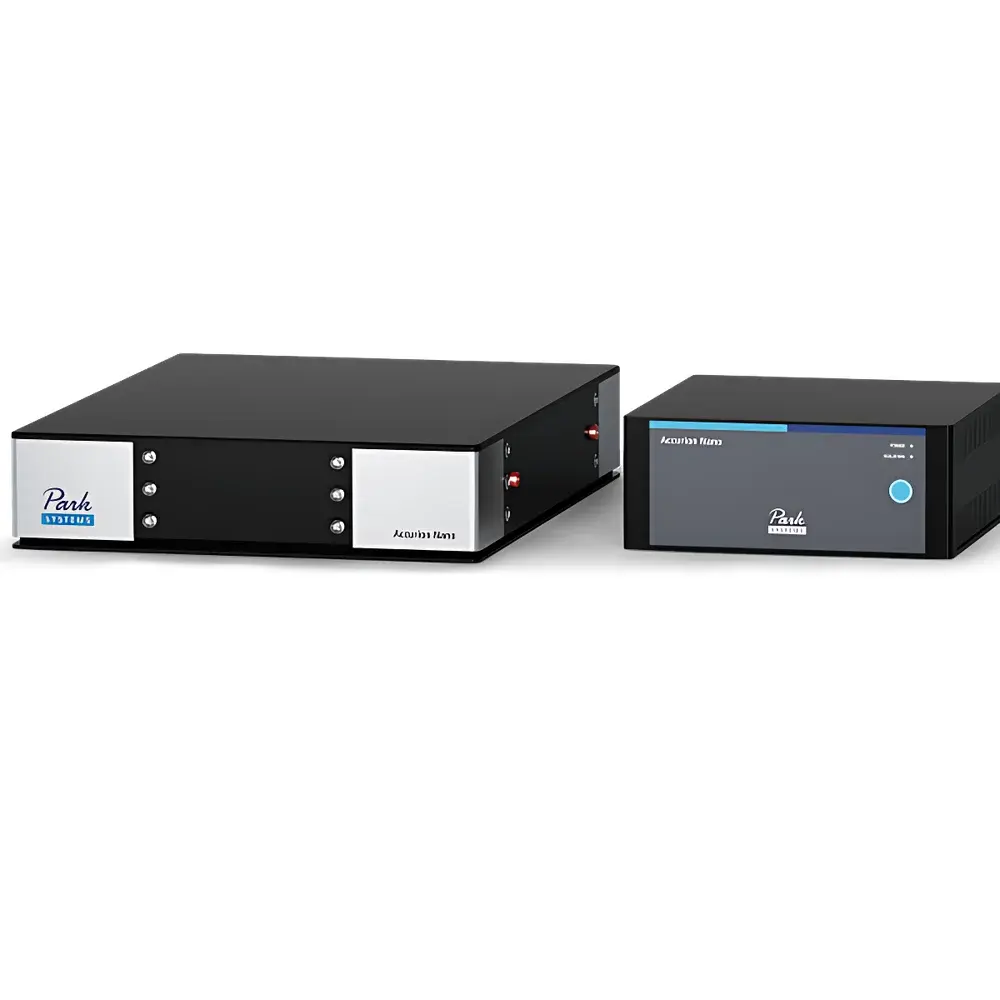
Accurion Nano30 Active Vibration Isolation Table
| Brand | Accurion |
|---|---|
| Origin | Germany |
| Model | Nano30 |
| Dimensions | 300 × 400 × 75 mm |
| Payload Capacity | 5–25 kg (standard) or 10–30 kg (high-load variant) |
| Active Isolation Bandwidth | 0.6/1 Hz – 200 Hz |
| Degrees of Freedom | 6-DOF (all axes actively controlled) |
| Settling Time | ≤ 0.3 s |
| Power Supply | Standard AC mains (no compressed air required) |
| Inherent Stiffness at 1 Hz | 20–30× higher than typical passive pneumatic tables |
Overview
The Accurion Nano30 Active Vibration Isolation Table is an engineered solution for high-stability laboratory environments where sub-micron positional fidelity and dynamic vibration rejection are critical. Unlike passive isolation systems—such as air-spring or elastomeric tables—the Nano30 employs real-time, closed-loop active control across all six degrees of freedom (6-DOF) to suppress environmental disturbances in the frequency range from 0.6 Hz (or 1 Hz, depending on configuration) up to 200 Hz. This performance envelope directly addresses the most problematic low-frequency building vibrations (e.g., footfall, HVAC-induced floor motion, and distant traffic), which are typically unattenuated—or even amplified—by conventional passive isolators due to their inherent resonance below 2–5 Hz. The Nano30’s electromagnetic actuator array continuously monitors inertial motion via integrated high-sensitivity accelerometers and velocity sensors, then generates precisely phase-inverted counter-forces to cancel incoming disturbances within milliseconds. Its solid-state architecture eliminates mechanical hysteresis and pneumatic latency, enabling a typical settling time of ≤ 0.3 seconds after step perturbations—orders of magnitude faster than the 30–60 second stabilization observed in standard passive systems.
Key Features
- True 6-degree-of-freedom active vibration cancellation—simultaneous suppression of translational (X, Y, Z) and rotational (pitch, yaw, roll) disturbances
- Ultra-low-frequency capability: effective isolation starting at 0.6 Hz (standard mode) or 1 Hz (high-stability mode), eliminating resonance-related amplification zones
- Sub-second dynamic response: ≤ 0.3 s settling time ensures rapid recovery after mechanical disturbance, essential for automated measurement sequences and stage repositioning
- Compact footprint (300 × 400 × 75 mm) with modular mounting interface—designed for integration beneath optical tables, scanning probe microscopes, nanoindenters, and compact interferometric setups
- No external infrastructure required: operates from standard AC power; zero dependency on compressed air, vacuum lines, or external cooling
- High static stiffness at 1 Hz (20–30× greater than typical pneumatic isolators), ensuring exceptional positional stability during long-duration acquisitions
- Intuitive operation: single-button activation with status LED feedback; no software installation or calibration needed for basic deployment
Sample Compatibility & Compliance
The Nano30 is compatible with instruments requiring nanometer-scale stability under ambient laboratory conditions—including atomic force microscopes (AFM), optical profilers, laser Doppler vibrometers, micro-hardness testers, and benchtop electron backscatter diffraction (EBSD) systems. Its payload range (5–25 kg standard; optional 10–30 kg variant) accommodates most compact analytical platforms without compromising isolation performance. The system complies with IEC 61000-6-3 (EMC emission standards) and meets CE marking requirements for laboratory equipment. While not certified to ISO 14644 cleanroom classes, its sealed electromagnetic actuators and absence of outgassing components make it suitable for Class 10,000 (ISO 8) environments. For regulated QC/QA workflows, the Nano30 supports audit-ready documentation packages upon request, aligning with GLP/GMP principles for instrument qualification (IQ/OQ/PQ).
Software & Data Management
The Nano30 operates autonomously via embedded firmware and requires no host PC for core functionality. Optional USB-C connectivity enables access to diagnostic telemetry—including real-time acceleration spectra, actuator utilization metrics, and system health logs—via Accurion’s NanoControl Suite (Windows/macOS). This software supports export of time-domain sensor data in CSV format for post-acquisition correlation with instrument output. Firmware updates are delivered via signed binary packages, ensuring integrity and traceability. No cloud connectivity or remote telemetry is enabled by default; all data remains local unless explicitly exported by the user. The system maintains full operational integrity during power cycling and retains configuration settings across restarts.
Applications
- Nanoscale surface metrology: enabling stable AFM imaging on non-basement lab floors without structural retrofitting
- In-situ mechanical testing: supporting high-resolution nanoindentation and scratch testing under vibrational noise
- Optical coherence tomography (OCT) and digital holography: preserving phase coherence during extended acquisition windows
- Quantum sensing platforms: isolating cold-atom interferometers and NV-center magnetometers from ground-borne microseisms
- Microfabrication alignment: stabilizing mask aligners and direct-write lithography tools during sub-100 nm overlay registration
- Calibration laboratories: fulfilling ISO/IEC 17025 requirements for vibration-controlled reference measurements
FAQ
Does the Nano30 require compressed air or external vacuum sources?
No. It operates solely from standard AC mains power and contains no pneumatic or hydraulic components.
Can the Nano30 be integrated into existing optical tables or custom frames?
Yes. It features standardized M6 threaded mounting holes on the top and bottom surfaces, compatible with industry-standard kinematic and rigid mounting solutions.
What is the recommended maintenance schedule?
None beyond periodic visual inspection of mounting interfaces and verification of power supply integrity; the system has no consumables or wear-prone mechanical elements.
Is the Nano30 compatible with electromagnetic compatibility (EMC)-sensitive instruments?
Yes. Its actuators and control electronics are fully shielded and meet IEC 61000-6-3 Class B emission limits for residential/commercial environments.
How is performance validated during installation?
Accurion provides a factory-calibrated reference accelerometer and test protocol for on-site verification of attenuation curves per ISO 20486 (vibration isolation performance testing).



