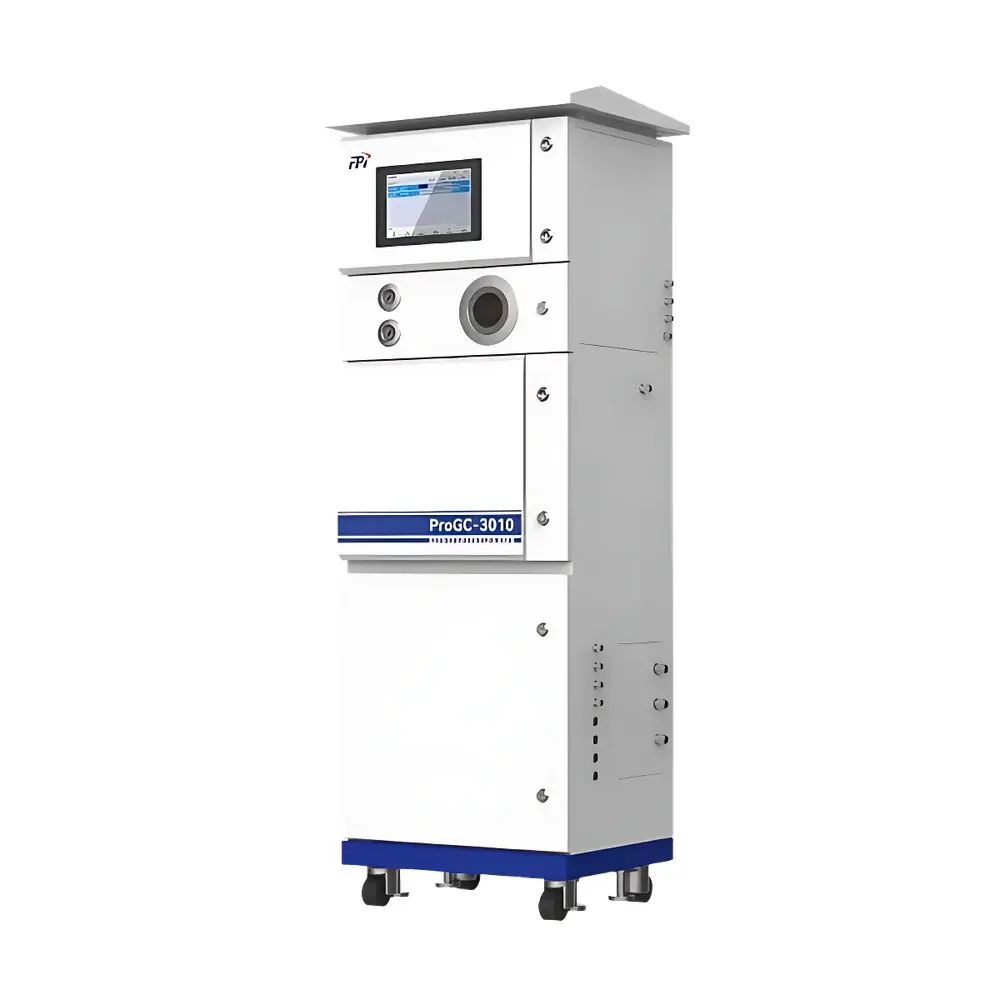
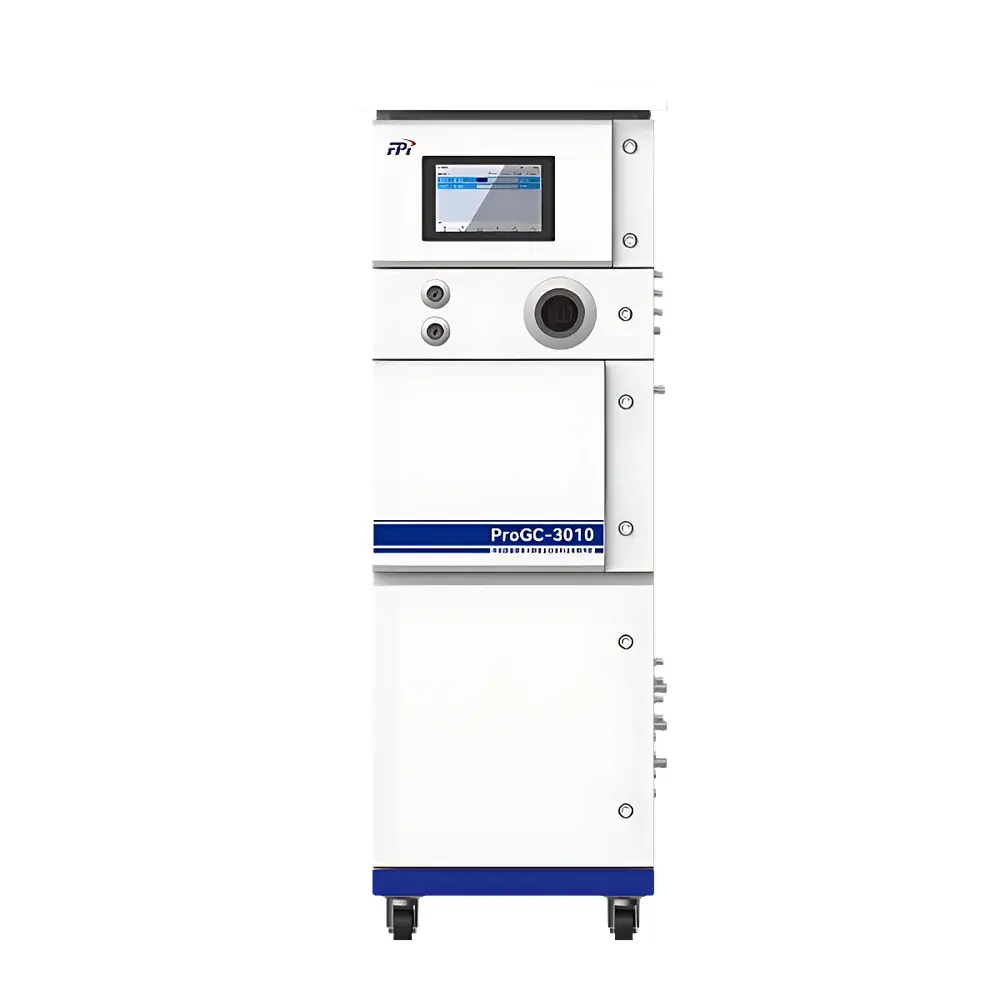
FPI ProGC-3010 Industrial Online Gas Calorific Value Analyzer
| Brand | FPI |
|---|---|
| Origin | Zhejiang, China |
| Manufacturer Type | Original Equipment Manufacturer (OEM) |
| Country of Origin | China |
| Model | ProGC-3010 |
| Pricing | Available Upon Request |
Overview
The FPI ProGC-3010 Industrial Online Gas Calorific Value Analyzer is a dedicated gas chromatography (GC)-based process analyzer engineered for continuous, real-time determination of calorific value (higher heating value, HHV, and lower heating value, LHV) in industrial fuel gas streams. Unlike conventional combustion-based calorimeters—which rely on flame-based energy measurement and carry inherent explosion risks—the ProGC-3010 employs a flameless, separation-driven analytical principle grounded in quantitative gas chromatography. It separates and quantifies individual combustible components (e.g., H₂, CH₄, C₂H₆, C₃H₈, CO, CO₂, N₂, O₂) in raw syngas, natural gas blends, coke oven gas, blast furnace gas, biogas, or mixed city gas with high repeatability and chemical specificity. By applying stoichiometric combustion equations to the molar composition output, the system computes theoretical calorific value and, critically, the molecular air-to-fuel ratio required for complete combustion—enabling precise, model-based combustion control rather than empirical flow-ratio tuning.
Key Features
- Flameless GC architecture eliminates ignition sources—certified for Class I, Division 1 hazardous area deployment per IEC 60079-0/10 and ATEX directives.
- Integrated thermal conductivity detector (TCD) and/or flame ionization detector (FID), configurable for multi-component analysis across C₁–C₄ hydrocarbons and permanent gases.
- Automated, unattended operation with <15-minute cycle time per analysis; robust sample introduction via heated stainless-steel sampling line and pressure-regulated, particulate-filtered gas conditioning system.
- Onboard temperature-controlled oven (40–200 °C range) ensures retention time stability and column longevity under fluctuating ambient conditions.
- Real-time calculation engine delivers HHV, LHV, Wobbe Index, stoichiometric air requirement (molar O₂ and air), and excess air coefficient—updated synchronously with each chromatogram.
- Modular hardware design supports hot-swap column cartridges and field-replaceable detectors, minimizing downtime during preventive maintenance.
Sample Compatibility & Compliance
The ProGC-3010 is validated for use with low- to medium-BTU gas matrices including but not limited to pipeline natural gas, landfill biogas, coal-derived syngas, coke oven gas (COG), and blended town gas. It complies with ISO 6974-2 (natural gas—determination of composition by GC), ASTM D1945 (analysis of natural gas by GC), and EN 15403 (biogas—determination of calorific value). All firmware and data handling routines are structured to support GLP/GMP-aligned audit trails, including user login logs, method versioning, calibration history, and raw chromatogram archiving—fully compatible with FDA 21 CFR Part 11 requirements when deployed with optional electronic signature modules.
Software & Data Management
The analyzer operates under FPI’s proprietary ProAnalytix™ Process Analytics Suite—a Windows-based SCADA-integrated platform supporting OPC UA and Modbus TCP protocols. The software provides full method development tools, automated calibration sequence scheduling (external standard or internal reference gas), drift compensation algorithms, and dynamic baseline correction. Raw chromatograms and derived parameters are timestamped and stored in an embedded SQL database with configurable retention policies. Export options include CSV, XML, and PDF reports compliant with ISO/IEC 17025 documentation standards. Remote diagnostics, firmware updates, and method push-down are supported via secure TLS 1.2 encrypted connections.
Applications
- Gas blending station optimization: Real-time tracking of upstream/downstream composition shifts enables predictive actuation of mixing valves using neural-network-derived setpoint adjustments—reducing thermal overshoot in downstream burners by up to 40% versus conventional PID control.
- Steel mill blast furnace gas (BFG) and basic oxygen furnace gas (BOFG) valorization: Continuous monitoring ensures safe co-firing with natural gas while maintaining consistent furnace temperature profiles and refractory life.
- Waste-to-energy plant biogas upgrading: Enables closed-loop control of amine scrubbing and membrane separation units based on real-time CH₄ purity and CO₂ slip metrics.
- Hydrogen-enriched natural gas (HENG) infrastructure: Quantifies H₂ content (0.1–30 vol%) and its impact on Wobbe Index deviation—critical for turbine and burner compatibility certification.
- Regulatory reporting: Automated generation of daily calorific value summaries aligned with national gas quality regulations (e.g., GB/T 13612 in China, EN 437 in EU).
FAQ
What detection technologies does the ProGC-3010 support?
The system is factory-configured with a high-stability TCD for permanent gases and light hydrocarbons; optional FID configuration is available for trace-level aromatic and heavy hydrocarbon detection.
Can it interface with DCS or PLC systems?
Yes—native support for Modbus TCP, OPC UA, and 4–20 mA analog outputs (with HART protocol) enables seamless integration into Emerson DeltaV, Honeywell Experion, Siemens PCS7, and Yokogawa CENTUM VP environments.
Is calibration traceable to national standards?
All factory calibrations are performed using NIST-traceable certified reference gases (CRMs), with full calibration certificates provided per ISO/IEC 17025 requirements.
How often does the system require maintenance?
Preventive maintenance intervals are specified at 6 months for consumables (filters, septa, carrier gas traps) and 12 months for column regeneration or replacement—documented in the included Maintenance Logbook module.
Does it support remote troubleshooting?
Yes—integrated VNC-based remote desktop access (with role-based permissions) and diagnostic event logging allow FPI Field Application Engineers to perform root-cause analysis without site visit.
Related Products