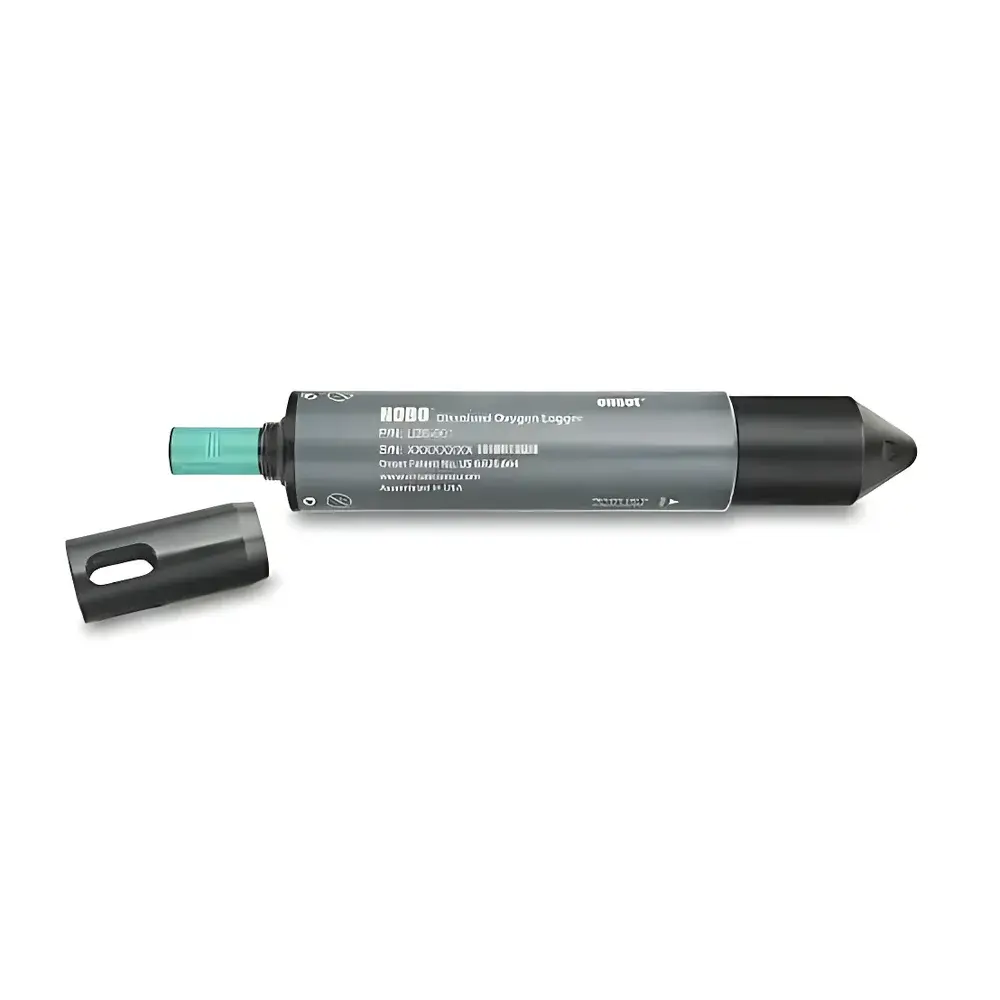
HOBO U26 Dissolved Oxygen Data Logger by Onset
| Key | Brand: Onset |
|---|---|
| Model | U26 |
| Sensor Type | Optical (Dynamic Fluorescence Quenching) |
| DO Range | 0–30 mg/L |
| Calibration Range | 0–20 mg/L |
| Accuracy | ±0.2 mg/L (0–8 mg/L), ±0.5 mg/L (8–20 mg/L) |
| Resolution | 0.02 mg/L |
| Response Time (t₉₀) | <2 min |
| Temperature Range | −5 to 40 °C |
| Temp Accuracy | ±0.2 °C |
| Temp Resolution | 0.02 °C |
| Memory | 64 KB (21,700 readings) |
| Logging Interval | 1 min – 18 hr |
| Battery Life | Up to 6 months typical |
| Depth Rating | ≤100 m |
| Dimensions | Ø3.96 cm × 26.67 cm |
| Weight | 464 g |
| Power | 3.6 V lithium battery |
Overview
The HOBO U26 Dissolved Oxygen Data Logger is a compact, self-contained, submersible instrument engineered for high-accuracy, long-term monitoring of dissolved oxygen (DO) concentration in natural and engineered aquatic systems. Unlike electrochemical Clark-type sensors, the U26 employs optical sensing based on dynamic fluorescence quenching—a principle where molecular oxygen modulates the lifetime and intensity of fluorescent emissions from a proprietary ruthenium-based luminophore immobilized on the sensor tip. This non-consumptive, membrane-free technology eliminates drift associated with cathode polarization or electrolyte depletion, delivering stable calibration over extended deployments. Designed for field autonomy, the U26 operates independently without external power or data cables, making it suitable for unattended use in remote lakes, rivers, estuaries, coastal zones, and aquaculture systems. Its robust stainless-steel housing and pressure-rated seal meet IP68 specifications, enabling reliable operation at depths up to 100 meters.
Key Features
- Optical DO sensing with dynamic fluorescence quenching—no membrane replacement, zero oxygen consumption, minimal biofouling susceptibility
- Integrated thermistor for simultaneous temperature measurement; automatic temperature compensation applied in real time during logging
- User-replaceable optical sensor cartridge—field-swappable without recalibration under standard conditions
- 64 KB non-volatile memory stores up to 21,700 timestamped DO/temperature pairs; configurable logging intervals from 1 minute to 18 hours
- Time accuracy of ±1 minute per month across 0–50 °C, traceable to NIST-certified quartz oscillator
- USB optical base (BASE-U-4 with COUPLER2-C) enables rapid, galvanically isolated data download—even when wet or submerged in freshwater
- Optional waterproof communication module (U-DTW-1) supports wireless telemetry via Bluetooth Low Energy for near-field retrieval
- Built-in Dissolved Oxygen Assistant software tools support post-deployment correction for fouling-induced signal attenuation using blank-reference and two-point normalization protocols
Sample Compatibility & Compliance
The U26 is validated for use in both freshwater and full-strength seawater (up to 45 ppt salinity), with built-in salinity compensation algorithms aligned with the UNESCO 1983 Practical Salinity Scale and APHA Standard Methods 4500-O G. It meets ASTM D888-22 requirements for field DO measurement in environmental monitoring applications and complies with EPA Method 360.1 for dissolved oxygen analysis in surface waters. While not certified for GLP or 21 CFR Part 11 environments out-of-the-box, its audit-ready HOBOware Pro export logs include full metadata (sensor ID, firmware version, timestamps, battery voltage, and error flags), supporting traceability in ISO/IEC 17025-accredited laboratories. The device carries CE marking for electromagnetic compatibility (EN 61326-1) and RoHS compliance for hazardous substances.
Software & Data Management
Data retrieval and configuration are managed exclusively through HOBOware Pro v4.x (Windows/macOS), a validated desktop application that generates CSV, Excel, and PDF reports with embedded uncertainty budgets. The software enforces secure parameter locking, password-protected configuration changes, and version-controlled firmware updates. All logged datasets include embedded calibration history, sensor serial numbers, and environmental context tags (e.g., deployment site ID, operator initials). Exported files conform to FAIR data principles (Findable, Accessible, Interoperable, Reusable) and integrate natively with common hydrological modeling platforms including EFDC, WASP, and QGIS via standardized time-series schema. Raw binary logs retain full precision (16-bit DO counts, 14-bit temperature ADC values) prior to conversion—ensuring reproducibility during reprocessing.
Applications
- Long-term hypolimnetic oxygen profiling in stratified lakes and reservoirs
- Diurnal DO cycling studies in streams and wetlands to assess primary productivity and respiration rates
- Coastal eutrophication monitoring—tracking seasonal anoxia onset and recovery in benthic boundary layers
- Regulatory compliance reporting for TMDL implementation and NPDES permit conditions
- Marine aquaculture site selection and feed optimization based on real-time DO thresholds
- Climate-driven deoxygenation research across continental shelf transects
- Validation of satellite-derived DO proxies (e.g., Sentinel-3 OLCI chlorophyll-a + SST fusion models)
FAQ
Is the U26 suitable for continuous deployment in turbid or high-fouling environments?
Yes—the optical sensor surface is chemically inert and resistant to organic adhesion; however, periodic visual inspection and gentle cleaning with soft brush and freshwater are recommended every 4–6 weeks in eutrophic or biofilm-prone sites.
Does the U26 require factory recalibration between deployments?
No—field recalibration using zero-oxygen (sodium sulfite) and air-saturation standards is supported via HOBOware; full factory recalibration is recommended annually or after mechanical impact.
Can dissolved oxygen data be corrected for salinity and atmospheric pressure post-hoc?
Yes—HOBOware Pro applies user-defined barometric pressure and measured salinity during data export, computing both mg/L and % saturation values per Winkler-derived solubility equations (Garcia & Gordon, 1992).
What is the expected battery life under typical logging conditions?
At 15-minute intervals and 20 °C, the 3.6 V lithium cell sustains >6 months of operation; battery voltage is logged with every reading to flag end-of-life conditions.
Is the U26 compatible with third-party telemetry networks (e.g., LoRaWAN, cellular gateways)?
Not natively—but raw .csv exports can be ingested into custom middleware (e.g., Node-RED, ThingsBoard) for integration into IoT infrastructure via REST API or MQTT ingestion pipelines.