
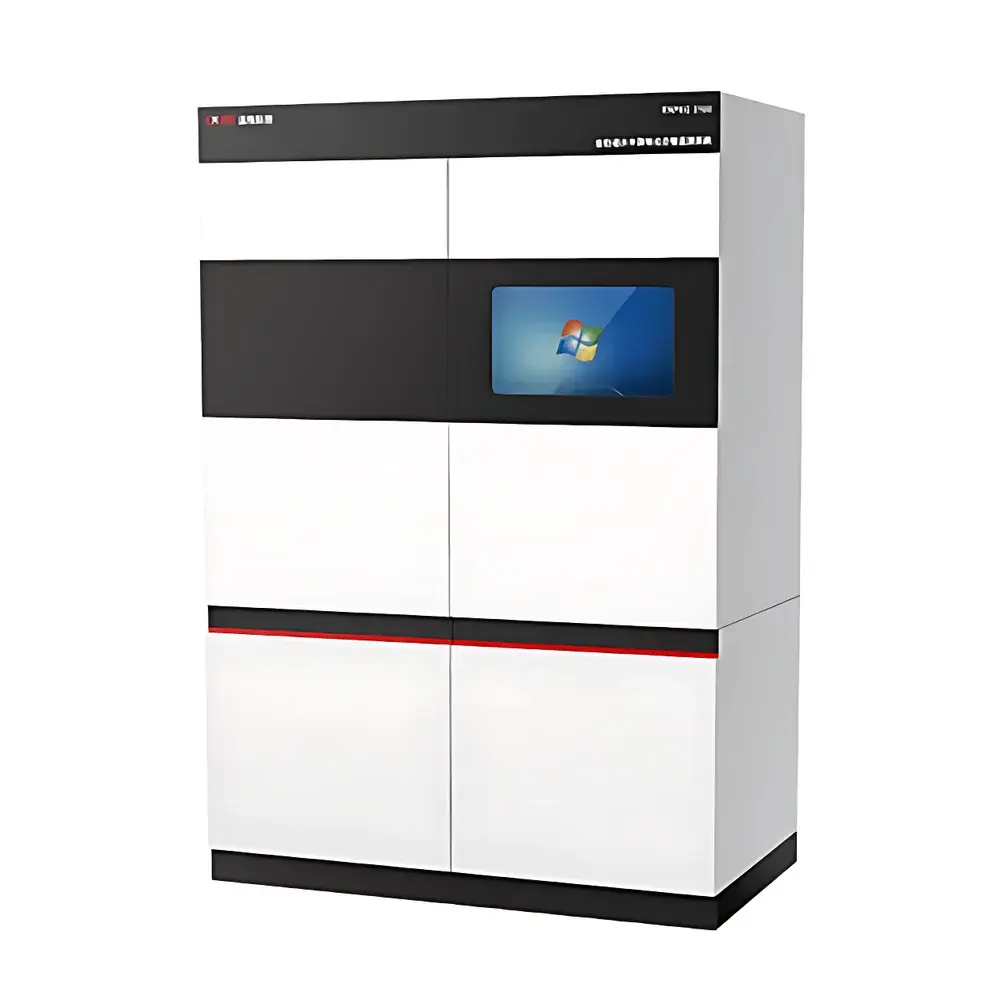
EXPEC 2100 Fully Automated Off-Flavor Compound Monitoring System for Water
| Brand | EXPEC |
|---|---|
| Origin | Zhejiang, China |
| Manufacturer Type | Authorized Distributor |
| Regional Classification | Domestic (China) |
| Model | EXPEC 2100 |
| Pricing | Upon Request |
Overview
The EXPEC 2100 Fully Automated Off-Flavor Compound Monitoring System is an integrated analytical platform engineered for continuous, unattended surveillance of geosmin and 2-methylisoborneol (MIB) in raw and finished drinking water. These two semi-volatile organic compounds—widely recognized as primary contributors to earthy-musty taste and odor complaints—are regulated under national drinking water guidelines and monitored as key indicators of algal bloom activity and treatment process efficacy. The system implements gas chromatography–mass spectrometry (GC–MS) coupled with automated solid-phase microextraction (SPME), enabling trace-level quantification at sub-ng/L sensitivity without manual intervention. Unlike conventional grab-sampling and lab-based GC–MS workflows, the EXPEC 2100 embeds sampling, internal standard addition, online SPME enrichment, thermal desorption, chromatographic separation, electron ionization (EI) mass detection, and calibrated data reporting into a single, self-contained architecture—designed specifically for deployment at source water intakes and potable water treatment plant influent/effluent points.
Key Features
- Fully automated end-to-end operation: Integrated peristaltic sampling, precision syringe-pump-based internal standard dosing (e.g., deuterated geosmin-d3 and MIB-d3), programmable SPME fiber exposure and desorption, GC temperature-programmed separation, and quadrupole MS detection.
- Uninterrupted monitoring capability: Engineered for ≥7-day unattended runtime with configurable cycle intervals (default 4-hour sampling frequency); cycle timing can be dynamically adjusted based on seasonal algal risk profiles.
- Compact, rack-mounted cabinet design: All subsystems—including water intake manifold, reagent reservoirs, SPME autosampler, GC–MS module, and embedded industrial PC—are housed within a single IP54-rated enclosure suitable for on-site installation in pump stations or control rooms.
- Robust calibration and quality control: Built-in daily system suitability checks, automatic retention time locking (RTL), and response factor tracking against multi-point aqueous calibration standards traceable to NIST SRMs.
- Fail-safe operational logic: Real-time pressure/flow monitoring, fiber integrity verification, carrier gas depletion alerts, and automatic recovery from transient power or communication interruptions.
Sample Compatibility & Compliance
The EXPEC 2100 is validated for direct analysis of surface water, reservoir water, river intake water, and filtered/potable water matrices without pre-filtration (0.45 µm optional). It complies with methodological principles aligned with EPA Method 525.3 (for semi-volatile organics in water) and ISO 15681-2:2021 (water quality — determination of geosmin and MIB — part 2: GC–MS method). Data acquisition and audit trails conform to GLP-compliant recordkeeping requirements; electronic signatures and user-access logging support alignment with FDA 21 CFR Part 11 when deployed in regulated utility environments.
Software & Data Management
The system runs on EXPEC AquaView™ v3.x—a Windows-based SCADA-integrated software suite supporting real-time chromatogram visualization, peak integration using selective ion monitoring (SIM) channels (m/z 112/113 for geosmin; m/z 122/123 for MIB), and auto-generated compliance reports in PDF/CSV formats. All raw data (.CDF), processed results, instrument logs, and QC records are stored locally with optional encrypted FTP/SFTP export to central LIMS or SCADA servers. Audit trail functionality captures operator actions, method changes, calibration events, and instrument status transitions with timestamped, immutable entries.
Applications
- Early-warning monitoring at drinking water source intakes to detect pre-bloom geosmin/MIB accumulation
- Process optimization at water treatment plants—evaluating oxidation (ozone, chlorine dioxide), activated carbon adsorption, and biofiltration efficiency
- Regulatory compliance reporting for municipal utilities subject to provincial or national organoleptic compound monitoring mandates
- Research applications in limnology and water quality modeling, where high-temporal-resolution off-flavor data informs predictive algal bloom forecasting
FAQ
What sample volume is required per analysis cycle?
Typical analysis uses 500 mL of raw water per 4-hour cycle, with SPME fiber exposure optimized for equilibrium partitioning under field-relevant temperature and pH conditions.
Is the system compatible with existing SCADA infrastructure?
Yes—Modbus TCP and OPC UA interfaces are supported for seamless integration with plant-wide control systems and alarm forwarding to centralized operations centers.
How is method validation performed during commissioning?
Factory acceptance testing includes spike recovery studies (n=6) across three concentration levels (1, 5, and 20 ng/L) in representative water matrices, with RSD ≤12% and recovery 85–115% per ISO/IEC 17025 principles.
Can the system be upgraded to monitor additional odorants?
Method expansion is possible via software configuration and GC–MS method development; validated extensions include 2-isopropyl-3-methoxypyrazine (IPMP) and β-cyclocitral upon customer-specific protocol qualification.
Related Products






