
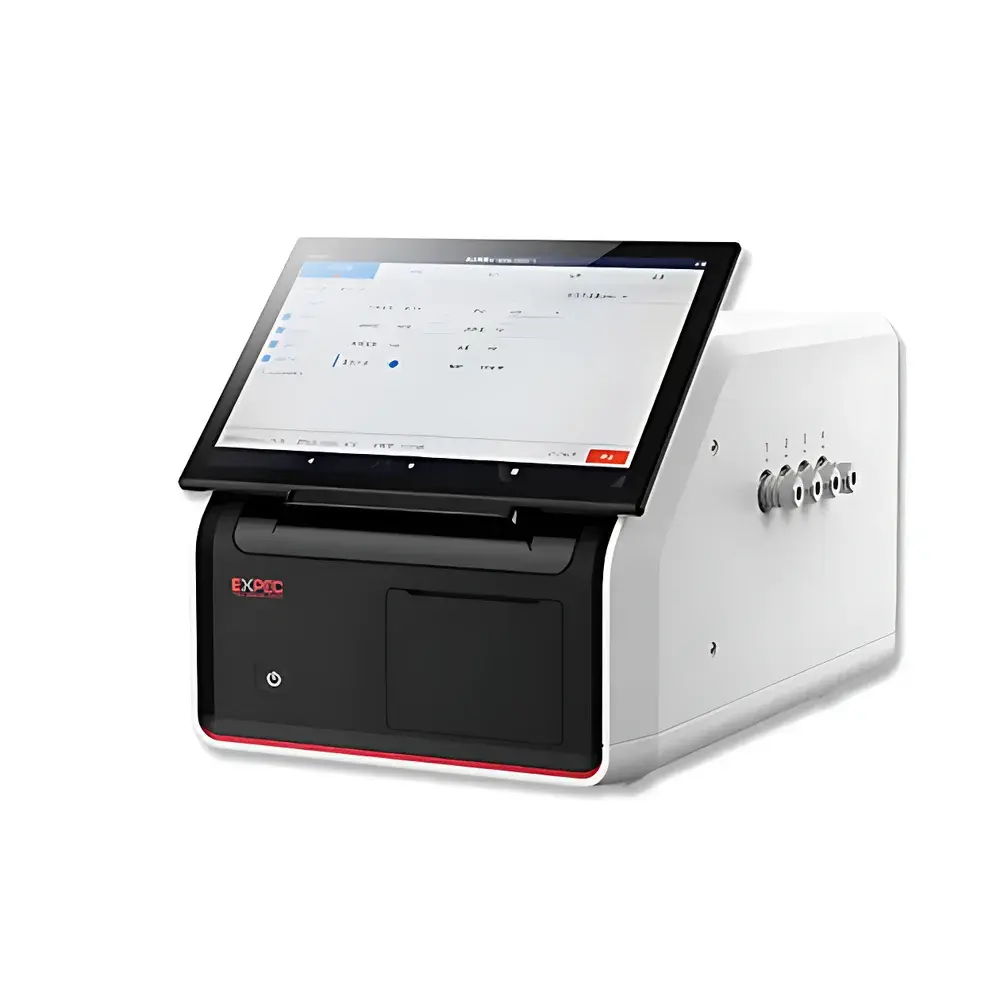
EXPEC 270 Static Gas Dilution System
| Brand | EXPEC (Hangzhou Superspectra Technology Co., Ltd.) |
|---|---|
| Origin | Zhejiang, China |
| Model | EXPEC 270 |
| Dilution Range | Up to 10,000× |
| Number of Independent Channels | 6 |
| Pressure Measurement Principle | Absolute Pressure Transducers |
| Dead Volume | Minimized via Optimized Flow Path Design |
| Tubing Material | Chemically Inert, Passivated Stainless Steel |
| Optional Module | Humidification Kit for Calibration Gas |
| Control Interface | Integrated Tablet via Wi-Fi (No External PC Required) |
| Data Management | Local Storage with Label Printing Support |
Overview
The EXPEC 270 Static Gas Dilution System is an engineered solution for precise, trace-level calibration gas preparation in analytical laboratories. Unlike dynamic dilution systems that rely on continuous mass flow controllers and active mixing, the EXPEC 270 employs a static pressure-based dilution methodology grounded in the ideal gas law (PV = nRT). It introduces a known quantity of concentrated standard gas into a fixed-volume, evacuated dilution chamber; subsequent measurement of absolute pressure rise—using high-stability, temperature-compensated piezoresistive transducers—enables accurate calculation of the final concentration. This approach eliminates flow-dependent uncertainties, minimizes residence time effects, and ensures exceptional reproducibility (<±0.8% RSD across repeated 100× dilutions under controlled ambient conditions). Designed for regulatory-grade applications, the system maintains metrological traceability through NIST-traceable pressure sensors and factory-calibrated volume chambers.
Key Features
- High-fidelity static dilution architecture with six independent, parallel dilution channels—enabling simultaneous preparation of multiple calibration standards without cross-channel interference.
- Ultra-low dead volume design: all internal pathways—including valves, fittings, and manifolds—are constructed from electropolished, silanized stainless steel and undergo rigorous inert surface passivation to suppress adsorption/desorption artifacts for reactive species (e.g., NO₂, H₂S, NH₃).
- Dilution factor range of 10× to 10,000×, verified across certified reference materials (CRMs) from NPL, NIST, and LNE; linearity maintained over full operational range per ISO 6145-1 (Gas mixtures — Preparation of calibration gas mixtures using the gravimetric method).
- Integrated humidification module (optional) delivers stable, traceable water vapor content (5–80% RH, ±2% RH accuracy) directly within the dilution stream—critical for ozone, VOC, and formaldehyde calibration where humidity-induced matrix effects are significant.
- Embedded Android-based tablet interface with Wi-Fi connectivity enables full system control, real-time pressure monitoring, audit trail logging, and one-touch label printing compliant with ISO/IEC 17025 documentation requirements.
Sample Compatibility & Compliance
The EXPEC 270 accommodates cylinder gases (up to 20 MPa inlet pressure), permeation tubes, and diffusion sources containing permanent gases (O₂, N₂, CO, CO₂), reactive analytes (Cl₂, SO₂, NOₓ), and volatile organic compounds (benzene, toluene, xylene, aldehydes). All wetted materials comply with ASTM E2654-22 (Standard Guide for Selection of Materials for Use in Gas Delivery Systems) and USP (Glass Containers). The system supports GLP/GMP workflows via configurable user roles, electronic signatures, and 21 CFR Part 11–compliant audit trails—including timestamped records of every dilution event, sensor calibration history, and operator ID. It meets the technical criteria outlined in EPA Method TO-15 Appendix B and EN 14662 for ambient air VOC calibration.
Software & Data Management
The embedded software platform provides ISO 17025-aligned data integrity features: immutable storage of dilution parameters (initial pressure, final pressure, chamber volume, temperature), automatic calculation of expanded uncertainty (k=2), and export of CSV/PDF reports with digital signatures. All data—including chromatographic integration references when linked to GC/MS or FTIR systems—is stored locally on encrypted internal flash memory with optional network backup via TLS 1.2–secured FTP/SFTP. Label printing supports GS1-compliant barcodes, batch IDs, expiration dates, and uncertainty statements—fully traceable to individual cylinder lot numbers and CRM certificates.
Applications
- Environmental monitoring laboratories preparing multi-point calibration curves for ambient air quality analyzers (e.g., chemiluminescence NOₓ analyzers, UV photometric O₃ monitors).
- Emergency response units requiring rapid, field-deployable generation of toxic gas standards (e.g., HCN, PH₃, HF) with documented chain-of-custody.
- Occupational health labs validating personal exposure monitors per ISO 7709 and NIOSH methods (e.g., 5515, 5520).
- Public health institutions performing method validation for WHO-recommended indoor air pollutants (PM₂.₅ co-pollutants, formaldehyde, acetaldehyde).
- Academic and metrology research groups conducting inter-laboratory comparison studies involving primary gas standards and gravimetric mixture verification.
FAQ
How does the EXPEC 270 achieve higher gas conservation compared to dynamic diluters?
It eliminates continuous purge flows and bypass losses inherent in mass flow controller–based systems—reducing standard gas consumption by ≥95% while maintaining equivalent accuracy.
Can the system be integrated into an existing LIMS or ELN infrastructure?
Yes—via RESTful API endpoints supporting JSON-formatted queries for dilution logs, certificate metadata, and instrument status; compatible with LabWare LIMS, Thermo Fisher SampleManager, and Veeva Vault.
Is third-party calibration of the pressure sensors required annually?
Factory calibration is performed against Fluke 754 Documenting Process Calibrators traceable to NIST; users may perform in-house verification using certified deadweight testers per ISO/IEC 17025 Clause 6.5.
What maintenance intervals are recommended for the inertized tubing and valves?
Valve lifetime exceeds 500,000 cycles; tubing requires no scheduled replacement but should be inspected quarterly for particulate accumulation when handling dusty or high-humidity matrices.
Does the humidification module introduce measurable carryover between humidity levels?
No—the module utilizes a dual-stage Peltier-cooled condensation dryer and saturator with <30-second equilibration time; residual moisture carryover is <0.5% RH as validated per ISO 8573-3.



