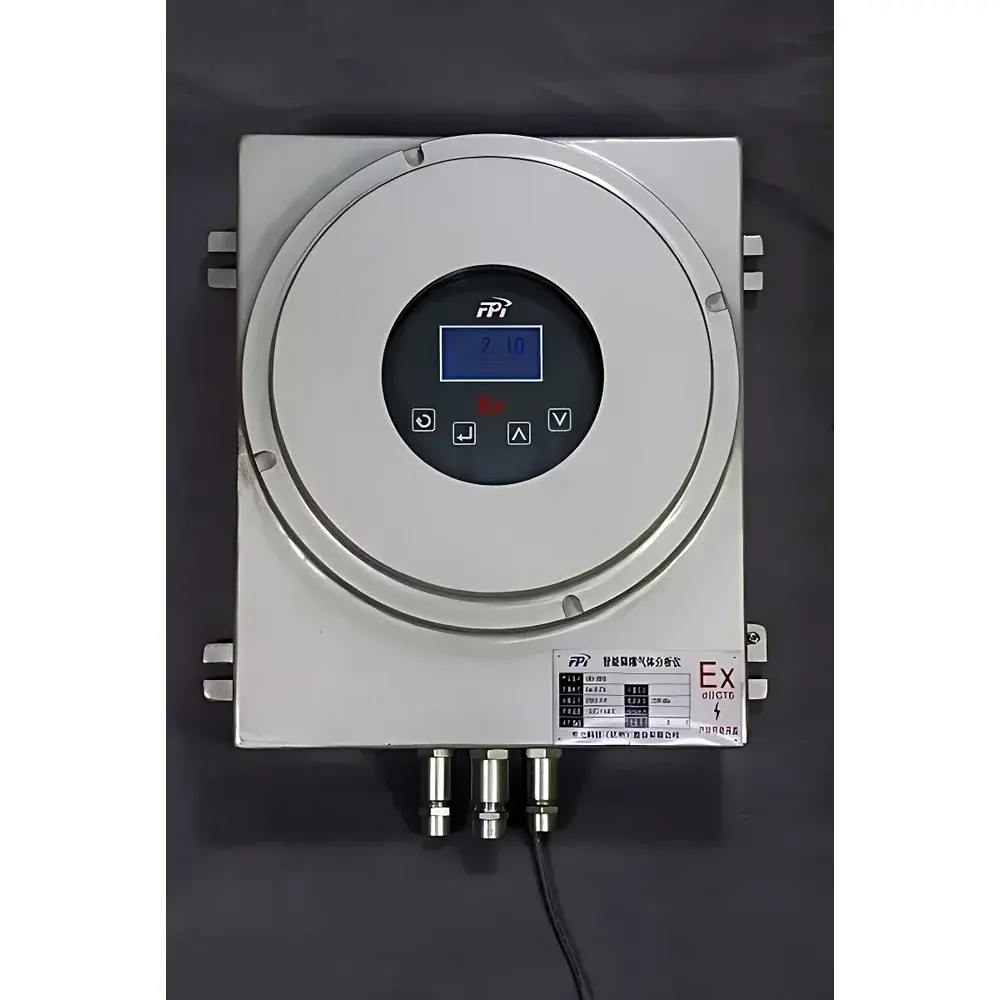
FPI GRD-2000 Intrinsically Safe Thermal Conductivity Gas Analyzer
| Brand | FPI |
|---|---|
| Origin | Zhejiang, China |
| Manufacturer Type | OEM Manufacturer |
| Country of Origin | China |
| Model | GRD-2000 |
| Pricing | Upon Request |
Overview
The FPI GRD-2000 Intrinsically Safe Thermal Conductivity Gas Analyzer is a fixed-mount, continuous online gas composition analyzer engineered for hazardous area deployment in industrial process environments. It operates on the fundamental physical principle that binary and multi-component gas mixtures exhibit thermal conductivity values linearly correlated with the concentration of individual constituents—particularly effective for quantifying hydrogen (H₂), helium (He), methane (CH₄), nitrogen (N₂), carbon dioxide (CO₂), and argon (Ar) in inert or non-reactive carrier matrices. Unlike catalytic or electrochemical sensors, thermal conductivity detection requires no consumables, exhibits minimal drift over time, and delivers inherently stable baseline performance under steady-state process conditions. The GRD-2000 integrates a micro-flow thermal conductivity detector housed within an explosion-proof (Ex d IIB T4 Gb / Ex tb IIIC T135°C Db) enclosure compliant with IEC 60079-0, -1, and -31 standards, enabling direct installation in Zone 1 and Zone 21 classified areas without additional barrier systems.
Key Features
- Intrinsically safe and flameproof-certified design meeting ATEX, IECEx, and GB 3836.1/2/13 requirements for Group IIB and IIIC atmospheres
- Micro-flow thermal conductivity sensor architecture ensuring high sensitivity (detection limit < 0.1% vol for H₂ in N₂), fast response time (T₉₀ < 15 s), and long-term zero stability (< ±0.5% FS/month)
- Large backlit dot-matrix LCD display with real-time gas concentration, date/time stamp, system status, and alarm indicators
- Dual independent alarm relays with fully configurable upper/lower setpoints, hysteresis, and latching/non-latching modes
- Galvanically isolated analog outputs: selectable 0–10 mA or 4–20 mA current loop with HART protocol support (optional)
- RS-232 serial interface supporting Modbus RTU and proprietary ASCII command sets for integration with DCS, PLC, or SCADA systems
- Onboard data logging with automatic timestamped storage (up to 30 days of 1-minute interval data) and recall via front panel or serial port
- Automatic temperature compensation and built-in H₂-specific thermal conductivity correction algorithm for accurate measurement in mixed-gas backgrounds
Sample Compatibility & Compliance
The GRD-2000 is validated for continuous analysis of dry, non-corrosive, non-condensing gas streams with operating pressures from 0.8 to 1.2 bar(a) and sample temperatures between 0 °C and 50 °C. It is not suitable for applications involving condensable vapors, halogenated hydrocarbons, or highly reactive species (e.g., Cl₂, NH₃, SO₂). Sample conditioning is recommended for particulate-laden or high-humidity streams. The analyzer conforms to electromagnetic compatibility (EMC) per IEC 61326-1 (industrial environment), safety per IEC 61010-1, and carries CE marking under the EU Low Voltage and EMC Directives. Documentation includes full Factory Acceptance Test (FAT) reports, calibration certificates traceable to NIM (China National Institute of Metrology), and compliance statements aligned with ISO/IEC 17025 laboratory practices.
Software & Data Management
Configuration, calibration, and diagnostics are performed locally via intuitive Chinese/English bilingual menu navigation or remotely using FPI’s PC-based configuration utility (GRD-ConfigTool v3.2). All parameter changes—including span adjustment, alarm thresholds, and communication settings—are logged with user ID, timestamp, and pre/post values to satisfy basic audit trail requirements. While the GRD-2000 does not implement full FDA 21 CFR Part 11 electronic signature functionality, its event log structure supports GLP/GMP-aligned operational review when deployed in quality-critical manufacturing zones. Data export is supported in CSV format via RS-232 or USB-to-serial adapter.
Applications
- Hydrogen purity monitoring in ammonia synthesis purge gas loops and chlor-alkali plant off-gases
- Oxygen/nitrogen ratio control in controlled-atmosphere heat treatment furnaces
- CO₂ concentration tracking in biogas upgrading and fermentation off-gas streams
- Inert gas blanketing verification in pharmaceutical reactor headspaces
- Leak detection support in high-purity nitrogen or argon distribution networks
- Process safety interlock signaling for flammable gas accumulation in battery drying rooms or solvent recovery units
FAQ
What certification standards does the GRD-2000 meet for hazardous area use?
It holds ATEX Directive 2014/34/EU (II 2G Ex d IIB T4 Gb) and IECEx certification (Ex d IIB T4 Gb), plus China’s GB 3836.1-2021, GB 3836.2-2021, and GB 3836.31-2017 approvals.
Can the analyzer measure hydrogen in air?
No—air contains ~78% N₂ and ~21% O₂, both with similar thermal conductivities; H₂ measurement in air requires paramagnetic or TCD configurations with oxygen compensation algorithms not implemented in the GRD-2000.
Is field calibration possible without removing the unit?
Yes—zero and span calibration can be executed in-situ using certified standard gases introduced via the dedicated calibration port, with automated validation of sensor response linearity.
What maintenance intervals are recommended?
Sensor element replacement is recommended every 24 months under continuous operation; filter elements should be inspected quarterly and replaced if pressure drop exceeds 5 kPa.
Does the GRD-2000 support Modbus TCP?
No—only RS-232 serial communication with Modbus RTU is supported; Ethernet connectivity requires external protocol converter hardware.
Related Products