
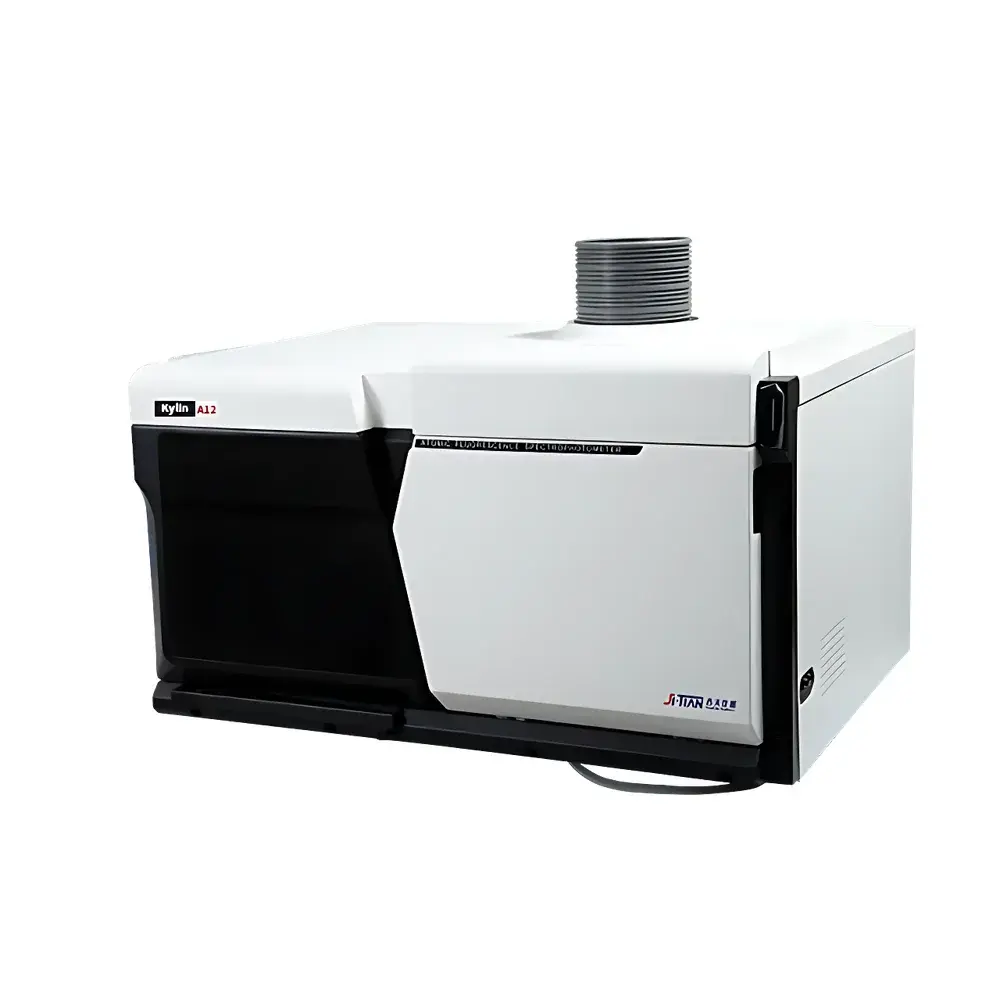
Titan Instruments Kylin A12 Dual-Channel Atomic Fluorescence Spectrometer
| Brand | Titan Instruments |
|---|---|
| Origin | Beijing, China |
| Model | Kylin A12 |
| Instrument Type | Multi-channel Atomic Fluorescence Spectrometer |
| Sample Introduction Mode | Dual Sequential Injection Pumps |
| Waste Disposal | Rear Exhaust Design |
| Hydride Generation Mode | Vapor Generation / Hydride Generation |
| Gas Flow Control | Mass Flow Controller (MFC) |
| Detectable Elements | As, Sb, Bi, Sn, Se, Te, Pb, Ge, Hg, Cd, Zn, Au |
| Relative Standard Deviation (RSD) | <0.6% |
| Linear Dynamic Range | >3 orders of magnitude |
| Detection Limits | As, Sb, Se, Bi, Te, Hg, Sn, Pb < 0.01 µg/L |
| Photomultiplier Tube Wavelength Range | 160–320 nm |
| Atomizer Temperature Control Range | 100–350 °C |
Overview
The Titan Instruments Kylin A12 Dual-Channel Atomic Fluorescence Spectrometer is a high-performance, hydride-generation-based analytical instrument engineered for trace-level quantification of hydride-forming and cold-vapor elements in complex environmental, food, clinical, and industrial matrices. It operates on the principle of atomic fluorescence spectroscopy (AFS), where analyte atoms—generated in situ via sodium borohydride (NaBH₄) reduction or mercury cold-vapor atomization—are excited by a sharp-line hollow cathode lamp (HCL) source and emit characteristic fluorescence photons at element-specific wavelengths. The Kylin A12 employs a fully orthogonal dual-beam optical architecture with spatially separated excitation and detection paths, minimizing stray light interference and enhancing signal-to-noise ratio. Its dual-channel design enables simultaneous, independent measurement of two elements—such as As and Se, or Hg and Sb—without spectral crosstalk or time multiplexing, significantly improving throughput while preserving metrological integrity.
Key Features
- Dual-channel synchronous detection with full channel equivalence: both optical paths feature identical focal geometry, photomultiplier gain calibration, and real-time reference drift correction—ensuring <0.6% RSD across repeated measurements.
- Automated sequential injection system with dual precision syringe pumps: supports reproducible reagent delivery, precise reaction timing, and programmable wash cycles; compatible with 160-position or 212-position polar-coordinate autosamplers.
- Integrated pneumatic sample introduction: maintains constant pressure during hydride generation, ensuring stable vapor transport and eliminating pulsation-induced signal noise.
- Orthogonal dual-optical-path design with optimized 160–320 nm PMT sensitivity: delivers high quantum efficiency in the far-UV region critical for As, Se, Sb, and Hg detection.
- Intelligent plug-and-play hollow cathode lamps: direct-insertion design with auto-identification, current regulation, and operational hour logging; mercury lamps include dedicated auto-ignition circuitry.
- Temperature-controlled quartz-trap atomizer with programmable 100–350 °C range: enables element-specific thermal optimization—e.g., lower temperatures for volatile Hg, higher for refractory Bi or Te.
- EFC-driven gas flow management: electronic mass flow controllers monitor and regulate Ar carrier gas pressure and flow in real time, with audible/visual alarms for deviations exceeding ±2% setpoint.
- Carbon-fiber-reinforced PTFE sampling probes: eliminate quartz needle fragility while maintaining chemical inertness and low memory effect for high-salinity or viscous samples.
- Comprehensive self-diagnostic suite: autonomously verifies status of optical alignment, hydride generator integrity, atomizer heating stability, liquid level sensors, lamp output, and gas line integrity—logging fault codes per ISO/IEC 17025 diagnostic traceability requirements.
Sample Compatibility & Compliance
The Kylin A12 is validated for use with aqueous, digested, and microwave-assisted leachates from diverse regulatory workflows. It complies with method requirements specified in major international and national standards including: ASTM D6729 (petroleum products), USP / (elemental impurities in pharmaceuticals), EPA Method 1631E (mercury in water), and Chinese national standards GB 5009.11–2014 (total and inorganic arsenic in food), GB 5009.17–2014 (total and organic mercury), HJ 694–2014 (water), HJ 680–2013 (soil/sediment), and HJ 702–2014 (solid waste). Its hardware architecture and software audit trail functionality support GLP and GMP environments compliant with FDA 21 CFR Part 11 for electronic records and signatures.
Software & Data Management
The Kylin A12 is operated via Titan’s proprietary AFSControl™ software—a dual-language (English/Chinese), role-based platform featuring full 21 CFR Part 11 compliance. Core capabilities include: user-defined method templates with multi-step calibration (linear, quadratic, weighted), automated QC check routines (spike recovery, blank monitoring, continuing calibration verification), customizable report generation with embedded chromatogram-style signal plots, and hierarchical permission management (administrator, analyst, reviewer). All data—including raw intensity values, lamp current logs, temperature profiles, gas flow history, and diagnostic events—are timestamped, digitally signed, and stored in encrypted SQLite databases with immutable audit trails. Backup and export support CSV, PDF, and XML formats for LIMS integration.
Applications
The Kylin A12 delivers robust performance across regulated and research-driven applications: environmental monitoring (As, Hg, Sb, Se in ambient air particulates per HJ 1133–2020; groundwater and wastewater per HJ 694–2014); food safety testing (inorganic As in rice, Hg in fish tissue, Pb in infant formula); agricultural feed analysis (Se in soybean meal, Cd in fertilizers); geochemical surveying (Te, Bi, Au in rock digests); metallurgical quality control (Ge in semiconductor-grade silicon, Sn in solder alloys); pharmaceutical excipient screening (catalytic metal residues); clinical toxicology (Hg, Pb, Se in whole blood and urine per CLIA guidelines); and petrochemical analysis (Sn, Zn, Pb in lubricants and crude oil fractions).
FAQ
What hydride-forming elements can the Kylin A12 quantify simultaneously?
The instrument supports concurrent detection of any two elements from As, Sb, Bi, Sn, Se, Te, Pb, Ge, Cd, Zn, and Au—provided their optimal atomization temperatures and hydride generation kinetics are compatible.
Does the system support EPA-compliant mercury speciation workflows?
While the Kylin A12 measures total Hg via cold-vapor AFS, speciation requires coupling with HPLC or GC separation upstream; the instrument accepts post-column hydride/cold-vapor interfaces per EPA Method 1631E Annex B.
Is method validation documentation available for pharmaceutical applications?
Yes—Titan provides IQ/OQ protocols, system suitability test procedures aligned with USP , and a full validation support package including LOD/LOQ studies, ruggedness assessments, and forced degradation reports.
Can the software generate reports compliant with CNAS accreditation requirements?
Absolutely—the AFSControl™ reporting engine embeds all metadata required by CNAS-CL01:2018, including analyst ID, instrument calibration certificates, reagent lot numbers, environmental monitoring logs, and electronic signature timestamps.
What maintenance intervals are recommended for routine operation?
Daily: rinse lines and check liquid levels; weekly: clean quartz trap and verify lamp alignment; quarterly: recalibrate gas flow controllers and validate PMT dark current; annually: full optical path inspection and atomizer furnace calibration per ISO/IEC 17025 Clause 6.4.
Related Products





