
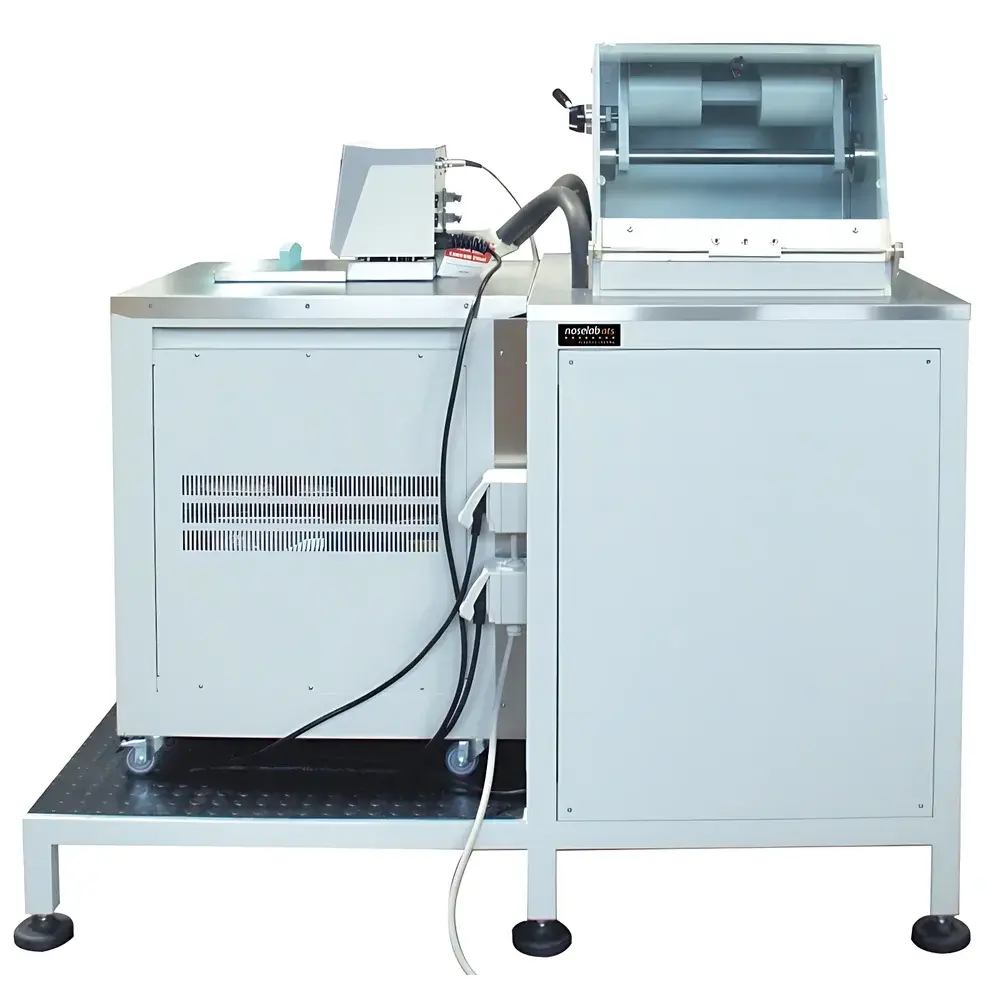
NOSELAB ATS 10012006 Low-Temperature Brittleness Tester
| Brand | NOSELAB ATS |
|---|---|
| Origin | Italy |
| Model | 10012006 |
| Operating Temperature Range | −80 °C to +100 °C |
| Sample Capacity | 5 specimens (ASTM D1329) or 10 specimens (ISO R 974) |
| Cooling Options | Dual-coil test bath with compatibility for liquid nitrogen, external cryogenic chiller, or dry-ice-based regulation |
| Bath Volume | 25 L |
| Integrated Dual-Stage Compressor System | Yes (−80 °C capability) |
| Compliance Standards | ASTM D1329, ISO R 974, TR-Test method |
| Safety Features | Automatic pendulum release mechanism, guarded sample positioning, mechanical interlock for operator protection |
Overview
The NOSELAB ATS 10012006 Low-Temperature Brittleness Tester is an engineered solution for determining the temperature at which polymeric, elastomeric, and rubber materials exhibit a 50% probability of brittle fracture under standardized impact loading. Based on the fundamental principle of pendulum impact testing under controlled thermal conditions, the instrument operates by cooling specimens to progressively lower temperatures and subjecting each to a calibrated single-directional swing impact from a fixed-mass pendulum. The transition temperature—defined as the point where half of the tested specimens fail—is determined statistically across replicate tests per ASTM D1329 and ISO R 974 protocols. This measurement is critical for validating low-temperature service limits in automotive sealing systems, aerospace elastomers, cable jacketing, and medical tubing, where material integrity at sub-zero ambient conditions directly affects functional reliability and regulatory compliance.
Key Features
- Thermally stabilized test bath with dual independent cooling coils, enabling flexible integration with liquid nitrogen supply lines, external cryogenic refrigeration units, or dry-ice-based thermal regulation
- Integrated dual-stage compressor system capable of maintaining stable bath temperatures down to −80 °C without auxiliary cryogens (25 L bath volume)
- Automated pendulum release mechanism synchronized with specimen positioning—ensures repeatable impact energy delivery and eliminates manual trigger variability
- Dual-configurable fixture sets: one compliant with ASTM D1329 (5-specimen capacity), and another conforming to ISO R 974 (10-specimen capacity), both featuring torque-controlled clamping via calibrated power wrench
- Mechanically interlocked safety enclosure with position-sensing door switch and pendulum arrest subsystem to prevent accidental exposure during operation
- Modular controller architecture supporting both standalone operation and PC-based remote control via RS-232 or Ethernet interface
Sample Compatibility & Compliance
The NOSELAB ATS 10012006 accommodates standard dumbbell- or strip-shaped specimens prepared using the included die-cutting tool (conforming to ASTM D1329 Annex A1 and ISO R 974 Clause 6). Specimen thickness ranges from 1.0 mm to 4.0 mm; width tolerance ±0.1 mm. The system meets essential requirements for GLP-compliant laboratories: full audit trail logging (time-stamped test records, operator ID, temperature setpoint history), password-protected parameter modification, and electronic signature support for regulated environments. It is validated for use in accordance with ASTM D1329 (TR-Test), ISO R 974 (now superseded by ISO 22884 but still widely referenced for legacy specifications), and aligned with the mechanical testing framework outlined in ISO/IEC 17025:2017 for calibration traceability and uncertainty estimation.
Software & Data Management
The embedded controller provides real-time temperature monitoring, automatic ramp-and-hold profiling, and pass/fail classification per specimen based on visual fracture assessment. Optional PC software (ATS ControlSuite v3.x) enables full method scripting, multi-batch statistical analysis (probit regression for 50% failure temperature calculation), export to CSV/PDF/Excel formats, and integration with LIMS platforms via ASTM E1384-compliant data structures. All raw thermal and event logs are stored with SHA-256 hash integrity verification, satisfying FDA 21 CFR Part 11 requirements for electronic records and signatures when configured with user role management and audit log retention policies.
Applications
This tester is routinely deployed in quality control laboratories of Tier-1 automotive suppliers for evaluating EPDM and silicone gasket materials used in cold-climate vehicle assemblies. It supports R&D validation of halogen-free flame-retardant cables under IEC 60811-504 low-temperature bending criteria. In the medical device sector, it verifies brittleness thresholds of PVC and TPE tubing intended for cryogenic storage or transport. Additional use cases include specification conformance testing for roofing membranes (ASTM D746), aerospace O-rings (SAE AMS3670), and industrial hose compounds subjected to arctic operational profiles.
FAQ
What standards does the NOSELAB ATS 10012006 explicitly support?
It is factory-configured and verified for ASTM D1329 (TR-Test), ISO R 974, and compatible with test procedures defined in ISO 22884, IEC 60811-504, and SAE AMS3670.
Can the unit operate without external cryogenic sources?
Yes—the integrated dual-stage compressor system achieves and maintains −80 °C independently; liquid nitrogen or external chillers are optional for accelerated cooldown or extended low-temperature hold stability.
Is the pendulum impact energy adjustable?
No—the pendulum mass and drop height are fixed per ASTM/ISO specifications to ensure inter-laboratory comparability; energy is defined by geometry and gravity, not user calibration.
How is the 50% brittle point calculated?
Using probit analysis on binary pass/fail outcomes across ≥20 specimens tested at five or more temperature intervals; software automates regression and reports confidence intervals per ISO 22884 Annex B.
Does the system support 21 CFR Part 11 compliance?
Yes—when operated with ATS ControlSuite v3.x and configured with enabled electronic signatures, audit trails, and role-based access control, it satisfies predicate rule requirements for regulated pharmaceutical and medical device testing.
Related Products






